
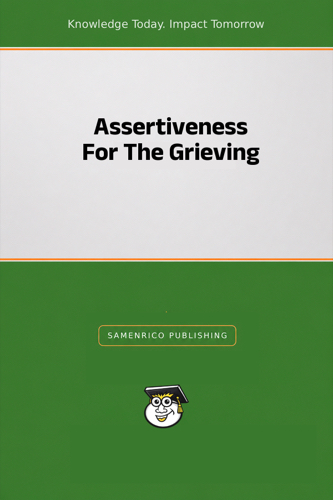
Assertiveness For The Grieving eBook
Set boundaries around condolences and support with
by Unger Elmira
Set boundaries around condolences and support without alienating loved ones.
Formats
Free sample
Chapter 1: The Gratitude Trap--–- The casserole arrived at 6:47 PM on a Tuesday, three days after the funeral. It was a chicken-and-rice bake, wrapped in aluminum foil with a handwritten note taped to the top: “Thinking of you! No need to return the dish.” I stared at it for a long time. I was not thinking about the casserole. I was thinking about how I had just spent forty-five minutes crying in the shower, how I had not eaten anything in two days, and how the very last thing I wanted to do was open my front door to another person who expected me to perform gratitude.
But I opened the door anyway. I smiled. I said thank you. I said it smelled wonderful. I lied.This is the Gratitude Trap, and it is the single most underrecognized source of suffering in the grieving process.
The trap works like this: you experience a devastating loss. The people in your life want to help, genuinely and often beautifully. Their help arrives in the form of meals, phone calls, visits, texts, offers to “take you out for a distraction,” invitations to “talk if you need to,” and suggestions about what you “should” be doing to feel better. You, the grieving person, are then expected to receive all of this help with visible appreciation. You are expected to say thank you.
You are expected to assure your helpers that yes, their specific contribution is exactly what you needed. You are expected to manage their anxiety, reassure them that they are doing a good job, and generally perform the role of the “grateful griever.”And if you fail to perform this role? If you say nothing? If you say “no thank you” to the casserole? If you let the phone calls go to voicemail?
Then you risk being labeled difficult, bitter, ungrateful, or—perhaps the most damning label of all—“not handling your grief well.”The purpose of this chapter is to name the trap, expose its hidden costs, and give you permission to climb out of it. Because here is the truth that no one tells you at the funeral: your grief is not a customer service job. You do not owe anyone a performance of gratitude. And the most compassionate thing you can do for yourself and for the people who love you is to learn how to say no—not cruelly, not aggressively, but clearly and honestly—before the weight of all that unexpressed need crushes you entirely.The Social Contract Nobody Signed Let us examine the invisible agreement that society imposes on grieving people. I call it the Grief Gratitude Contract, and it contains three unspoken clauses.Clause one: When someone offers help, you must accept it graciously, regardless of whether the help actually serves you.
This means eating casseroles you cannot stomach, accepting visits when you need solitude, and answering phone calls when you have nothing to say. The moment you decline a meal or ask for space, you risk being perceived as rejecting the person’s love—because in our culture, declining the offer is conflated with declining the relationship.Clause two: You must never express annoyance, frustration, or anger toward people who are “just trying to help.” Even if the help is intrusive, exhausting, or actively counterproductive, you are expected to swallow your irritation and smile. Expressing negative emotion toward a helper is treated as moral failure, as though the helper’s good intention cancels out the impact of their behavior. This is the logic of the “but they meant well” defense, and it systematically invalidates the griever’s lived experience.Clause three: You must reassure your helpers that they are doing enough. This is the most insidious clause.
Not only must you receive help; you must also manage the helper’s anxiety about whether they are helping enough. That means saying things like “No, really, this means so much” and “You have no idea how much I appreciate this” even when what you actually feel is exhaustion, numbness, or the overwhelming desire to be left alone.Here is what makes this contract so pernicious: you never signed it. No one explained these terms to you at the hospital or the funeral home. The contract is enforced socially, through subtle cues and implicit expectations, and the penalty for violating it is social alienation at the exact moment when you most need connection. You are trapped between two bad options: comply and drain yourself dry, or resist and risk losing the very people who are trying to support you.This chapter exists to offer a third option.
You can refuse the contract without refusing the relationship. You can say no to specific offers while saying yes to the person making them. You can protect your energy without pushing love away. But to do any of that, you first have to see the trap for what it is.The People-Pleasing Grieving Pattern I have a name for the automatic response that most grievers develop in the face of this social pressure. I call it the People-Pleasing Grieving Pattern, and it operates like a reflex rather than a choice.The pattern goes like this.
Someone offers help. You feel an internal sensation—perhaps a tightening in your chest, a fatigue at the thought of engaging, a quiet voice that says “I really don’t want to do this.” But before you can even register that sensation fully, your mouth opens and you say yes. You say thank you. You say you would love that. You say please come over.
You say the words that you have been conditioned to say, and you say them automatically, like a recording that plays whether you want it to or not.After the interaction ends, you feel depleted. Maybe you feel resentful, though you immediately feel guilty about the resentment because the person was only trying to help. Maybe you feel invisible, because no one asked what you actually needed. Maybe you feel exhausted, because you just spent an hour performing a version of yourself that does not exist anymore. And then, because you are exhausted and resentful and invisible, you withdraw.
You stop answering texts. You avoid making plans. You let the casseroles pile up in the refrigerator until they grow mold, because you cannot bear to throw them away but you also cannot bear to eat them.The people who love you, noticing your withdrawal, interpret it as rejection. They think you are angry at them. They think you do not want their help.
They double down—more calls, more visits, more offers—because they are afraid of losing you. And you, already depleted, say yes again. The cycle repeats. And repeats. And repeats.The People-Pleasing Grieving Pattern is not a character flaw.
It is a learned survival strategy, and it made sense once. Perhaps you grew up in a household where saying no was punished. Perhaps you learned early that your worth was contingent on your agreeability. Perhaps you have watched other grievers get abandoned for being “difficult,” and you are terrified of the same fate. Whatever the origin, the pattern has outlived its usefulness.
It is now harming you, and it is also harming the very relationships you are trying to protect. Because here…
This is the end of the free sample. Get the eBook to keep going. Buy now
About this book
Details
- Author
- Unger Elmira
- Publisher
- SamEnrico
- Language
- English
- Genre
- Non-Fiction, Self-Help, Grief
- Released
- 2026-06-09
- Pages (approx.)
- 131
- Available as
- eBook, Audiobook

Read better in the ZLOADR app
Your eBooks on your phone or tablet. Sign in with your SamEnrico account and start reading.
More by Unger Elmira
 Parent Loss and Identity ShiftUnger Elmira$11.99
 The Nap Temperature GuideUnger Elmira$11.99
 Spin Metrics ExplainedUnger Elmira$11.99
 The Domestic Servant SurvivorUnger Elmira$11.99
 Pain Meditation SuccessUnger Elmira$11.99
 Bipolar Eating Disorder GuideUnger Elmira$11.99
 Jumia Performance Bonus GuideUnger Elmira$11.99
 Friends Don't Know What To SayUnger Elmira$11.99
 The Phantom of the Kremlin: How a Double Agent Outsmarted the Cold WarUnger Elmira$11.99
 The Shadow Cabinet: How the Secretaries of State Shaped Modern AmericaUnger Elmira$11.99
 The Last Whisper of the Beothuk: A Forgotten Voice RebornUnger Elmira$11.99
 Growing GynandririsUnger Elmira$11.99
You may also like
 The Funeral NonverbalsHaller Sandie$11.99
 The Parent Loss Grief GuideAviles Tiara$11.99
 The Breath and Grief ConnectionHanes Loreta$11.99
 Social Media Comparison and GriefGuzman Latoya$11.99
 Self Hypnosis For Grief Processing GuideTan Lonna$11.99
 Loneliness After Loss Healing GuideLynn Brinda$11.99
 Grief Related Anger TriggersSeiler Jacqui$11.99
 Forgiveness After GriefWeathers Taryn$11.99
 Empathy For Grieving PeopleEaton Hilario$11.99
 Anger And Grief ConnectionDaniels Seth$11.99
 The Sobriety Grief GuideReyna Trish$11.99
 Purpose After Loss GuideSolano Aurora$11.99