
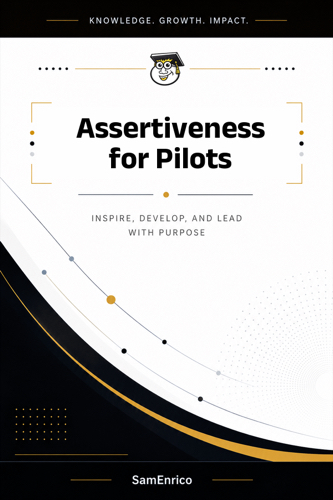
Assertiveness for Pilots
Cockpit communication and crew resource management
by Frick Jon
Cockpit communication and crew resource management.
Formats
About this book
Free sample
Chapter 1: The Price of Silence...--–- The human voice is the most underutilized safety device in any cockpit. It weighs nothing, requires no maintenance, and has prevented more disasters than any instrument ever built. Yet, on a clear March evening in 1977, on a foggy runway in the Canary Islands, two voices remained silent when they should have roared. The result was 583 deaths—the deadliest accident in aviation history. The Tenerife disaster was not caused by mechanical failure, bad weather, or even the terrorist bomb that had diverted the aircraft to that small island airport.
It was caused by a junior flight engineer who recognized a captain's error and said nothing forceful enough to stop it. It was caused by a first officer who deferred when he should have commanded. And it was caused by a captain whose authority was never questioned until it was too late.This chapter is about the anatomy of that silence. It is about why highly trained professionals—people who can recite emergency checklists from memory and land a crippled aircraft on a single engine—fail to speak up when they see danger approaching. The answer is not incompetence or cowardice.
The answer is more disturbing: silence is a trained behavior. And like any trained behavior, it can be unlearned.The Silent Threat: More Than a Metaphor The phrase "silent cockpit" is not a technical term you will find in any flight manual. But every pilot knows what it means. It is the feeling of watching a captain line up for the wrong runway and saying nothing because "he must know something I don't." It is the moment of recognizing a dangerous descent rate and swallowing the words because "I don't want to be that guy." It is the weight of certainty pressing against the ceiling of rank—and losing.The aviation industry has spent billions of dollars on technology to prevent accidents. Ground proximity warning systems.
Traffic collision avoidance systems. Enhanced flight vision systems. Synthetic vision. Predictive windshear radar. These are remarkable tools.
But they all share a fatal limitation: they can only warn about what they are programmed to detect. No algorithm…
This is the end of the free sample. Get the eBook to keep going. Buy now
Contents
- Chapter 1
- Chapter 2
- Chapter 3
- Chapter 4
- Chapter 5
- Chapter 6
- Chapter 7
- Chapter 8
- Chapter 9
- Chapter 10
- Chapter 11
- Chapter 12
Details
- Author
- Frick Jon
- Publisher
- SamEnrico
- Language
- English
- Genre
- Non-Fiction, Self-Help, Aviation
- Released
- 2026-06-08
- Pages (approx.)
- 150
- Available as
- eBook, Audiobook

Read better in the ZLOADR app
Your eBooks on your phone or tablet. Sign in with your SamEnrico account and start reading.
More by Frick Jon
 Divorce After StillbirthFrick Jon$11.99
 PESTEL Analysis SummaryFrick Jon$11.99
 Tailgating Response StrategiesFrick Jon$11.99
 Fashion Inventory AIFrick Jon$11.99
 Chunking for Seniors GuideFrick Jon$11.99
 Constraints for MarketersFrick Jon$11.99
 Breast Cancer Symptoms ChecklistFrick Jon$11.99
 The Illuminated Deceiver: How a 15th-Century Persian Calligrapher Forged a MasterpieceFrick Jon$11.99
 The Alchemists' Feast: A Banquet of EnlightenmentFrick Jon$11.99
 How to Produce Packaging RopeFrick Jon$11.99
 How to Produce Contact Lens Care ProductsFrick Jon$11.99
 Chinchillas: PET Care, Habitat, Fur & BehaviorFrick Jon$11.99
You may also like
 Hong Kong Handover 1997Dunn Johnnie$11.99
 Zumba For Postnatal Recovery CourseNeal Christian$11.99
 Zumba for BeginnersLadner Nikia$11.99
 YouTube Comment Mining GuideHumes Pandora$12.99
 Worry Box MeditationCarlin Rudy$11.99
 Workplace Stress MeditationNguyen Lynn$11.99
 Workplace Stress and Sleep RepairHawley Ivory$11.99
 Workplace Perfectionism CureDelaney Jeffry$11.99
 Workplace Injustice Anger GuideWallen Isabelle$11.99
 Work Addiction and Burnout LinkGreenwood Ester$11.99
 Women in Yoga and WellnessBeattie Galina$11.99
 Women in Stand Up ComedyChun Evangeline$11.99