
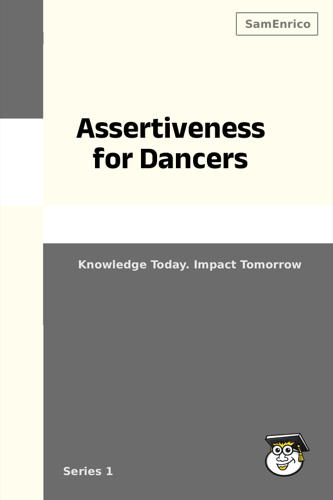
Assertiveness for Dancers eBook
Communicate physically and verbally in rehearsals
by Lange Audrie
Communicate physically and verbally in rehearsals and auditions without intimidation.
Formats
Free sample
Chapter 1: The Silence Injury...--The first time a dancer learns to be silent is usually not the first time they are told to shut up. It is quieter than that. It is a choreographer turning away mid-sentence. It is a correction delivered to the person standing next to you while you watch, knowing the note was meant for you. It is the subtle, unspoken curriculum of the dance studio: your body is the instrument, but your voice is optional.
And for generations, the dancers who succeeded—the ones who got the contracts, the solos, the second seasons—were not necessarily the most talented. They were the most compliant. They were the ones who learned to swallow their questions, their pain, their boundaries, and their selves in service of the art.This chapter dismantles the false binary that dancers must choose between being a doormat or a diva. It names the historical legacy of abuse in dance—rooted in patriarchal, hierarchical studio cultures where "breakdown to build up" was mistaken for pedagogy. It introduces a central case study of a dancer we will call Brandon—a technically brilliant performer whose silent intensity terrified his partners even though he felt completely neutral inside.
This reveals the gap between intention and perception that haunts so many dancers. Finally, the chapter establishes the three archetypes—Passive, Aggressive, and Assertive—that will serve as the book's compass. The goal is to reach the "I'm OK, You're OK" professional dynamic, where the dancer stops performing for approval and starts collaborating as an equal artist.The Cost of Compliance Before we learn what assertiveness looks like, we must first understand what silence costs. The dance industry has a long, uncomfortable history of mistaking obedience for discipline and suffering for dedication. From the brutal hierarchies of Imperial Russian ballet to the "breakdown to build up" pedagogy that persisted in Western conservatories well into the 1990s, dancers have been trained to believe that their voice is irrelevant.
The choreographer speaks. The dancer executes. The body is a vessel; the vessel does not ask questions.This legacy is not ancient history. In 2020, the dance world experienced a long-overdue reckoning as hundreds of dancers came forward with accounts of emotional abuse, unsafe working conditions, and systemic silencing at major companies including New York City Ballet, The Royal Ballet, and countless regional houses. The common thread in these accounts was not just the abuse itself—it was the years of silence that preceded the speaking.
Dancers reported knowing that something was wrong but feeling powerless to name it. They reported watching colleagues break down and then return to the studio the next day as if nothing had happened. They reported being told, explicitly or implicitly, that speaking up would end their careers.The numbers bear this out. A 2019 survey by Dance/USA found that nearly 60% of professional dancers had experienced some form of harassment or abuse during their careers. More strikingly, 85% of those dancers did not report it.
When asked why, the most common answer was not fear of retaliation—though that was present—but a deeper, more insidious belief: "I didn't think it was my place to say anything."This is the silence injury. It is not the injury of being told to shut up. It is the injury of never having been told that you are allowed to speak.The Passive, The Aggressive, and The Assertive Throughout this book, we will use three archetypes to understand communication styles. These are not personality types—no one is permanently stuck in any of them—but rather patterns of behavior that can be recognized, analyzed, and changed. We will define them once here and refer to them throughout the book without re-explanation.The Passive Dancer is the one who never speaks.
When given a correction they don't understand, they nod and try to guess. When asked a question, they defer to others. When they are injured, they dance through the pain. When a lift feels dangerous, they close their eyes and hope. The passive dancer is often praised as "easy to work with" and "low maintenance"—but they are also the dancer who is consistently overlooked for opportunities, who watches others get the roles they deserved, who leaves the studio wondering why no one sees them.
The passive dancer has confused compliance with professionalism, and in doing so, has erased themselves from the room.The Aggressive Dancer is the one who speaks too loudly, too often, and too late. They are not necessarily mean—though some are—but they have learned that volume is the only way to be heard. They interrupt the choreographer mid-phrase. They argue with corrections. They dominate the dressing room and the rehearsal floor.
The aggressive dancer is often feared rather than respected, and while they may get short-term wins (a correction changed, a piece of music replaced), they are rarely rehired. Other dancers avoid partnering with them. Choreographers remember their names for the wrong reasons. The aggressive dancer has confused volume with power, and in doing so, has made themselves a liability.The Assertive Dancer is the one who speaks clearly, calmly, and at the right time. They ask questions without apologizing.
They set boundaries without explaining. They receive corrections without collapsing or defending. The assertive dancer is neither invisible nor threatening. They are present. They are the dancer who says, "I need a spotter for this lift" without fear of being called difficult.
They are the dancer who says, "Can you show me that timing again?" without crying or shutting down. And they are the dancer who gets hired back. Not because they are the most talented—though they may be—but because they are the most reliable. Reliability is not just about showing up on time and knowing the combination. Reliability is about being a clear, safe, predictable collaborator.
That is what assertiveness buys you.The Brandon Intervention: A Case Study in Intention vs. Perception Let us meet Brandon. Brandon is a real dancer whose story has been anonymized at his request. When we first encounter him in the narrative that opens this chapter, he is 24 years old, recently graduated from a prestigious conservatory, and dancing with a contemporary company in New York. Technically, he is exceptional—clean turns, explosive jumps, a quality of stillness that makes audiences hold their breath.
But Brandon has a problem. He cannot keep a partner.In his first year with the company, he cycles through five different partners across three pieces. The feedback from the women he dances with is consistent but vague: "He's intense." "It's hard to connect with him." "I don't feel safe." The choreographer, a woman in her fifties who has worked with dozens of dancers over three decades, calls Brandon into her office. She does not accuse him of anything. She does not say he is aggressive or dangerous.
She says something more confusing: "Brandon, your partners are afraid of you. And when I ask them why, they can't really explain it. They just say you're... a lot."Brandon is stunned. He is not aggressive.
He has never raised his voice, never criticized a partner, never done anything he would consider threatening. In fact, he has…
This is the end of the free sample. Get the eBook to keep going. Buy now
About this book
Details
- Author
- Lange Audrie
- Publisher
- SamEnrico
- Language
- English
- Genre
- Non-Fiction, Self-Help, Dance
- Released
- 2026-06-07
- Pages (approx.)
- 141
- Available as
- eBook, Audiobook

Read better in the ZLOADR app
Your eBooks on your phone or tablet. Sign in with your SamEnrico account and start reading.
More by Lange Audrie
 Creative Famine FeastLange Audrie$11.99
 Emergency Service AngerLange Audrie$11.99
 Compassionate Body ScanLange Audrie$11.99
 The St Bartholomew Massacre StudyLange Audrie$11.99
 AI-Generated Short-Form Video BusinessLange Audrie$11.99
 Understanding Physical UrticariaLange Audrie$17.99
 JEE Main Advanced Study GuideLange Audrie$12.99
 Communication Tools for VAsLange Audrie$12.99
 How to Start a Buttons Business (Beginners Guide)Lange Audrie$11.99
You may also like
 Hong Kong Handover 1997Dunn Johnnie$11.99
 Zumba For Postnatal Recovery CourseNeal Christian$11.99
 Zumba for BeginnersLadner Nikia$11.99
 YouTube Comment Mining GuideHumes Pandora$12.99
 Worry Box MeditationCarlin Rudy$11.99
 Workplace Stress MeditationNguyen Lynn$11.99
 Workplace Stress and Sleep RepairHawley Ivory$11.99
 Workplace Perfectionism CureDelaney Jeffry$11.99
 Workplace Injustice Anger GuideWallen Isabelle$11.99
 Work Addiction and Burnout LinkGreenwood Ester$11.99
 Women in Yoga and WellnessBeattie Galina$11.99
 Women in Stand Up ComedyChun Evangeline$11.99