
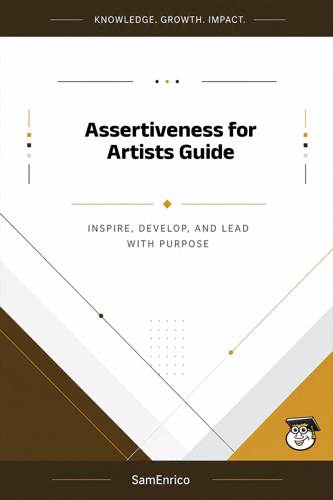
Non-FictionSelf-HelpCreative Careers
Assertiveness for Artists Guide eBook
Price work firmly, decline requests for free art,
Price work firmly, decline requests for free art, and protect creative time.
Formats
Free sample
Chapter 1: The Passion Penalty--–- Every artist knows the feeling. You are standing in your studio, brush in hand, having just completed a piece that genuinely surprised you. It came from somewhere deep—that flow state where time disappears and the work seems to make itself. You feel proud, vulnerable, and strangely complete. Then your phone buzzes.
A friend has seen your Instagram post. She writes: “This is stunning! You should sell these. How much?”And just like that, the warmth drains away. Your stomach tightens.
Your mind races through a familiar calculus: “If I name a price, will she still respect me? What if she says no? What if she says yes but then expects more than I can give? Maybe I should just give it to her. She’s been so supportive.
I don’t want to seem greedy.”You type back: “Oh, I don’t know… what do you think is fair?”You have just experienced the Passion Penalty.This chapter is about that exact moment—the split second where love for your work collides with the need to be paid. It is not a chapter about pricing strategy or negotiation tactics. Those come later. This chapter is about something more fundamental: the psychological machinery that makes pricing feel like betrayal. Because until you understand why undervaluing your work feels like the right thing to do, no amount of business advice will stick.The Paradox at the Heart of Creative Work Most business books assume a clean separation between the worker and the product.
A plumber does not feel that quoting a price for fixing a pipe is a comment on their soul. An accountant does not lie awake wondering if charging by the hour makes them less authentic. But artists are different. Your work is not something you produce; it is something you reveal. It carries your fingerprints, your emotional landscape, your hours of invisible struggle.
When someone asks “How much?”, you hear “How much is your soul worth?”This is the paradox: the very love that drives artistic excellence is the same emotion that makes pricing feel like a violation.Let me name the culprit clearly. It is called toxic positivity, and it is one of the most destructive forces in the creative economy. Toxic positivity is the well-intentioned but culturally enforced message that art should be for joy, not for money. It sounds like this: “Do what you love and you’ll never work a day in your life.” “Real artists don’t care about money.” “Just be grateful someone wants your art at all.” These phrases roll off the tongue like wisdom, but they are traps. They sound like encouragement.
They function like handcuffs.The Lie of the “Gift”Artists are told from childhood that their work is a “gift.” Parents say it: “You have such a gift for drawing.” Teachers say it: “Your gift will take you places.” And the word “gift” feels warm. It feels like validation. But think about what a gift actually is. A gift, by definition, is not sold. You do not put a price tag on a birthday present.
You do not negotiate the value of a kind gesture. When you call something a gift, you are signaling that it exists outside the economy of exchange.So here is the trap. You internalize this label. You believe that your art is a gift—from the universe, from God, from your ancestors, from wherever creativity comes from. And because it is a gift, charging money for it feels like a betrayal.
You are not selling a product; you are commodifying your soul. Guilt floods in. And guilt leads to undercharging. Undercharging leads to burnout. Burnout leads to resentment.
And resentment is the death of art.I have watched this happen to hundreds of artists. They start with passion, produce beautiful work, get asked to sell it, quote a price that is half of what they need, feel relieved when the client says yes (because at least they didn’t say no), and then spend the next month exhausted, underpaid, and secretly angry at the very work they once loved. The Passion Penalty is not a personality flaw. It is a structural feature of how artists are trained to think about money.Where the Passion Penalty Comes From This did not happen by accident. The romantic image of the starving artist is a relatively recent invention.
Before the 19th century, artists were craftspeople. They belonged to guilds. They had apprentices. They negotiated contracts. Michelangelo did not paint the Sistine Chapel for exposure.
He had a contract with Pope Julius II that specified payment, timelines, and penalties for delay. Rembrandt sued clients who refused to pay. Vermeer ran a successful art dealership while painting. These were businesspeople who happened to make art.The Romantic era changed everything. Poets and painters began to cultivate the image of the suffering genius—the artist too pure for commerce, too sensitive for contracts, too authentic for money.
Van Gogh died penniless, and society turned his poverty into a virtue. The message was clear: real artists suffer. Real artists are not paid. Real artists give their work away because money would taint the purity.This myth persists because it serves someone. It serves the wealthy patrons who want free art.
It serves the corporations who want logos for “exposure.” It serves the friends and family who want paintings of their dogs for nothing. The myth of the starving artist is a convenience for everyone except the artist. And you have been trained to believe it.The Difference Between Monetary Value and Creative Worth To break free of the Passion Penalty, you must learn to separate two things that have been fused together in your mind: creative worth and monetary value.Creative worth is infinite, internal, and intangible. It is the joy of the brushstroke. It is the flow state where time disappears.
It is the meaning you derive from making something that did not exist before. This cannot be priced, and it should not be priced. It is yours forever, regardless of whether anyone buys anything. No client can take it from you. No low offer diminishes it.
No rejection touches it. Creative worth is not for sale.Monetary value is finite, external, and transactional. It is the cost of your canvas and paint. It is the hours you spent laboring. It is the market demand for work like yours.
It is the specific problem your art solves for a client—whether that problem is “my living room wall is empty” or “my startup needs a logo that investors will trust.” Monetary value changes with context. It goes up and down. It is negotiated. It has nothing to do with your soul.The mistake artists make is conflating these two things. When a client asks “How much?”, the artist hears “How much is your soul worth?” And because the soul is priceless, the artist panics and names a low number to avoid the discomfort of the question.
But the client is not asking about your soul. They are asking about the exchange rate for your labor and materials. That is a business question, not a…
This is the end of the free sample. Get the eBook to keep going. Buy now
About this book
Details
- Author
- Redmon Annita
- Publisher
- SamEnrico
- Language
- English
- Genre
- Non-Fiction, Self-Help, Creative Careers
- Released
- 2026-06-08
- Pages (approx.)
- 109
- Available as
- eBook, Audiobook

Read better in the ZLOADR app
Your eBooks on your phone or tablet. Sign in with your SamEnrico account and start reading.
More by Redmon Annita
 Foreclosure Emotional Recovery GuideRedmon Annita$11.99
 Teresian Vision of Heaven MeditationRedmon Annita$11.99
 Guided Imagery for PainRedmon Annita$11.99
 Wedding Dream Meaning CourseRedmon Annita$11.99
 The Brain Cartographers: Mapping the Mind in the Age of DiscoveryRedmon Annita$11.99
 Fury Beneath the Sands: The Lost Eruption of TheraRedmon Annita$11.99
 Understanding Epidermolysis Bullosa, JunctionalRedmon Annita$17.99
 Digital Nomad Visa House SitRedmon Annita$12.99
 LSE On Campus vs OnlineRedmon Annita$12.99
 Infrastructure Reliability EngineerRedmon Annita$11.99
 How to Start a Dance Productions Business (Beginners Guide)Redmon Annita$11.99
You may also like
 Hong Kong Handover 1997Dunn Johnnie$11.99
 Zumba For Postnatal Recovery CourseNeal Christian$11.99
 Zumba for BeginnersLadner Nikia$11.99
 YouTube Comment Mining GuideHumes Pandora$12.99
 Worry Box MeditationCarlin Rudy$11.99
 Workplace Stress MeditationNguyen Lynn$11.99
 Workplace Stress and Sleep RepairHawley Ivory$11.99
 Workplace Perfectionism CureDelaney Jeffry$11.99
 Workplace Injustice Anger GuideWallen Isabelle$11.99
 Work Addiction and Burnout LinkGreenwood Ester$11.99
 Women in Yoga and WellnessBeattie Galina$11.99
 Women in Stand Up ComedyChun Evangeline$11.99