
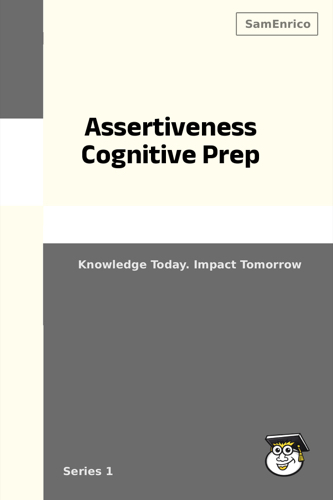
Assertiveness Cognitive Prep eBook
Restructures fear of conflict to allow calm expres
by Hogan Amelia
Restructures fear of conflict to allow calm expression.
Formats
Free sample
Chapter 1: The 3 A.M. Spiral--–- You are lying in bed. The room is dark. The clock reads 3:14 a.m. Everyone else is asleep.
But your mind is not. It is pacing. It is replaying a conversation from twelve hours ago—a conversation that lasted maybe ninety seconds. But in your head, it has been playing on a continuous loop for six hours.You said something. Or you did not say something.
Or you said it the wrong way—too soft, too late, too apologetic. Or you said nothing at all, and now the silence feels like a betrayal of yourself. The other person’s face appears in your memory: a raised eyebrow, a pause, a slight turn away. And your brain, that tireless architect of catastrophe, has built an entire narrative from that one small gesture. They think you are weak.
They have lost respect for you. They will bring this up again. They will use it against you. You should have spoken up. You should have stayed quiet.
You should have been different.This is the 3 a.m. spiral. And if you are reading this book, you know exactly what it feels like.It is not about the content of the disagreement, not really. It is about what the disagreement meant. It is about what your silence—or your awkward, rushed, overly polite attempt at assertiveness—said about you.
It is about the fear that you have somehow shrunk yourself again, traded your needs for approval, exchanged your voice for peace that was not really peace but just the absence of conflict.Here is the first and most important thing you will learn in this book: That spiral is not a sign of weakness. It is a sign that your brain is working exactly as it was designed to work—for a world that no longer exists.What you experience as a personal failing, a character flaw, or evidence that you are “just not the assertive type” is actually a highly efficient, ancient biological survival mechanism. Your fear of conflict is not a weakness. It is a relic. And once you understand it as a relic, you can stop fighting yourself and start retraining the system.This chapter is about that system.
It is about the architecture of fear—where it comes from, why it hijacks your voice at the worst possible moments, and how to stop confusing your body’s ancient alarm signals with the truth about who you are. By the end of this chapter, you will no longer ask, “What is wrong with me?” Instead, you will ask, “What is my ancient wiring trying to tell me—and how do I consciously override it?”Let us begin with the biology of a broken conversation.The Amygdala Hijack: When Your Alarm System Becomes Your Dictator Deep inside your brain, tucked behind your ears and roughly the size and shape of an almond, sits the amygdala. Its job is simple and ancient: detect threats and sound the alarm. It does not think. It does not reason.
It does not ask clarifying questions like, “Is this actually a life-threatening danger, or is it just my boss using a slightly critical tone?” The amygdala acts first and asks questions never. It is the smoke detector of your nervous system—and smoke detectors are designed to err on the side of screaming.When the amygdala perceives a threat, it initiates a cascade of physiological events that psychologists call the fight-or-flight response. Your adrenal glands release epinephrine and norepinephrine. Your heart rate spikes. Your breathing becomes shallow and rapid.
Blood rushes away from your digestive system and toward your large muscles. Your pupils dilate. Your non-essential functions—including, crucially, the higher cognitive processing centers of your prefrontal cortex—are temporarily deprioritized. Your body is getting ready to fight a tiger or run from a bear.But here is the problem. You are not facing a tiger.
You are facing a colleague who just took credit for your work. You are facing a parent who makes passive-aggressive comments about your life choices. You are facing a partner who reacts to the word “no” with silence or withdrawal. You are facing a friend who asks for one more favor when you are already exhausted. These are not physical threats.
They will not eat you. They will not chase you across the savanna.But your amygdala does not know that.Evolution moves slowly. The neural circuitry that helped your ancestors survive predators, hostile tribes, and environmental dangers has not been updated for the modern world of office politics, family dynamics, and text messages left on read. To your amygdala, social rejection feels like physical danger. Studies using functional MRI have shown that the same brain regions activated by physical pain are also activated by social exclusion.
Being criticized, dismissed, or disapproved of lights up your anterior cingulate cortex—the same region that processes the sting of a burn or a cut.This is the evolutionary mismatch at the heart of conflict fear. Your brain is using a paleolithic threat-detection system to navigate twenty-first-century social interactions. And because the system is designed to prioritize survival over comfort, it errs on the side of alarm. It would rather have you freeze, flee, or appease a hundred times unnecessarily than miss one genuine threat. In evolutionary terms, false positives are cheap.
False negatives—failing to flee from a real predator—are fatal.So your amygdala hijacks your rational speech. It floods your body with stress hormones. It shuts down the prefrontal cortex, the part of your brain responsible for complex language, long-term planning, and impulse control. And then, in the middle of a conversation where you desperately need to be clear, calm, and articulate, you find yourself saying “never mind” or “it’s fine” or “sorry, I shouldn’t have brought it up.” You do not fail at assertiveness because you are weak. You fail at assertiveness because your brain is doing its ancient job too well.This is not an excuse.
It is an explanation. And explanations are the first step toward change.Somatic Markers: Why Your Body Knows Before Your Mind Does Before you ever consciously think, “I am afraid of this conversation,” your body has already signaled the fear. Psychologist Antonio Damasio coined the term somatic markers to describe the physical sensations that accompany emotional states. These are the body’s way of flagging situations that have been dangerous in the past. Your heart races.
Your palms sweat. Your throat tightens. Your stomach clenches. Your voice trembles. Your shoulders rise toward your ears.For people who struggle with assertiveness, these somatic markers are often misinterpreted.
The most common misinterpretation is: “This physical discomfort means something is wrong with me. I am not cut out for this. I should avoid the situation entirely.” The second most common misinterpretation is: “My body is reacting this way because I am actually in the wrong. The guilt I feel must mean I am guilty.”Both interpretations are false. But they feel true because the sensations are so powerful and so immediate.Here is what is actually happening: Your body is preparing for perceived danger.
That is all. The somatic markers are not evidence of your inadequacy. They are evidence of your evolutionary heritage. They…
This is the end of the free sample. Get the eBook to keep going. Buy now
About this book
Details
- Author
- Hogan Amelia
- Publisher
- SamEnrico
- Language
- English
- Genre
- Non-Fiction, Self-Help, Assertiveness
- Released
- 2026-06-06
- Pages (approx.)
- 145
- Available as
- eBook, Audiobook

Read better in the ZLOADR app
Your eBooks on your phone or tablet. Sign in with your SamEnrico account and start reading.
More by Hogan Amelia
 The Workaholic's Parent Child RepairHogan Amelia$11.99
 Interview Confidence MasteryHogan Amelia$11.99
 Remote Work Burnout GuideHogan Amelia$11.99
 Tarantino Pop Art CinemaHogan Amelia$11.99
 Cash Flow for CoachingHogan Amelia$11.99
 Emergency Lighting and Power GuideHogan Amelia$11.99
 The Koresh Marriage BedHogan Amelia$11.99
 Elizabeth I's Espionage Director HandbookHogan Amelia$11.99
 The Vanishing of Flight 370: The Untold SignalsHogan Amelia$11.99
 The Doodle Revolt: How a Graffiti Artist Toppled a DictatorHogan Amelia$11.99
 The Silent Betrayal: How a Princess Sold Her Kingdom for a ThroneHogan Amelia$11.99
 Growing PachycereusHogan Amelia$11.99
You may also like
 Recurring Dreams of ScreamingNolen Lester$11.99
 Interruption Proof Personal BoundariesMorey Wilhelmina$11.99
 Anger Assertiveness DistinctionHendrix Marianela$11.99
 Making Clear Requests GuideFries Pinkie$11.99
 Assertiveness For Lovers GuideWeller Alec$11.99
 Workplace Boundary Setting CourseEaston Truman$11.99
 Saying No GracefullyRichie Rochell$11.99
 Honest Expression NVCHackett Krystin$11.99
 The Interruption FearTurner Ora$11.99
 The Interruption Deflection ScriptLuster Billi$11.99
 Passive Aggressive Stress ResponseMeredith Shirly$11.99
 Guilt Of Saying NoGordon Vera$11.99