
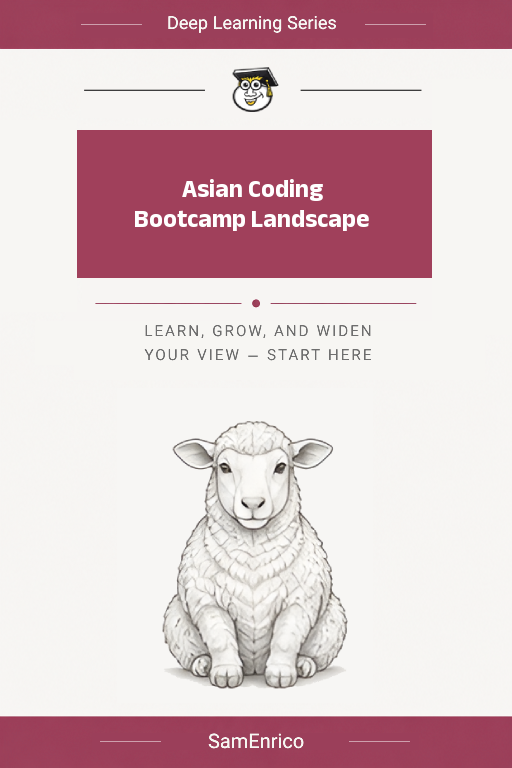
Non-FictionStudent's ShortcutAsian Education
Asian Coding Bootcamp Landscape eBook
Analyze bootcamp growth in India, Singapore, Vietn
by Kemp Tanna
Analyze bootcamp growth in India, Singapore, Vietnam, and Philippines versus traditional engineering degrees respected by local tech firms.
Formats
Free sample
Chapter 1: Thirty-Seven Percent–- The conference room on the thirty-seventh floor of a Singapore skyscraper overlooked the strait where tankers crawled toward the Malacca shipping lanes. Inside, a hiring manager named Mei Lin pushed two résumés across the glass table toward her technical lead. To her left sat the first candidate's file: a twenty-two-year-old National University of Singapore computer engineering graduate with first-class honors, three internships, and a capstone project in distributed systems. To her right sat the second: a thirty-four-year-old former hotel operations manager who had completed a Le Wagon bootcamp nine months ago, built a portfolio of six web applications, and spent the last three months freelancing for a Singaporean e-commerce startup.Mei Lin's dilemma was not about skill. Both candidates had passed the technical screen.
Both could write production-ready React components. Both understood REST APIs and could debug a memory leak. The problem was structural. Her company, a regional fintech firm backed by a state-linked investment fund, had a board that cared about credentials. The client contract required "degree-holding personnel" for certain compliance-related roles.
And the visa for the bootcamp graduate—he was Malaysian—would be evaluated under Singapore's COMPASS framework, which awarded fewer points for bootcamp certificates than for university degrees.She hired the NUS graduate. Not because he was better. Because the system was not ready for the alternative.That decision, repeated across thousands of hiring desks in Bangalore, Ho Chi Minh City, Manila, and Singapore, is the quiet crisis at the heart of Asia's technology revolution. Every day, somewhere in this region of 4.5 billion people, a hiring manager chooses a degree over demonstrated competence. Every day, a bootcamp graduate who can code circles around their university-educated peers is told, politely or otherwise, that their credentials are insufficient.
And every day, a young person who cannot afford a four-year degree decides to enroll in a bootcamp anyway, hoping to be the exception.This book is about the chasm between what Asia's digital economy needs and what its credentialing system will accept. It is about the explosive growth of coding bootcamps in a region that simultaneously venerates the four-year engineering degree and admits that most graduates cannot code their way out of a logic error. And it is about the strange, unstable peace that has emerged between these two worlds—a détente that benefits neither side and serves only to delay the reckoning that is coming.The Number That Changes Everything To understand why Asia matters, start with one number. Thirty-seven percent.According to comprehensive industry data compiled from bootcamp directories, enrollment platforms, government education statistics, and investor reports, Asia accounts for 37 percent of all global coding bootcamp enrollments. That is more than North America.
That is more than Europe. That is more than the rest of the world combined, outside of China's separate and largely insulated ecosystem.Let that sink in. More than one out of every three people learning to code in a structured, intensive, short-term program anywhere on earth is doing so in Asia.Every day, tens of thousands of Asian students log into virtual classrooms, sit in packed co-working spaces in Bangalore and Manila, stay up late hacking on projects in Hanoi and Cebu, all in the desperate hope of escaping dead-end jobs, stagnant wages, and the crushing realization that their university degree—if they have one—did not prepare them for the workforce that awaits. They are not hobbyists. They are not weekend warriors.
They are economic refugees fleeing a credentialing system that failed them.Now look at the second number. Twenty percent.Asia generates only 20 percent of global bootcamp revenue.Let those two numbers sit next to each other. Thirty-seven percent of the students. Twenty percent of the money. That is the volume paradox.
Asia produces nearly twice as many bootcamp graduates as its share of global revenue would predict, which means that the average Asian bootcamp student pays dramatically less than their Western counterpart. Much less. An order of magnitude less.In India, a student can complete a quality coding bootcamp for the equivalent of three hundred and fifty dollars. In Vietnam, eight hundred. In the Philippines, one thousand.
In Singapore, the most expensive market in Southeast Asia, six thousand to eleven thousand dollars—still a fraction of the forty thousand dollars or more that a US bootcamp might charge for a comparable program.Low prices mean high volume. High volume means that bootcamps in Asia operate on razor-thin margins, scaling not through premium pricing but through sheer numbers. A bootcamp in Bangalore might graduate five hundred students per cohort, each paying a small fee, collectively generating enough revenue to keep the lights on and the instructors paid. There are no venture capital-funded palaces of coding education in Asia's secondary cities. There are rented classrooms, borrowed laptops, and instructors who work nights and weekends because they believe in the mission or because they need the extra income.This is not the Silicon Valley model of disruption.
This is grassroots, pragmatic, survival-driven education. It is messy, uneven, inconsistent in quality, and often brilliant in its resourcefulness. It is also, by sheer weight of numbers, the future of global tech talent production. The world's next million developers will not come from Stanford or even from IIT. They will come from a bootcamp in Indore, a training center in Da Nang, or an online program accessed through a smartphone in a Philippine province.The Three Forces Shoving Millions into Code Three powerful forces are driving this explosion.
Understanding them is essential to understanding everything that follows.The first force is demographic. Asia is young. Not young in the way that marketing departments use the word. Young in the sense that hundreds of millions of people are entering the workforce every decade with no clear path to stable, dignified employment. India alone has more people under the age of thirty than the entire population of the United States.
Vietnam's median age is thirty-two. The Philippines' median age is twenty-five and a half. These are not countries with aging populations worrying about pension shortfalls. These are countries with youth bulges that look like weapons of mass aspiration.What happens when a country has too many young people and not enough formal jobs? Historically, bad things.
Revolution, emigration, civil unrest, or some combination of the three. Coding bootcamps offer an alternative: a relatively low-cost, fast path to a globally tradable skill. A young person in Indore can learn to code for a few hundred dollars, build a portfolio, and start freelancing for clients in Singapore or the United States within six months. They do not need a degree. They do not need connections.
They need a laptop, an internet connection, and the discipline to work through frustration.The second force is digital transformation accelerated by the pandemic. Before 2020, remote work was a perk for Western tech workers with generous benefits packages. After 2020, it became a lifeline for Asian freelancers who had been locked out of the formal economy. A developer in Ho Chi Minh City can now work for a Singaporean startup, a Japanese trading firm, an American fintech company, or a German automotive supplier without leaving their apartment. The currency…
This is the end of the free sample. Get the eBook to keep going. Buy now
About this book
Details
- Author
- Kemp Tanna
- Publisher
- SamEnrico
- Language
- English
- Genre
- Non-Fiction, Student's Shortcut, Asian Education
- Released
- 2026-06-01
- Pages (approx.)
- 123
- Available as
- eBook, Audiobook

Read better in the ZLOADR app
Your eBooks on your phone or tablet. Sign in with your SamEnrico account and start reading.
More by Kemp Tanna
 Personal Ing For Success Speaker GuideKemp Tanna$11.99
 Intuitive Eating Social Situations ManualKemp Tanna$11.99
 The Cost of Living Talent PushKemp Tanna$11.99
 Pediatric Chronic Pain MedsKemp Tanna$11.99
 Paternal Anger Healing WorkbookKemp Tanna$11.99
 The Star That Swallowed the Sky: Africa's Forgotten Astronomers of the Age of DiscoveryKemp Tanna$11.99
 The Last Broadcast: The Mystery of the 1938 War of the Worlds PanicKemp Tanna$11.99
 How to Start a Power-driven Lifting Winches Business (Beginners Guide)Kemp Tanna$11.99
 Ecommerce LLC for Non ResidentsKemp Tanna$12.99
 Understanding Biermer DiseaseKemp Tanna$17.99
 Redwood HarvestingKemp Tanna$11.99
You may also like
 Hong Kong Handover 1997Dunn Johnnie$11.99
 Zumba For Postnatal Recovery CourseNeal Christian$11.99
 Zumba for BeginnersLadner Nikia$11.99
 YouTube Comment Mining GuideHumes Pandora$12.99
 Worry Box MeditationCarlin Rudy$11.99
 Workplace Stress MeditationNguyen Lynn$11.99
 Workplace Stress and Sleep RepairHawley Ivory$11.99
 Workplace Perfectionism CureDelaney Jeffry$11.99
 Workplace Injustice Anger GuideWallen Isabelle$11.99
 Work Addiction and Burnout LinkGreenwood Ester$11.99
 Women in Yoga and WellnessBeattie Galina$11.99
 Women in Stand Up ComedyChun Evangeline$11.99