
Non-FictionProfessional's Cheat SheetDependencies
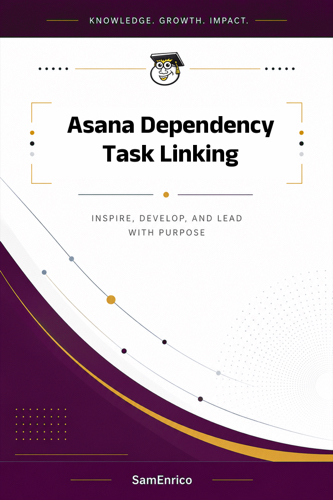
Asana Dependency Task Linking eBook
Creates blocking and waiting-on relationships with
by Fry Clora
Creates blocking and waiting-on relationships with automatic delay propagation.
Formats
Free sample
Chapter 1: The Finish Line Fallacy--–- Every project manager has felt the sinking sensation. You open your task list on a Tuesday morning, coffee in hand, ready to tackle the day. Your team has been humming along—designs delivered, copy approved, stakeholders briefed. You check off three completed tasks from yesterday with a satisfying click. Then you look at what is supposed to start today.
The "Development Sprint" task is marked as "Blocked." You hover over the hourglass icon. A small gray tooltip appears: Waiting on: Beta Feedback (due yesterday).Your stomach drops. You scroll to the Beta Feedback task. It is still marked "In Progress." The assignee, a senior engineer, has not updated it in four days. You send a Slack message: "Hey, any update on beta feedback?
Development is blocked." Twenty minutes later, the reply arrives: "Oh, sorry—ran into some edge cases. Probably need two more days. Forgot to update the date."Two more days. You look at the project timeline. The final launch date is in nine days.
You were already cutting it close. Now you need to figure out what happens to every task that comes after Beta Feedback. How many tasks are waiting on this? You start clicking through dependencies manually, opening task after task, doing mental math. One hour later, you realize the launch is now impossible.
You send an email to the stakeholder. The meeting to discuss the "slip" is scheduled for tomorrow. Everyone is frustrated. Nobody is productive.This scenario plays out thousands of times every day across every industry. The problem is not lazy employees or unreasonable deadlines.
The problem is something far more fundamental: the belief that finishing individual tasks is the same as moving a project forward.The Productivity Theater We call this phenomenon the Finish Line Fallacy—the mistaken assumption that checking off a task means you have made progress toward a project's completion. In reality, a completed task that someone else was waiting on is progress. A completed task that nobody depended on is just a checkbox. And a task marked complete that was actually not complete is a landmine.The Finish Line Fallacy creates what we call Productivity Theater: the performative act of closing tasks to feel productive while the actual project stalls in invisible bottlenecks. Teams become addicted to the dopamine hit of the completion checkmark.
Managers reward visible activity. Stakeholders demand status updates. Everyone is busy. Nothing is moving.Let us be precise about what is happening here. When you complete a task that serves as a blocker for downstream work, you have created value.
When you complete a task that has no dependencies, you have merely finished something—which may or may not matter. And when you mark a task complete prematurely, you have actively damaged the project by sending a false signal to everyone waiting on that task.The dependency engine—whether automatic or manual—cannot distinguish between genuine completion and false completion. It only sees the checkmark. This is why the Finish Line Fallacy is so dangerous. It turns your project management tool from a navigation system into a hallucination machine.The Three States of Work Most project management tools, including Asana's default configuration, recognize only two states of work: To Do and Done.
Some add a third: In Progress. But this binary or trinary system hides the most important state of all: Waiting On.Think about your own work for a moment. How often are you genuinely free to start a task? And how often are you waiting—for an approval, for a file, for a decision, for a teammate to finish something? For most knowledge workers, the waiting state consumes more time than the doing state.
A 2019 study by the Project Management Institute found that the average project team spends 47% of its time waiting on dependencies, handoffs, and approvals.Yet almost no tool makes the waiting state explicit. Asana has the hourglass icon and the "Blocked By" field, but these are optional features buried in the task detail pane. Most users never touch them. Most teams never train on them. As a result, projects operate in a state of chronic, invisible blockage.This book introduces a different mental model.
We recognize three fundamental states of work:To Do – The task is available to start. All dependencies are satisfied. No blockers exist.Waiting On – The task cannot proceed because one or more predecessors are incomplete. The task has an incoming dependency that is not yet satisfied.Done – The task is complete, verified, and all downstream dependencies can now proceed.Notice that "In Progress" is not a distinct state in this model. It is a sub-state of either To Do or Waiting On.
If you are working on a task but its dependencies are not satisfied, you are not making progress—you are wasting effort. If you are working on a task whose dependencies are satisfied, you are in To Do. The distinction matters because it changes how you prioritize.The Hidden Network Here is the central insight of this book: Work is a network, not a list. Every task in your project exists in relationship to other tasks. Those relationships are either dependency relationships (one task blocks another) or adjacency relationships (tasks are related but do not block each other).When you view your project as a list—the default view in Asana and most tools—you see isolated items.
Task 17 is overdue. Task 23 is on track. Task 42 is waiting on something unspecified. These individual data points tell you nothing about the health of the system. A project can have 90% of its tasks on time and still miss its deadline by weeks, if the 10% of tasks that are late happen to be critical blockers.When you view your project as a network, you see structure.
You see which tasks block which other tasks. You see the chains of dependency that form the project's backbone. You see the fan-out points where one task blocks ten others, and the fan-in points where one task waits on ten predecessors. You see the critical path—the single sequence of tasks that determines the project's finish date.This network view transforms how you manage. Instead of asking "What tasks are overdue?", you ask "What blockers are delaying the critical path?" Instead of celebrating "We completed 15 tasks this week," you ask "Did we unblock any downstream work this week?" Instead of reporting "We are 80% done by task count," you report "We are 60% done by critical path completion."The difference is not semantic.
It is the difference between steering a ship and counting the oars.The Propagation Principle Let us return to the opening scenario. Beta Feedback was delayed by two days. What should happen to the Development task that depends on it? What about Testing, which depends on Development? What about Deployment, which depends on Testing?In a perfect world, the moment Beta Feedback's due date moved from Friday to Tuesday, every downstream due date would shift automatically.
Development would shift from Monday to Wednesday. Testing would shift from Wednesday to Friday. Deployment would shift from Friday to Sunday (or Monday, if you do not ship on weekends). The entire project timeline would recalculate itself…
This is the end of the free sample. Get the eBook to keep going. Buy now
About this book
Details
- Author
- Fry Clora
- Publisher
- SamEnrico
- Language
- English
- Genre
- Non-Fiction, Professional's Cheat Sheet, Dependencies
- Released
- 2026-06-07
- Pages (approx.)
- 145
- Available as
- eBook, Audiobook

Read better in the ZLOADR app
Your eBooks on your phone or tablet. Sign in with your SamEnrico account and start reading.
More by Fry Clora
 Alcohol Recovery for PerfectionistsFry Clora$11.99
 Caffeine Anxiety CalmingFry Clora$11.99
 Daniel Day Lewis CraftFry Clora$11.99
 SSRI for Seasonal Affective DisorderFry Clora$11.99
 Widow s Identity RebuildingFry Clora$11.99
 Job Loss and ParentingFry Clora$11.99
 Catholic Worker Movement FounderFry Clora$11.99
 Kasserine Pass: Rommel's First Defeat in the DesertFry Clora$11.99
 The Battle of Penghu: The Dutch Defeat That Shaped Taiwan (1624)Fry Clora$11.99
 How to Produce Mounting BoardsFry Clora$11.99
 How to Become a Propulsion-motor-and-generator RepairerFry Clora$11.99
 How to Produce Packaging Machinery PartsFry Clora$11.99
You may also like
 Hong Kong Handover 1997Dunn Johnnie$11.99
 Zumba For Postnatal Recovery CourseNeal Christian$11.99
 Zumba for BeginnersLadner Nikia$11.99
 YouTube Comment Mining GuideHumes Pandora$12.99
 Worry Box MeditationCarlin Rudy$11.99
 Workplace Stress MeditationNguyen Lynn$11.99
 Workplace Stress and Sleep RepairHawley Ivory$11.99
 Workplace Perfectionism CureDelaney Jeffry$11.99
 Workplace Injustice Anger GuideWallen Isabelle$11.99
 Work Addiction and Burnout LinkGreenwood Ester$11.99
 Women in Yoga and WellnessBeattie Galina$11.99
 Women in Stand Up ComedyChun Evangeline$11.99