
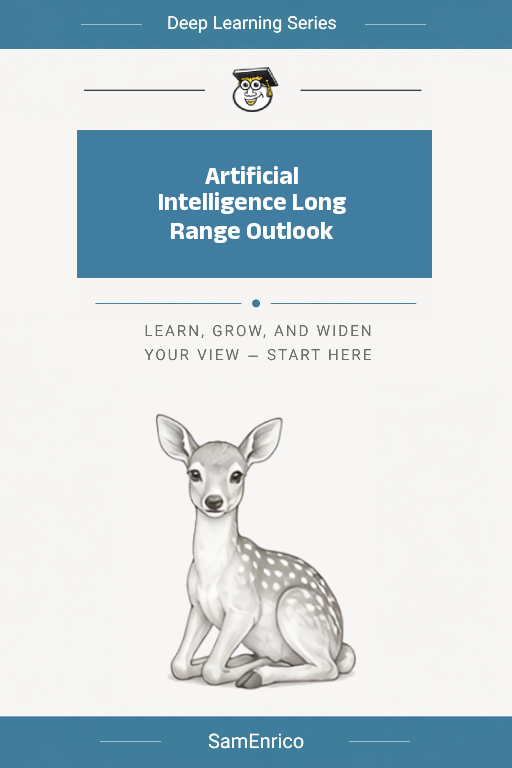
Non-FictionForecast & OutlookLong Range
Artificial Intelligence Long Range Outlook eBook
Project human-level reasoning timelines, economic
Project human-level reasoning timelines, economic impact models, and societal transformation scenarios extending from 2026 to 2030 and beyond.
Formats
Free sample
Chapter 1: The Linear Horizon...--–- On a Tuesday morning in March 2026, a mid-level marketing manager named Elena opened her laptop to find that seventeen of her routine tasks had already been completed. Her email drafts were written, her calendar was optimized, her competitor analysis spreadsheet was populated, and her first draft of the quarterly report was waiting for her review. She hadn't asked for any of this. Her company had quietly deployed an agentic AI system over the weekend, and without fanfare or layoffs, the nature of her job had changed forever. Elena spent the morning verifying the AI's work, making three small corrections, and then went to lunch with a colleague to discuss strategy—something she used to have no time for.
She felt a strange mixture of relief and unease. Her job hadn't been eliminated. But it also wasn't the same job she had accepted eighteen months ago. And she couldn't shake the feeling that the clock was ticking.This is not a story about mass unemployment. It is not a story about a robot apocalypse or a utopian future of leisure.
It is a story about the slow, steady, and largely invisible transformation that is already underway—and that will define the next decade of work, wealth, and human identity. To understand this transformation, we must first unlearn almost everything the headlines have taught us about artificial intelligence.The Binary Trap For the past several years, public discourse about AI has been trapped in a binary cage. On one side stand the doomers, who warn of an imminent superintelligence that will either enslave humanity or render us irrelevant. Their vocabulary includes words like "Singularity," "existential risk," and "alignment catastrophe." On the other side stand the boosters, who insist that AI is just another tool—like the spreadsheet or the smartphone—that will create more jobs than it destroys while making us all more productive. Their vocabulary includes words like "augmentation," "co-pilot," and "this time is different."Both sides are wrong.
Not because they have misjudged the technology's potential, but because they have mistaken the shape of its arrival. The doomers imagine an explosion. The boosters imagine a straight line. The reality is something stranger and more consequential than either: a gradual, predictable climb in AI capability that nevertheless produces sudden, disruptive economic and social dislocations because our institutions are not prepared for even gradual change.This chapter introduces the framework that anchors this entire book: the Linear Horizon Model. It is a simple but powerful way of measuring AI progress, understanding its economic implications, and planning for a future that is neither apocalypse nor utopia but something far more interesting—a steady, manageable, and yet deeply unsettling transformation of nearly every aspect of human life.Beyond the Chatbot: What Actually Changed in 2026To understand where we are going, we must first understand where we have arrived.
The year 2026 marks a critical inflection point, though not the kind that makes dramatic headlines. The shift is from Generative AI to Agentic AI.Generative AI, which dominated headlines from 2023 to 2025, is fundamentally reactive. You ask it a question; it gives you an answer. You give it a prompt; it produces an image, a paragraph, or a line of code. It is a powerful tool, but it has no agency.
It cannot pursue a goal, execute a sequence of tasks, or adapt its behavior based on changing circumstances. It waits for you to act.Agentic AI is different. An agentic system can take a high-level objective—"prepare the quarterly report"—and break it down into subtasks: gather data from three sources, analyze trends, draft narrative sections, format tables, check for inconsistencies, and deliver a completed draft. It can execute these tasks in sequence, handle exceptions, ask for clarification when needed, and even prioritize among competing objectives. It does not wait to be told every individual step.
It acts.The difference is not merely technical. It is economic and social. A generative AI tool makes an individual worker more productive. An agentic AI system can replace an entire workflow—and the junior employees who once executed that workflow. This is why 2026 is the year the conversation changes.
Not because the technology suddenly leaped forward, but because it crossed a threshold of autonomy that reorganizes how work gets done.The Linear Horizon Model: Measuring What Matters The core insight of the Linear Horizon Model is that AI capability is best measured not by benchmarks or parameter counts but by a single, intuitive metric: the length of time an AI system can work autonomously on a complex task without human intervention.Call this the Agentic Horizon.Current data, drawn from deployment logs across hundreds of enterprise AI systems, suggests a remarkably steady progression. Since 2022, the agentic horizon has increased by approximately one hour every six months. In early 2022, the most advanced AI systems could manage about five minutes of autonomous work before needing a human prompt or encountering an error they could not resolve. By early 2024, that had grown to roughly two hours. By early 2026, the most capable systems can operate autonomously for four to five hours—roughly half a standard workday.Extrapolating this trend forward yields a striking forecast.
By late 2027, the agentic horizon reaches eight hours—a full workday. By 2029, it reaches twelve hours. By 2031, sixteen hours. The trend is linear, not exponential. Each year adds roughly two hours of autonomous capability.
There is no explosion, no singularity, no sudden leap. But there is also no plateau.The linearity of this progression is the single most important fact about AI that most discussions ignore. Exponential curves produce fear and euphoria. Linear curves produce boredom and complacency. Neither response is appropriate.
A linear trend in capability produces nonlinear disruptions in the economy because human institutions—hiring practices, training programs, job designs, regulatory frameworks—are built around the assumption of stasis. When capability changes steadily but relentlessly, institutions experience a series of small shocks that accumulate into a transformation.Why the Agentic Horizon Matters More Than Benchmarks You might reasonably ask: why focus on the agentic horizon rather than more familiar metrics like performance on standardized tests, parameter counts, or computational scale?The answer is that benchmarks are misleading. An AI system can score in the 99th percentile on a bar exam and yet be unable to file a simple legal motion autonomously because the motion requires navigating a labyrinth of court websites, formatting rules, and exception handling. Benchmarks measure isolated competence. The agentic horizon measures integrated usefulness.Parameter counts are similarly deceptive.
A model with 100 billion parameters is not necessarily more useful than a model with 10 billion parameters if the smaller model is optimized for a specific domain and can run autonomously for longer. In fact, as we will see in Chapter 2, the trend in enterprise AI is toward smaller, more specialized models that trade raw scale for efficiency and reliability.The agentic horizon captures something that benchmarks and parameter counts miss: the messy reality of real-world tasks. These tasks are not single-step questions. They are sequences of subtasks, each with its own failure modes, edge cases, and dependencies. An AI that can answer any question perfectly but cannot execute…
This is the end of the free sample. Get the eBook to keep going. Buy now
About this book
Details
- Author
- Humphries Ettie
- Publisher
- SamEnrico
- Language
- English
- Genre
- Non-Fiction, Forecast & Outlook, Long Range
- Released
- 2026-05-29
- Pages (approx.)
- 137
- Available as
- eBook, Audiobook

Read better in the ZLOADR app
Your eBooks on your phone or tablet. Sign in with your SamEnrico account and start reading.
More by Humphries Ettie
 Shah and Nixon AllianceHumphries Ettie$11.99
 Menstrual Health At Work GuideHumphries Ettie$11.99
 Sexual Sobriety First Steps CourseHumphries Ettie$11.99
 Dreams After Natural Disaster GuideHumphries Ettie$11.99
 Domestic Violence Dream ProcessingHumphries Ettie$11.99
 The Water Clock Alchemists: Medieval Southeast Asia's First AIHumphries Ettie$11.99
 Baba Yaga's Apprentice: Lessons from the Iron TeethHumphries Ettie$11.99
 How to Start a Hobby in Novel WritingHumphries Ettie$11.99
 Barley TradingHumphries Ettie$11.99
 Express Entry For International Students WorkbookHumphries Ettie$12.99
 Understanding Haspeslagh–fryns–muelenaere SyndromeHumphries Ettie$17.99
You may also like
 Hong Kong Handover 1997Dunn Johnnie$11.99
 Zumba For Postnatal Recovery CourseNeal Christian$11.99
 Zumba for BeginnersLadner Nikia$11.99
 YouTube Comment Mining GuideHumes Pandora$12.99
 Worry Box MeditationCarlin Rudy$11.99
 Workplace Stress MeditationNguyen Lynn$11.99
 Workplace Stress and Sleep RepairHawley Ivory$11.99
 Workplace Perfectionism CureDelaney Jeffry$11.99
 Workplace Injustice Anger GuideWallen Isabelle$11.99
 Work Addiction and Burnout LinkGreenwood Ester$11.99
 Women in Yoga and WellnessBeattie Galina$11.99
 Women in Stand Up ComedyChun Evangeline$11.99