
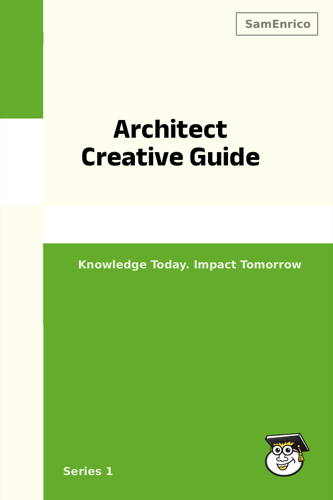
Non-FictionSelf-HelpArchitectural Creativity
Architect Creative Guide eBook
Design buildings that inspire using this practical
by Baird Mitsue
Design buildings that inspire using this practical creativity handbook for structural thinkers.
Formats
Free sample
Chapter 1: The Structural Poem--–- Every building tells a story. Most tell the same one: "Here is a box. It keeps the rain off. You may enter." But the buildings that haunt us—the ones we photograph, remember, and return to—tell a different story. They whisper, sometimes shout: "Look at how I hold myself up.
See how gravity flows through me like water. Watch how tension makes me dance." These buildings are structural poems, and they are not accidents. They emerge from a way of thinking that this book will teach you: the integration of creativity and structure, not as opposing forces, but as the same force expressed in two languages.The Great False War For at least a century, architectural education has been built on a lie. The lie says that there are two kinds of people in the world: the artists who dream up beautiful shapes, and the engineers who figure out how to keep those shapes from collapsing. The artists are creative; the engineers are practical.
The artists work in sketches and models; the engineers work in calculations and graphs. One is the poet, the other the plumber.This lie has produced three generations of architects who are afraid of math, three generations of engineers who are suspicious of intuition, and millions of buildings that are either structurally honest and emotionally dead, or emotionally ambitious and structurally dishonest.Consider the typical suburban office park. The structure is a steel frame, perfectly adequate, utterly invisible behind a skin of reflective glass and aluminum panels. The building does not express how it stands. You cannot tell, looking at it, where the columns are, how the beams span, or where the bracing resists wind.
The structure is hidden, almost ashamed of itself. The creativity—such as it is—has been applied as decoration: a curved entrance canopy here, a colored panel there, a fake stone veneer somewhere else. This is "applied creativity," and it is the architectural equivalent of putting a bow tie on a corpse.On the other hand, consider the engineering solution that ignores the human experience entirely. A highway overpass is a marvel of structural efficiency, but no one lingers beneath it. A power plant's cooling towers are mathematically elegant hyperboloids, but they do not invite contemplation.
These structures are honest about their loads, but they are not poems. They are spreadsheets.The lie has convinced us that we must choose: be creative but superficial, or be structural but soulless.This book exists to tell you that the lie is optional.What This Chapter Will Do For You By the end of this chapter, you will have fundamentally shifted how you see the relationship between creativity and structure. You will understand:Why the most inspiring buildings in history are also the most structurally inventive How to reframe gravity, tension, and lateral loads as generative parameters rather than constraints The difference between "applied creativity" (decoration added after structure) and "emergent creativity" (form that grows from structural logic)A practical exercise called the Creative Load Path that will train you to see multiple structural possibilities in a single set of supports The one question that will change how you look at every building you encounter for the rest of your life This is not a chapter about engineering. You will not learn how to calculate beam deflections or size a foundation. This is a chapter about thinking—about rewiring your mental habits so that when you sit down to design, structure becomes your partner, not your adversary.The Case of the Two Bridges Let us begin with a concrete example.
Two bridges span the same river. Both must carry the same load: cars, trucks, the occasional emergency vehicle. Both face the same environmental conditions: wind, rain, thermal expansion, seismic risk in the distant but real background. Both were designed by competent structural engineers who followed the same codes and standards.The first bridge is a concrete box girder. It is gray, flat, and featureless.
It does its job. You cross it without noticing you have crossed it. If asked to describe it, you would say, "It's a bridge." It is structurally honest—every element is doing exactly what the calculations say it should do—but it is not memorable. It is a solution, not a statement.The second bridge is the Millau Viaduct in southern France, designed by the engineer Michel Virlogeux and the architect Norman Foster. It rises from the valley floor on seven slender piers, each one tapering as it ascends.
The deck is a steel box girder that seems to float, so thin it appears to be drawn across the sky with a single stroke of a pen. The cables are not hidden but celebrated—fanning out from the piers like the stays of a sailing ship. The entire structure reads as a single, coherent gesture: a ribbon of road suspended above the clouds.Both bridges solve the same engineering problem. Both are structurally honest. One is a poem; the other is a receipt.What accounts for the difference?
The answer is not "more decoration." The Millau Viaduct has no applied ornament. There are no gargoyles, no colored panels, no decorative arches. Every visible element is structural. The tapering piers are shaped that way because the bending moment in a tall pier is highest at the base and lowest at the top—the taper expresses the moment diagram. The fan of cables is arranged that way because the geometry of a cable-stayed bridge demands that the stays meet the tower at specific angles for equilibrium—the fan is the most efficient arrangement.
The thinness of the deck is possible because steel has high tensile strength—the thinness expresses the material's capability.The Millau Viaduct is beautiful because it is completely structural. The creativity emerged from the inventive resolution of forces, not from applied decoration. The bridge tells the truth about how it stands, and the truth is beautiful.This is the central insight of this book: structural honesty does not equal monotony. The most creative architecture is not the architecture that escapes structure, but the architecture that celebrates structure.Reframing Forces as Generative Parameters The word "constraint" has a bad reputation. When an architect hears that a site has challenging soil conditions or that the budget limits the span or that the local code restricts the height, the instinct is to see obstacles.
Constraints are things that get in the way of the vision.This chapter asks you to perform a mental operation that will feel strange at first, then liberating: stop seeing forces as constraints and start seeing them as generative parameters.Let me explain the distinction. A constraint says: "You cannot do X." A generative parameter says: "If you do Y, you will get Z, and Z might be interesting." Gravity is not a rule that says "Your building must be heavy." Gravity is an opportunity to explore compression, stacking, massing, and the relationship between base and top. Wind is not a rule that says "Your building must be chunky." Wind is an opportunity to explore tapering, bracing, aerodynamic shaping, and the visual language of resistance. Tension is not a rule that says "Your building…
This is the end of the free sample. Get the eBook to keep going. Buy now
About this book
Details
- Author
- Baird Mitsue
- Publisher
- SamEnrico
- Language
- English
- Genre
- Non-Fiction, Self-Help, Architectural Creativity
- Released
- 2026-06-06
- Pages (approx.)
- 144
- Available as
- eBook, Audiobook

Read better in the ZLOADR app
Your eBooks on your phone or tablet. Sign in with your SamEnrico account and start reading.
More by Baird Mitsue
 Bereavement After Long IllnessBaird Mitsue$11.99
 Beginner Mindfulness for AngerBaird Mitsue$11.99
 Complicated Grief After OverdoseBaird Mitsue$11.99
 The Emotional Validation in HealthcareBaird Mitsue$11.99
 The Battle of the Lighthouse: The Dutch Defy the Mighty Spanish Armada (1597)Baird Mitsue$11.99
 How to Start a Accessories for Photographic Equipment Business (Beginners Guide)Baird Mitsue$11.99
 Procurement Bottleneck GuideBaird Mitsue$12.99
 Chatbot Accounting AssistantBaird Mitsue$12.99
 Understanding Stimmler SyndromeBaird Mitsue$17.99
 Client Operations SpecialistBaird Mitsue$11.99Client Operations SpecialistBaird Mitsue$11.99Client Operations SpecialistBaird Mitsue$11.99
You may also like
 Hong Kong Handover 1997Dunn Johnnie$11.99
 Zumba For Postnatal Recovery CourseNeal Christian$11.99
 Zumba for BeginnersLadner Nikia$11.99
 YouTube Comment Mining GuideHumes Pandora$12.99
 Worry Box MeditationCarlin Rudy$11.99
 Workplace Stress MeditationNguyen Lynn$11.99
 Workplace Stress and Sleep RepairHawley Ivory$11.99
 Workplace Perfectionism CureDelaney Jeffry$11.99
 Workplace Injustice Anger GuideWallen Isabelle$11.99
 Work Addiction and Burnout LinkGreenwood Ester$11.99
 Women in Yoga and WellnessBeattie Galina$11.99
 Women in Stand Up ComedyChun Evangeline$11.99