
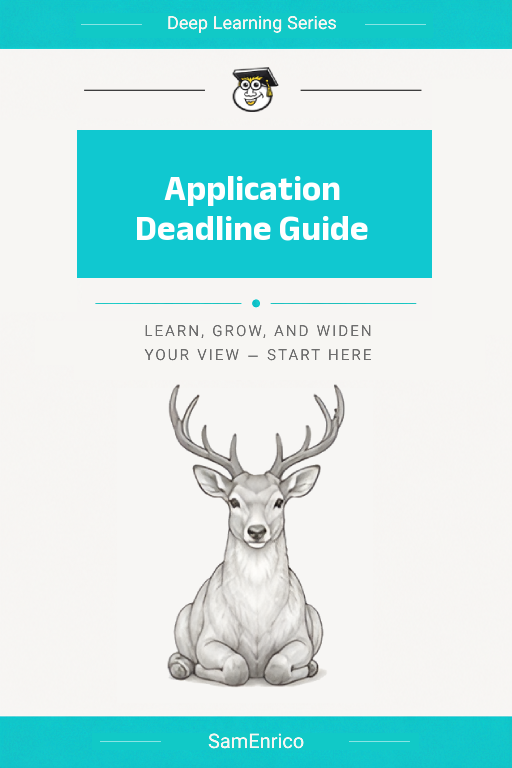
Application Deadline Guide eBook
Compare UK UCAS (Jan), US early/regular (Nov-Jan),
Compare UK UCAS (Jan), US early/regular (Nov-Jan), and Australian semester deadlines.
Formats
Free sample
Chapter 1: The Calendar Lie--Most students believe deadlines are dates on a calendar. They are not. Deadlines are weapons, and right now, someone else is holding yours.If you are reading this book, you are probably anxious. You have a list of universities in three different countries, a pile of essays that all sound the same, and a parent who keeps asking, “Have you submitted anything yet?” You have six tabs open: UCAS, Common App, a Australian university portal, a scholarship spreadsheet, your email inbox (three unread messages from recommenders you are too afraid to open), and a countdown clock for a deadline that is definitely, absolutely, positively not going to move.Here is what nobody tells you: the student who gets into their dream school is not necessarily smarter, richer, or more talented than you. They are almost certainly better at using deadlines.This book will teach you to see the admissions calendar not as a series of obstacles but as a strategic asset.
By the time you finish Chapter 12, you will know exactly when to apply to which university in the United States, the United Kingdom, and Australia—not just to meet the deadline, but to maximize your odds of acceptance, financial aid, housing, and sanity.But first, you have to unlearn everything you think you know about deadlines.The Passive Myth Most students treat deadlines like expiration dates on milk. They see a date on a website—November 1st, January 15th, October 15th—and they work backward from that date. “If the deadline is November 1st,” they think, “I should finish my application by October 25th, leaving myself a week for problems.” Then October 25th becomes October 28th. October 28th becomes October 30th. On October 31st, they are frantically uploading documents while their internet connection fails, their recommender sends the wrong letter, and the Common App crashes because thirty thousand other students had the exact same idea.This is the passive myth: the belief that a deadline is a finish line.
It is not. A deadline is a trap.Universities do not set deadlines to help you. They set deadlines to manage themselves. An admissions committee has a certain number of seats, a certain amount of financial aid, and a certain number of hours to read applications. Every single deadline in this book exists to serve the institution first and you second—sometimes a distant second.The Strategic Truth Here is the strategic truth that changes everything: the date you submit your application affects your probability of acceptance just as much as your grades do.
Sometimes more.This is especially true for rolling admissions, a term you will hear throughout this book. Rolling admissions means the university reviews applications as they arrive, not after a fixed deadline. If you apply in August for a February start date, you are competing against a small pool of early birds. If you apply in November, you are competing against everyone else who procrastinated. The university has the same number of seats either way, but in November, many of those seats are already gone.A student with average grades who applies in August to a rolling-admission university has a higher chance of acceptance than a student with excellent grades who applies in December.
This is not speculation. This is how the math works.But rolling admissions is only one piece of the puzzle. The United States, the United Kingdom, and Australia each have completely different deadline systems, each with its own logic, traps, and hidden advantages. Understanding all three is not optional if you are applying across multiple countries. It is survival.Before we dive into each country, let us establish the three core concepts that will appear in every chapter of this book.Core Concept 1: Hard Cutoffs vs.
Rolling Admissions A hard cutoff deadline means the university will not accept any applications after a specific date. If you miss it, you are done. You cannot apply again until the next cycle, which usually means waiting a full year. The UK’s October 15th deadline for Oxford and Cambridge is a hard cutoff. Most US Regular Decision deadlines are hard cutoffs.
Miss January 1st at an Ivy League school, and you are not getting in.A rolling admissions deadline means the university accepts applications continuously until all seats are filled. There is technically a final deadline, but the real deadline is whenever the class fills up. This could be weeks or months before the posted date. Australian universities use rolling admissions extensively, as do many US public universities and some UK programs after their main deadlines.Here is the critical distinction that most guides get wrong, and that this book will repeat until it sticks: there is a massive difference between early rolling and late rolling.Early rolling means applying as soon as the application portal opens, usually 6 to 12 months before the start date. Early rolling gives you a statistical advantage because you are competing against the smallest pool for the largest number of seats.Late rolling means applying after you have missed other deadlines, usually 2 to 4 months before the start date.
Late rolling is a backup option, not an advantage. The seats are mostly gone. The financial aid is mostly allocated. The housing is mostly full. Late rolling can still get you into a university, but it will not get you into your top-choice university with a scholarship and a dorm room overlooking the quad.Throughout this book, whenever you see “rolling admissions,” ask yourself: are we talking about early rolling or late rolling?
The answer changes everything.Core Concept 2: The Institutional Calendar Universities in different countries run on completely different schedules. This seems obvious, but you would be surprised how many students miss deadlines because they assumed every university starts in September.The United States operates primarily on a fall intake (September start) with early deadlines in November and regular deadlines in January. There are also spring intakes (January start) at some institutions, but these have fewer courses, fewer scholarships, and fewer international students. Apply for fall unless you have a very specific reason not to.The United Kingdom operates on a September or October start with two major deadlines: October 15th for Oxford, Cambridge, and most medicine programs, and January 14th for everything else. There is no spring intake at most UK universities.
Miss the January deadline, and you are waiting an entire year.Australia operates on two main intakes: Semester 1 (February or March start) and Semester 2 (July or August start). Some Australian universities also offer trimester systems with up to four start dates per year: January, May, August, and November. This is both a blessing and a curse. A blessing because missing a deadline usually means waiting only six months, not a full year. A curse because the multiple deadlines create confusion and false hope for disorganized students.Understanding these calendars is step one.
Step two is understanding that institutional priorities shape deadlines just as much as logistics do.Core Concept 3: Fit and Institutional Priorities Every university has a problem. For elite US colleges, the problem is yield: they need to admit exactly the right number of students to fill their class without admitting too many (over-enrollment) or…
This is the end of the free sample. Get the eBook to keep going. Buy now
About this book
Details
- Author
- Paredes Myrta
- Publisher
- SamEnrico
- Language
- English
- Genre
- Non-Fiction, Student's Shortcut, Deadlines
- Released
- 2026-05-29
- Pages (approx.)
- 131
- Available as
- eBook, Audiobook

Read better in the ZLOADR app
Your eBooks on your phone or tablet. Sign in with your SamEnrico account and start reading.
More by Paredes Myrta
 Design Thinking for PresentationsParedes Myrta$11.99
 Children's Bedtime MeditationParedes Myrta$11.99
 Detox for Deaf PatientsParedes Myrta$11.99
 DBT for Substance UseParedes Myrta$11.99
 Parent Child NVC GuideParedes Myrta$11.99
 Remote Work for MarketersParedes Myrta$11.99
 Empathy Boundaries GuideParedes Myrta$11.99
 Elizabeth Spy NetworkParedes Myrta$11.99
 The First Conviction: How DNA Solved the Florida Rape Case That Changed Forensics (1987)Paredes Myrta$11.99
 The Casablanca Cartel: The Prohibition-Era Drug War That Shook AfricaParedes Myrta$11.99
 A Collector's Handbook to the Hillman MinxParedes Myrta$11.99
 How to Produce an Impact MillParedes Myrta$11.99
You may also like
 University Application DeadlinesLavoie Freeman$12.99
 Turkish Application DeadlinesRead Margarito$12.99
 LSE Online Application DeadlinesHolden Kory$12.99
 Korean Scholarship Deadlines TrackerLemieux Zenobia$12.99
 Brazil University Application Deadlines GuideMueller Darell$12.99
 Harvard Extension Application DeadlinesLudwig Norah$12.99
 Scholarship Application CalendarRicker Helaine$12.99
 Rwanda Student Application DeadlinesZeigler Roxie$12.99