
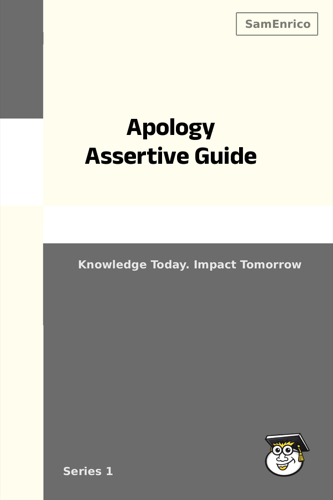
Apology Assertive Guide eBook
Take responsibility without groveling.
by Velez Jason
Take responsibility without groveling.
Formats
Free sample
Chapter 1: The Apology Paradox--–- The email arrived at 11:47 PM on a Tuesday. Sarah, a 34-year-old marketing director, had spent twenty minutes drafting it. Fifteen versions. Each one either sounded defensive ("I'm sorry you felt that way, but the deadline was unrealistic") or groveling ("I am SO sorry, I'm the worst, please don't hate me"). She deleted both.
Then she wrote nothing. She closed her laptop and lay awake until 3 AM, stomach churning, because she could not find the words to say "I made a mistake" without also saying "I am a mistake."Across town, her colleague James had no such problem. James never apologized. When he missed the same deadline, he sent a one-line email: "Timeline shifted due to unforeseen factors." He did not lose sleep. He also did not have Sarah's problem—he had a different one.
His team had stopped trusting him six months ago. They worked around him, not with him. When he finally needed their help on a critical project, they gave him exactly what he asked for and nothing more. He had won every argument and lost every relationship.This book is for Sarah. And this book is for James.
And this book is for everyone who has ever felt that terrifying split second after hurting someone—when you know you should say something, but every option feels wrong.The Modern Apology Crisis We live in an age of constant apologies. Public figures apologize on social media within hours of a scandal. Corporations issue statements expressing "regret for any inconvenience." Friends text "sorry" for canceling plans, followed by a crying-laughing emoji. We have never said "sorry" more often. And we have never been worse at it.The problem is not a lack of apologizing.
The problem is a crisis of two dysfunctional camps, and most people fall into one of them.The first camp is the Pleaser. The Pleaser apologizes for everything—for being five minutes late, for having a different opinion, for asking a question in a meeting, for existing in someone's way. The Pleaser has confused accountability with self-punishment. When the Pleaser says "I'm sorry," what they often mean is "Please don't be angry with me" or "Please reassure me that I'm not a bad person." Their apologies are not repairs; they are performances of unworthiness designed to elicit comfort. And everyone around them is exhausted, because every apology from a Pleaser demands emotional labor in return.
You cannot simply accept a Pleaser's apology; you must also soothe them, tell them it's okay, and convince them they are not a monster. The original harm gets lost in the theater of self-flagellation.The second camp is the Defender. The Defender never apologizes for anything that matters. When confronted with evidence of harm, the Defender deflects ("That's not what happened"), defends ("You're being too sensitive"), or disappears ("I don't have time for this"). The Defender has confused strength with invulnerability.
They believe that saying "I was wrong" is a sign of weakness—that once you admit fault, you lose power. The research suggests the opposite, but the Defender operates on instinct, not evidence. Their relationships are brittle, built on a foundation of unacknowledged harms that calcify into resentments. People stop bringing problems to the Defender because they know nothing will change. The Defender wins every argument and loses every connection.There is a third camp, but it is rare.
Perhaps ten percent of people naturally occupy it. These are the Responsible Assertive—people who apologize when they are actually wrong, with specificity and action, and who do not apologize when they are not wrong. They take responsibility without groveling. They repair what they break without breaking themselves in the process. They are not born this way; they have learned it.
And this book exists to teach what they know.Why "Sorry" Became the Hardest Word The word "sorry" carries an extraordinary weight. In English, it serves multiple masters. It can express empathy ("I'm sorry for your loss"), regret ("I'm sorry I hurt you"), politeness ("Sorry, could you move?"), and even aggression ("You'll be sorry"). This flexibility is also its curse. Because "sorry" can mean so many things, it often means nothing at all.But the deeper problem is psychological.
Neuroscience research using functional magnetic resonance imaging (f MRI) has shown that apologizing activates brain regions associated with both social pain and reward. When we contemplate apologizing, our brains anticipate the possibility of rejection—the other person might not accept it, might use it against us, might think less of us. This anticipation triggers the same neural circuits as physical pain. No wonder we avoid it.At the same time, failing to apologize when we know we should triggers its own form of distress. A study published in the Journal of Personality and Social Psychology found that when people caused harm and refused to apologize, their own emotional distress increased over time, not decreased.
The refusal to apologize acts like a psychological splinter—the longer it stays in, the more it hurts. Defenders are not as comfortable as they appear. They have simply learned to numb the pain of their own unacknowledged wrongs, often through blame, projection, or emotional withdrawal.The Pleaser faces a different neurological trap. For Pleasers, apologizing has become a conditioned response to any discomfort. If you grew up in an environment where mistakes were punished harshly—where a spilled glass of milk meant thirty minutes of screaming, or where a wrong answer meant withdrawal of love—your brain learned that preemptive self-blame is safer than waiting to be blamed.
You learned to say "sorry" before anyone else could accuse you. This is not a moral failing. It is a survival strategy that outlived its usefulness. But it leaves you apologizing for things that are not your fault, in ways that exhaust everyone around you, while never actually addressing the real harm.The Research: What Actually Happens When We Apologize (or Don't)Social psychologists have studied apology for decades, and their findings are both surprising and actionable.Finding One: A refused apology doubles the emotional intensity of a conflict.In a landmark study, researchers asked participants to recall a time someone had hurt them. Half were told to imagine that the offender had apologized sincerely.
The other half were told to imagine that the offender had refused to apologize. Those in the "refused apology" condition reported significantly higher levels of anger, rumination, and desire for revenge—not just immediately, but when asked again one week later. The refusal to apologize does not make the conflict go away. It entrenches it.Finding Two: A poorly delivered apology is worse than no apology at all.Not all apologies are better than silence. The classic non-apology—"I'm sorry you feel that way"—has been shown to increase anger in recipients compared to saying nothing.
Why? Because it feels like gaslighting. It acknowledges their emotion while accepting zero responsibility for causing it. The message received is not "I regret my action" but "Your reaction is the problem." Similarly, apologies that are overly self-punishing ("I'm the worst person in the world, I don't deserve to live") create a different kind of harm: they force the injured party…
This is the end of the free sample. Get the eBook to keep going. Buy now
About this book
Details
- Author
- Velez Jason
- Publisher
- SamEnrico
- Language
- English
- Genre
- Non-Fiction, Self-Help, Apology
- Released
- 2026-06-07
- Pages (approx.)
- 143
- Available as
- eBook, Audiobook

Read better in the ZLOADR app
Your eBooks on your phone or tablet. Sign in with your SamEnrico account and start reading.
More by Velez Jason
 Fiduciary Management GuideVelez Jason$11.99Fiduciary Management GuideVelez Jason$11.99
 Vitamin A For Measles RecoveryVelez Jason$11.99
 Senior Forgiveness Self EsteemVelez Jason$11.99
 Guilt Induced Rumination StopVelez Jason$11.99
 Difficult Conversations with TherapistsVelez Jason$11.99
 Natural Cycles For PCOSVelez Jason$11.99
 Self Hypnosis for ProcrastinationVelez Jason$11.99
 The Last Satrap of Susa: A Persian Rebel’s DefianceVelez Jason$11.99
 The Curse of Bakasura: The Demon Who Devoured ChildrenVelez Jason$11.99
 How to Produce Crafting CanvasVelez Jason$11.99
 Cloud and SaaS Sales to GCCVelez Jason$12.99
You may also like
 Hong Kong Handover 1997Dunn Johnnie$11.99
 Zumba For Postnatal Recovery CourseNeal Christian$11.99
 Zumba for BeginnersLadner Nikia$11.99
 YouTube Comment Mining GuideHumes Pandora$12.99
 Worry Box MeditationCarlin Rudy$11.99
 Workplace Stress MeditationNguyen Lynn$11.99
 Workplace Stress and Sleep RepairHawley Ivory$11.99
 Workplace Perfectionism CureDelaney Jeffry$11.99
 Workplace Injustice Anger GuideWallen Isabelle$11.99
 Work Addiction and Burnout LinkGreenwood Ester$11.99
 Women in Yoga and WellnessBeattie Galina$11.99
 Women in Stand Up ComedyChun Evangeline$11.99