
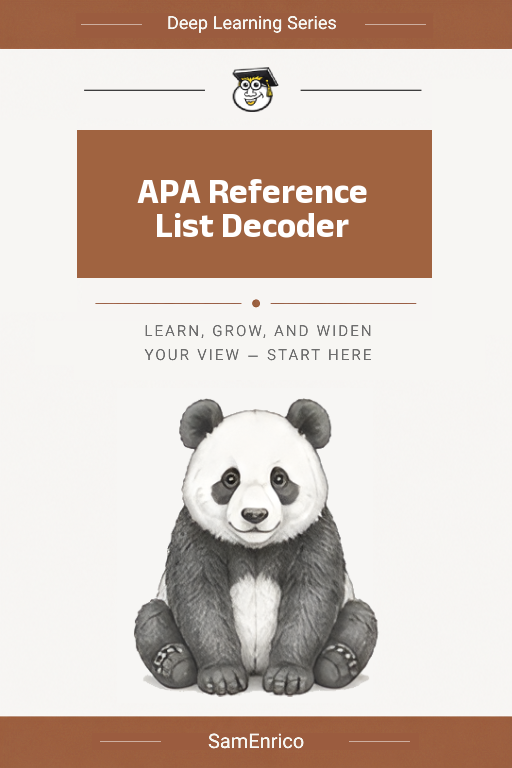
Non-FictionStudent's ShortcutAPA StyleAcademic Writing
APA Reference List Decoder eBook
Build correct author-date citations for journals,
Build correct author-date citations for journals, books, and digital sources using hanging indents and doi rules.
Formats
Free sample
Chapter 1: The One-to-One Lie...--You have been lied to. Not maliciously, but the lie persists. The lie is this: that citing sources is about memorizing punctuation, that a missing comma will doom your grade, and that APA style exists to make your life miserable.None of that is true.APA style exists for one reason only: findability. The entire system—the author-date format, the reference list, the hanging indents, the DOIs—is designed to answer a single question as quickly as possible: Where did this idea come from, and can I go read it myself?That is it.Every period, every comma, every italicized title serves that goal. When you understand that, APA stops being a list of arbitrary rules and becomes a logical system.
You stop memorizing and start decoding.This book is called APA Reference List Decoder for a reason. You are not here to memorize 500 rules. You are here to learn the pattern. Once you see the pattern, you will never need to look up the same citation format twice.And the pattern starts with one deceptively simple rule: the one-to-one rule.The One-to-One Rule: Your North Star Here is the single most important sentence in this entire book, more important than any comma placement or italicization rule:Every in-text citation must have exactly one matching entry in the reference list. And every reference list entry must have at least one matching in-text citation.That is the one-to-one rule.Let me say it again, because students violate this rule more than any other:If you write (Smith, 2020) in your paper, there must be a reference entry for Smith (2020) at the end.If you have a reference entry for Jones (2019) in your list, you must have cited Jones (2019) somewhere in your paper.No exceptions.
No "but I thought about citing it." No "I found it online but didn't use it directly." No "it's a background source."The reference list is not a bibliography. In APA style, those two words are not interchangeable. A bibliography lists everything you read. A reference list lists only what you cited. If you read it but did not cite it, it does not belong in your reference list.
Full stop.This rule is your north star. Whenever you are confused about whether to include something, or how to format something, come back to the one-to-one rule. It will guide you.Why Findability Matters More Than Perfection Before we go any further, I need to reframe how you think about citations.Most students treat citations as a punishment. You write a beautiful paragraph, and then you have to spoil it with a clunky (Smith, 2020) at the end. The reference list feels like busywork—eight pages of formatting you will never use again.That framing is backwards.Citations are a gift to your reader.
Every time you provide a precise, accurate citation, you are saying: "Here is exactly where I found this information. You can go verify it yourself in under 30 seconds."That is powerful. In an era of misinformation, AI-generated nonsense, and broken hyperlinks, a correct citation is an act of intellectual generosity.Consider two scenarios:Scenario A: You write, "Research shows that sleep deprivation impairs memory formation." No citation. The reader has no idea who researched this, when, or whether the study was done on humans or mice. They cannot follow up.
You have given them a dead end.Scenario B: You write, "Sleep deprivation impairs memory formation (Walker & Stickgold, 2019)." The reader looks at your reference list, finds Walker and Stickgold (2019), sees the DOI https://doi.org/10.1037/xge0000456, clicks it, and is reading the original study in ten seconds.That is findability. That is the entire point of APA style.Every rule in this book serves findability. When you understand that, the rules stop feeling arbitrary. The hanging indent exists because it makes reference lists scannable. The DOI format exists because DOIs never break, unlike URLs.
The author-date format exists because chronological sorting helps readers understand the evolution of research.You are not learning punctuation. You are learning how to give your reader a map.The Anatomy of an In-Text Citation Now let us look at the two ways you will cite sources within your paper. Understanding these now will make the reference list rules much clearer later.Parenthetical Citations The most common form. Both the author and the date appear inside parentheses at the end of the sentence.Example: The relationship between sleep and memory consolidation is well established (Smith, 2020).Format: (Author Last Name, Year)Punctuation note: There is a comma between the author and the year. There is no "p." for page numbers unless you are quoting directly (more on that in Chapter 8).
The period of the sentence comes after the closing parenthesis.Multiple authors:Two authors: (Smith & Jones, 2020) — note the ampersand (&) inside parentheses Three or more authors: (Smith et al., 2020) — from the very first citation Multiple works: (Smith, 2020; Jones, 2019; Lee, 2021) — semicolons separate different sources, ordered alphabetically by the first author's last name Narrative Citations The author name is part of the sentence itself. Only the year is in parentheses.Example: Smith (2020) found that sleep quality directly predicts memory consolidation.Format: Author Last Name (Year) + verb Punctuation note: No comma between author and year. The parentheses hug only the year.Multiple authors in narrative form:Two authors: Smith and Jones (2020) found — note the word "and" (not ampersand) outside parentheses Three or more authors: Smith et al. (2020) found Which one should you use?Both are correct. Use parenthetical citations when the author is not important to your sentence.
Use narrative citations when you want to emphasize the researcher or when you are comparing multiple studies: "Smith (2020) found X, but Jones (2019) found Y."Neither is "better." They serve different rhetorical purposes. Your paper can use both freely.The Reference List: Your Paper's Destination Map If in-text citations are signposts on a highway ("Exit 47, 2 miles"), the reference list is the detailed map showing exactly how to get there.Every reference entry has the same underlying structure, which we will explore in depth in Chapter 2. But for now, understand this:A reference entry tells the reader four things:Who created it (author)When it was published (date)What it is called (title)Where to find it (source information, often a DOI or URL)That is it. Every single reference entry—journal article, book, You Tube video, podcast, government report—follows those four categories. The order changes slightly depending on the source type, but the categories never change.A journal article reference looks like this:Smith, J.
A. (2020). The effects of sleep on memory consolidation. Journal of Sleep Research, 15(3), 245–260. https://doi.org/10.1037/xge0000456Let us decode it:Who: Smith, J.
A.When: (2020)What: The effects of sleep on memory consolidation.Where: Journal of Sleep Research, 15(3), 245–260. https://doi.org/10.1037/xge0000456A book reference looks like this:Jones, M. B. (2019). Why we sleep: The science of rest and recovery.
Penguin Books.Decoded:Who: Jones, M. B.When: (2019)What: Why we sleep: The science of rest and recovery Where: Penguin Books Notice the pattern? The four categories are always there. The punctuation changes (periods vs. commas, italics vs.
plain text), but the information is the same.Once you learn to identify these four categories in any source you find…
This is the end of the free sample. Get the eBook to keep going. Buy now
About this book
Details
- Author
- Sweeney Rosenda
- Publisher
- SamEnrico
- Language
- English
- Genre
- Non-Fiction, Student's Shortcut, APA Style, Academic Writing
- Released
- 2026-05-29
- Pages (approx.)
- 147
- Available as
- eBook, Audiobook

Read better in the ZLOADR app
Your eBooks on your phone or tablet. Sign in with your SamEnrico account and start reading.
More by Sweeney Rosenda
 Small Talk for Autism SpectrumSweeney Rosenda$11.99
 Napping for Autoimmune DiseaseSweeney Rosenda$11.99
 Zumba for CouplesSweeney Rosenda$11.99
 Samsung Reminder AppSweeney Rosenda$11.99
 The Migrant Worker's CageSweeney Rosenda$11.99
 Bipolar Mindfulness WorkbookSweeney Rosenda$11.99
 Self Explanation TechniqueSweeney Rosenda$11.99
 Self Awareness EQ Foundation CourseSweeney Rosenda$11.99
 Neonatal Death GriefSweeney Rosenda$11.99
 Whispers from the Barley Fields: The Vanishing of the Corn DolliesSweeney Rosenda$11.99
 The Moscow Gambit: How a CIA Operative Played Both Sides in the Cold WarSweeney Rosenda$11.99
 The Last Voyage of the SS Andrea Doria: A Titanic Mystery in the AtlanticSweeney Rosenda$11.99
You may also like
 Hong Kong Handover 1997Dunn Johnnie$11.99
 Zumba For Postnatal Recovery CourseNeal Christian$11.99
 Zumba for BeginnersLadner Nikia$11.99
 YouTube Comment Mining GuideHumes Pandora$12.99
 Worry Box MeditationCarlin Rudy$11.99
 Workplace Stress MeditationNguyen Lynn$11.99
 Workplace Stress and Sleep RepairHawley Ivory$11.99
 Workplace Perfectionism CureDelaney Jeffry$11.99
 Workplace Injustice Anger GuideWallen Isabelle$11.99
 Work Addiction and Burnout LinkGreenwood Ester$11.99
 Women in Yoga and WellnessBeattie Galina$11.99
 Women in Stand Up ComedyChun Evangeline$11.99