
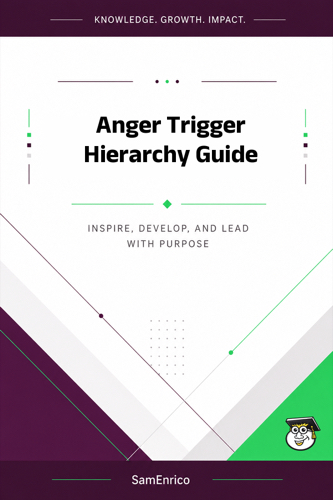
Anger Trigger Hierarchy Guide eBook
Rank triggers from least to most intense for syste
Rank triggers from least to most intense for systematic desensitization planning.
Formats
Free sample
Chapter 1: The Amygdala's Lie--–- You are not losing control. You are being hijacked by a brain structure the size and shape of an almond that cannot tell the difference between a forgotten anniversary and a saber-toothed tiger.Let that land for a moment.Every time you have exploded at a slow driver, a passive-aggressive email, a child who left wet towels on the floor, or a partner who used the wrong tone of voice, your amygdala—that small, ancient cluster of neurons buried deep in your temporal lobe—has done the same thing it would do if you were being chased by a predator. It has flooded your body with cortisol and adrenaline. It has shut down your prefrontal cortex (the rational, planning part of your brain). And it has convinced you, in that moment, that the wet towel is an existential threat.The amygdala is not stupid.
It is efficient. Its only job is survival. But here is the problem the self-help industry does not want you to hear: your amygdala is also lazy. It categorizes threats using a binary system—safe or not safe, friend or enemy, fight or flight. There is no folder in the amygdala for "mildly annoying but ultimately inconsequential." There is no neural pathway for "this person is being thoughtless, not malicious."And so, every time you feel that hot rush of blood, every time your jaw clenches and your voice rises, you are experiencing the amygdala's lie: the lie that the stakes are life and death when they are almost always inconvenience and ego.This chapter will teach you to see that lie for what it is.
You will learn the difference between low-level annoyance (governed by your prefrontal cortex, slow and reasoned) and high-level rage (amygdala-driven, fast and reactive). You will understand why these two states are physiologically incompatible—why you cannot be genuinely relaxed and genuinely enraged at the same time. And you will be introduced to the two non-negotiable facts that govern every other chapter in this book: Reciprocal Inhibition (you must replace anger with relaxation, not suppress it) and the Vividness Principle (vague triggers cannot be desensitized; only specific, movie-like scenes can be rewired).By the end of this chapter, you will no longer see your anger as a character flaw or a moral failing. You will see it as a neurological short circuit—one that can be mapped, ranked, and systematically repaired.The Two Brains Inside Your One Head For most of human history, we believed that anger was a single thing—a rising tide of emotion that could be either indulged or suppressed. Modern neuroscience has killed that idea.
What we call "anger" is actually two distinct neurological processes that happen in different parts of the brain, at different speeds, with different consequences.Let me introduce you to the two brains inside your one head.Brain Number One: The Prefrontal Cortex (The CEO). This is the six-millimeter-thick layer of tissue just behind your forehead. It is the most recently evolved part of the human brain—so recent that other primates have only a rudimentary version. The prefrontal cortex is responsible for planning, impulse control, reasoning, empathy, and what psychologists call "executive function." When you are using your prefrontal cortex, you can say things like, "I notice I am feeling irritated. That irritation is a 35 on the SUAS scale.
I will take three deep breaths before responding." The prefrontal cortex is slow (reaction time: 500–800 milliseconds) and energy-intensive (it consumes glucose at a furious rate). This is why you make worse decisions when you are hungry or tired—your CEO is running on empty.Brain Number Two: The Amygdala (The Fire Alarm). This is a small, almond-shaped cluster of nuclei buried deep in your temporal lobe. It is ancient—so ancient that reptiles have a functional equivalent. The amygdala does not think.
It detects. It scans your environment for threats at a speed of 50–100 milliseconds. When it detects a threat, it does not ask questions. It does not consider context. It does not wonder whether the threat is real or imagined, past or present, physical or social.
It simply sounds the alarm. Cortisol and adrenaline flood your system. Your heart rate doubles. Your breathing becomes shallow. Blood rushes to your large muscle groups (so you can fight or flee) and away from your prefrontal cortex (which the amygdala considers a luxury you cannot afford in an emergency).Here is the cruel irony: the amygdala cannot tell the difference between a physical threat and a social slight.
It cannot distinguish between a man with a knife and a coworker who just took credit for your idea. It cannot differentiate between a car swerving into your lane and your partner using a slightly sharper tone than usual. To your amygdala, they are all fires. And it will pull the alarm every single time.The Relaxation-Angle Response (Why "Calm Down" Never Works)You have probably been told to "just calm down" hundreds of times. Maybe you have said it to yourself.
Maybe someone else has said it to you. And every single time, it has failed. Not because you are bad at calming down. Not because you lack willpower. But because your nervous system is designed to make calm and rage mutually exclusive.This is called Reciprocal Inhibition, a term coined by the psychologist Joseph Wolpe in the 1950s.
The concept is deceptively simple: the parasympathetic nervous system (which produces relaxation, digestion, and rest) and the sympathetic nervous system (which produces fight-or-flight) cannot be fully active at the same time. They are like a seesaw. When one goes up, the other goes down.I call this the Relaxation-Angle Response because it follows a geometric logic: you cannot be at a 90-degree angle (pure rage) and a 0-degree angle (pure relaxation) simultaneously. The best you can do is find a middle angle—and that middle angle is where desensitization happens.Here is what this means for your anger hierarchy work. When you attempt to visualize or experience a trigger while you are still physiologically aroused (heart rate elevated, muscles tense, breathing shallow), you are not desensitizing yourself.
You are practicing anger. You are strengthening the neural pathway that says, "This trigger equals threat." Every time you rehearse anger while angry, you make future anger more likely and more intense.But when you deliberately lower your physiological arousal before encountering a trigger—when you bring your SUAS score down to 20 or below using the breathing and relaxation techniques in Chapter 7—you create a window of opportunity. Your brain experiences the trigger while in a relaxation state. And because the relaxation state and the rage state cannot coexist, your brain is forced to do something remarkable: it rewires. It creates a new association.
The trigger becomes less threatening. The amygdala learns, slowly and reluctantly, that this particular stimulus is not, in fact, a saber-toothed tiger.This is not positive thinking. This is not "looking on the bright side." This is neuroplasticity—the physical reorganization of your brain's neural pathways. And it is the only method that has been shown to produce lasting, measurable reductions in anger intensity.Equity Matching: Why Unfairness Hurts Like a Punch Not all…
This is the end of the free sample. Get the eBook to keep going. Buy now
About this book
Details
- Author
- Lake Lamonica
- Publisher
- SamEnrico
- Language
- English
- Genre
- Non-Fiction, Self-Help, Hierarchy
- Released
- 2026-06-08
- Pages (approx.)
- 151
- Available as
- eBook, Audiobook

Read better in the ZLOADR app
Your eBooks on your phone or tablet. Sign in with your SamEnrico account and start reading.
More by Lake Lamonica
 The Serenity Prayer In PracticeLake Lamonica$11.99
 Pain Neuroscience for CoachesLake Lamonica$11.99
 Vacation Time Block PlanningLake Lamonica$11.99
 Ballot of the Damned: The 1892 Recall That Never WasLake Lamonica$11.99
 The Poisoner's Prescription: The Deadly Legacy of Dr. Harold Frederick ShipmanLake Lamonica$11.99
 Fraud Ring Detection AnalyticsLake Lamonica$12.99
 Esports Marketing PrimerLake Lamonica$12.99
 Understanding Hyperparathyroidism, Familial, PrimaryLake Lamonica$17.99
 Advertising ConsultantLake Lamonica$11.99
 How to Become a Chemical-strength TesterLake Lamonica$11.99
You may also like
 Hong Kong Handover 1997Dunn Johnnie$11.99
 Zumba For Postnatal Recovery CourseNeal Christian$11.99
 Zumba for BeginnersLadner Nikia$11.99
 YouTube Comment Mining GuideHumes Pandora$12.99
 Worry Box MeditationCarlin Rudy$11.99
 Workplace Stress MeditationNguyen Lynn$11.99
 Workplace Stress and Sleep RepairHawley Ivory$11.99
 Workplace Perfectionism CureDelaney Jeffry$11.99
 Workplace Injustice Anger GuideWallen Isabelle$11.99
 Work Addiction and Burnout LinkGreenwood Ester$11.99
 Women in Yoga and WellnessBeattie Galina$11.99
 Women in Stand Up ComedyChun Evangeline$11.99