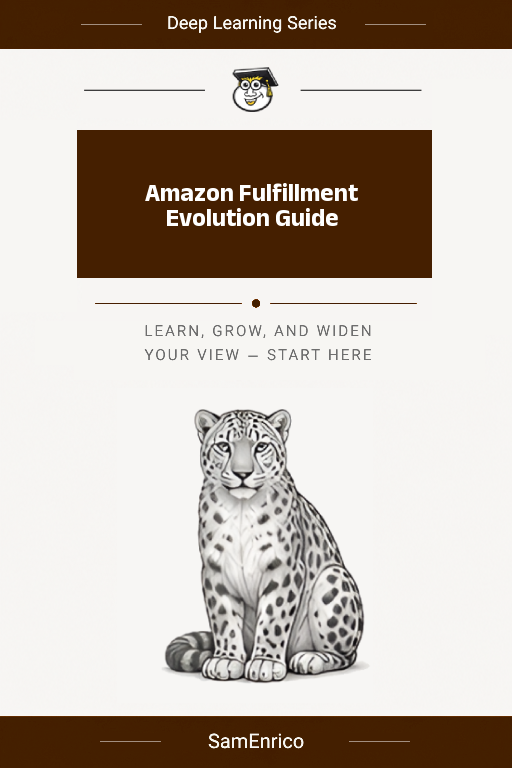
Amazon Fulfillment Evolution Guide eBook
Explore robotics deployment, same-day delivery bui
Explore robotics deployment, same-day delivery build-out, and last-mile innovations that built the e-commerce logistics empire.
Formats
Free sample
Chapter 1: The Velocity Mandate--–- In the late 1990s, when Amazon was still a books-only retailer operating out of a converted warehouse in Seattle, the concept of “fulfillment” was barely an afterthought for most business strategists. Warehouses existed to store inventory until it was needed, and delivery meant handing a box to UPS or Fed Ex, after which the retailer’s responsibility effectively ended. The prevailing logic was simple: build a good enough product, advertise it broadly, and customers would tolerate waiting five to seven business days for arrival. Speed was a luxury, not a baseline expectation. Then Jeff Bezos made a bet that defied every convention of retail economics.
He argued that the physical act of getting a product from a shelf to a doorstep was not a cost to be minimized but an experience to be perfected. This chapter traces the foundational shift that turned warehousing from a back-office necessity into the central competitive weapon of the twenty-first century’s most disruptive company.To understand Amazon’s fulfillment evolution, one must first erase the mental image of a traditional warehouse. The legacy model, which still operates in thousands of distribution centers worldwide, is fundamentally batch-oriented. Pallets arrive from manufacturers and are stored in static racks arranged in long, narrow aisles. When an order arrives, a picker—usually a human worker with a paper list or handheld scanner—walks those aisles, often covering ten to fifteen miles per shift, retrieving items one by one.
Those items are then taken to a packing station, placed in a box, sealed, labeled, and eventually handed to a carrier. Each of these steps is a discrete event, and between each step lies idle time. The industry’s standard metric, “touches per unit,” typically ranges from eight to twelve. A touch is any time a human or machine interacts with a product, and each touch adds cost, risk of damage, and most importantly, time. In the pre-Amazon paradigm, touches were accepted as inevitable.Amazon’s insight was that touches are not inevitable.
They are choices. And every touch that can be eliminated or compressed creates a compounding advantage. This is not merely an operational insight; it is a strategic one. Most retailers viewed fulfillment as a fixed cost of doing business, something to be outsourced to third-party logistics providers (3PLs) or absorbed as a necessary evil. Amazon viewed fulfillment as a variable cost that could be relentlessly engineered downward, with the savings passed back to customers in the form of lower prices, which in turn drove higher volume, which allowed further investment in fulfillment efficiency.
This self-reinforcing loop is the master flywheel, a concept that will appear throughout this book in different contexts. But in this chapter, we focus on its origin and its most dramatic expression: the decision to launch Amazon Prime.The Sunk Cost That Changed Everything In early 2005, Amazon was profitable but not yet the colossus it would become. The company had survived the dot-com crash and expanded beyond books into electronics, toys, and home goods. But customer behavior still reflected the legacy expectation of slow delivery. Shoppers would fill a virtual cart over several days, consolidate items to justify shipping costs, and often abandon carts entirely when faced with a five-dollar shipping fee on a ten-dollar item.
The friction was not in the product selection or the price; it was in the wait and the uncertainty. Amazon’s logistics network at the time was competent but conventional. Two-day shipping was available as an expensive expedited option, chosen by fewer than five percent of customers.The idea that would become Prime emerged from a series of internal debates about how to increase customer lifetime value. Traditional loyalty programs offered points or discounts on future purchases, but Bezos pushed for something different. He wanted to change the fundamental calculus of the shopping decision.
Instead of charging per shipment, what if customers paid a flat annual fee for unlimited two-day delivery? The financial model looked disastrous on paper. The average customer at the time placed roughly twelve orders per year, with an average shipping cost to Amazon of nearly four dollars per order. A $79 annual fee would require those customers to more than double their order frequency just to break even on shipping costs alone, never mind the additional inventory holding costs and packing materials. The finance team projected losses in the hundreds of millions.What the spreadsheets failed to capture was behavioral psychology.
Once a customer pays a sunk cost—the $79 Prime fee—every subsequent purchase carries no marginal shipping charge. The mental barrier between “do I need this now?” and “I’ll just add it to my cart” collapses. Small, low-margin items that would never justify a standalone shipping fee become trivial additions. A five-dollar phone charger, a three-pack of batteries, a single book—items that would have been deferred or bought elsewhere become Amazon purchases because the marginal cost to the customer is zero. This is the sunk cost fallacy working in reverse, not as a cognitive error but as a deliberate design feature.
Amazon was not tricking customers; it was removing friction. And the data would prove that customers responded by changing their behavior more radically than anyone predicted.Within three years of Prime’s launch, average order frequency among Prime members more than tripled. The number of items per order also increased, but the more significant shift was in the composition of those orders. Prime members began buying consumables—diapers, toilet paper, pet food—through Amazon, categories that had previously been the exclusive domain of brick-and-mortar stores because of their recurring, low-consideration nature. These “subscribe and save” items generated predictable, high-frequency volume that allowed Amazon to optimize its fulfillment network around density rather than just capacity.
The flywheel was spinning. Lower perceived shipping cost drove higher frequency. Higher frequency drove higher volume. Higher volume allowed Amazon to build more fulfillment centers closer to customers. More fulfillment centers meant faster delivery, which further increased the value of Prime membership.
Each turn of the flywheel made the next turn easier.The Fulfillment Machine as a Competitive Weapon The term “fulfillment machine” is not a metaphor. Amazon’s fulfillment centers are designed as integrated systems where every component—shelving, conveyor belts, packing stations, sorting equipment, and eventually robots—is optimized for continuous flow rather than batch processing. In a traditional warehouse, work arrives in waves. A truck unloads pallets in the morning. Workers put away those pallets throughout the day.
Orders are picked in afternoon batches. Packing happens in the evening. The next morning, the packed boxes are loaded onto outbound trucks. Each step waits for the previous step to complete. The fulfillment machine, by contrast, operates as a continuous process.
Inbound trucks are unloaded directly onto conveyor systems that feed into storage or directly to packing stations, depending on demand forecasts. Picking does not wait for put-away to finish; both happen simultaneously in different zones. Outbound loading begins as soon as the first boxes of the day are sealed, not after a nightly batch.This continuous flow model requires a level of coordination that was impossible before real-time data and algorithmic management. Amazon’s fulfillment centers are governed by a central software…
This is the end of the free sample. Get the eBook to keep going. Buy now
About this book
Details
- Author
- Crittenden Lida
- Publisher
- SamEnrico
- Language
- English
- Genre
- Non-Fiction, Strategic Atlas, Ecommerce Logistics
- Released
- 2026-05-29
- Pages (approx.)
- 155
- Available as
- eBook, Audiobook

Read better in the ZLOADR app
Your eBooks on your phone or tablet. Sign in with your SamEnrico account and start reading.
More by Crittenden Lida
 Eritrean Canadian Return To Asmara WorkbookCrittenden Lida$11.99
 Overcoming Self Doubt for High AchieversCrittenden Lida$11.99
 Metta for Body Image IssuesCrittenden Lida$11.99
 Breath Awareness For TinnitusCrittenden Lida$11.99
 Tanzania Ujamaa Socialism GuideCrittenden Lida$11.99
 The Architect of Dreams: Archibald Leitch and the Birth of Modern Football StadiumsCrittenden Lida$11.99
 Understanding Monoamine Oxidase a DeficiencyCrittenden Lida$17.99
 Technical Writing QA ChecklistCrittenden Lida$12.99
 Gmelinite MiningCrittenden Lida$11.99
 How to Become a Door AssemblerCrittenden Lida$11.99