
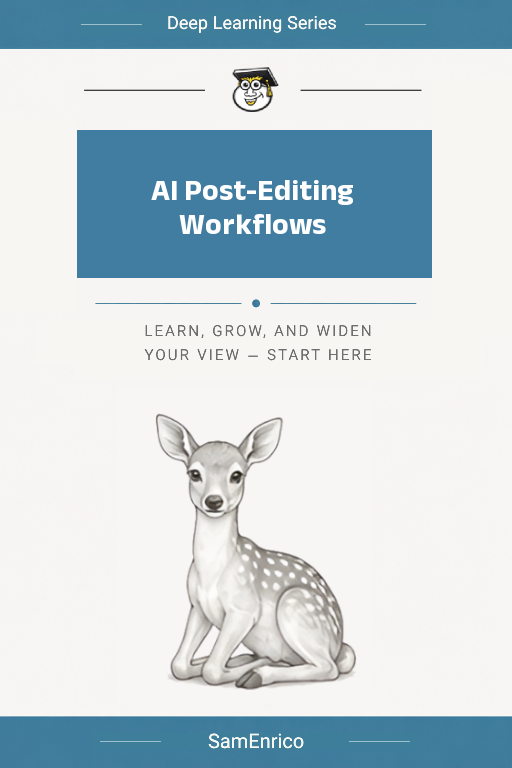
Non-FictionAI OperatorLanguage Services
AI Post-Editing Workflows Audiobook
Optimize human-AI collaboration for translation po
by Gossett Gene
Optimize human-AI collaboration for translation post-editing. Reduce costs while maintaining quality.
Formats
Free sample
Chapter 1: The Broken Promise...--The email arrived at 11:47 PM on a Tuesday. Maria, a senior translator with fourteen years of experience, opened it to find a notification that her largest client—a German automotive parts manufacturer she had served for nearly a decade—was moving their entire technical documentation workflow to a "hybrid AI solution." The attached rate sheet showed a 62 percent reduction in per-word payment. The new role was no longer "translator" but "post-editor." The message ended with a phrase that would haunt her for months: "Light post-editing only. Please do not over-deliver."Six months later, Maria sat across from me at a coffee shop in Berlin, her laptop open to a spreadsheet she had built to track her declining income. "I followed their rules," she said, stirring a cappuccino that had gone cold.
"I did exactly what they asked. Light post-editing on their machine translation output. And then they rejected three of my last five projects for quality issues." She turned the laptop toward me. The rejection reasons were damning: "Inconsistent terminology," "missed critical errors," "style guide violations." But when she had tried to fix those issues—adding proper terminology, correcting passive voice, ensuring cultural appropriateness—the project managers had accused her of "over-editing" and exceeding the allowed time budget.Maria was trapped between two impossible demands: do less and fail quality, or do more and lose money. And she was not alone.This chapter dismantles the false promise that led Maria—and thousands of translators like her—into this trap.
The promise was simple and seductive: machine translation plus light human post-editing equals lower costs with acceptable quality. The reality, as we shall see, is that the traditional two-tiered model of post-editing is not just flawed. It is a false economy that costs organizations millions in wasted effort, damaged brand reputation, and undetected critical errors. It destroys the livelihoods of professional linguists while failing to deliver the quality that clients actually need.The Origin of a Bad Idea To understand why the light versus full post-editing model became the industry standard, we must go back to 2010. Neural machine translation was still years away from practical deployment.
The dominant technology was Statistical Machine Translation (SMT), which produced output that was, by modern standards, barely usable. It stumbled over word order, mangled idioms, and regularly produced gibberish for any sentence longer than fifteen words.In that environment, the distinction between…
This is the end of the free sample. Get the Audiobook to keep going. Buy now
About this book
Details
- Author
- Gossett Gene
- Publisher
- SamEnrico
- Language
- English
- Genre
- Non-Fiction, AI Operator, Language Services
- Released
- 2026-06-01
- Pages (approx.)
- 146
- Available as
- eBook, Audiobook

Listen in the VoxFlicks app
Audiobooks and audio dramas wherever you go. Sign in with your SamEnrico account and press play.
More by Gossett Gene
 Gacy Parole Hearing FarceGossett Gene$11.99
 Illustrator Gestures GuideGossett Gene$11.99
 Grocery List Notepad AdsGossett Gene$11.99
 Smoking Cessation Support Group GuideGossett Gene$11.99
 The Angel of Death: The Hunt for Europe's Most Prolific Hospital KillerGossett Gene$11.99
 Learn to Play the SralaiGossett Gene$11.99
 Fabrication SupervisorGossett Gene$11.99
You may also like
 Hong Kong Handover 1997Dunn Johnnie$11.99
 Zumba For Postnatal Recovery CourseNeal Christian$11.99
 Zumba for BeginnersLadner Nikia$11.99
 YouTube Comment Mining GuideHumes Pandora$12.99
 Worry Box MeditationCarlin Rudy$11.99
 Workplace Stress MeditationNguyen Lynn$11.99
 Workplace Stress and Sleep RepairHawley Ivory$11.99
 Workplace Perfectionism CureDelaney Jeffry$11.99
 Workplace Injustice Anger GuideWallen Isabelle$11.99
 Work Addiction and Burnout LinkGreenwood Ester$11.99
 Women in Yoga and WellnessBeattie Galina$11.99
 Women in Stand Up ComedyChun Evangeline$11.99