
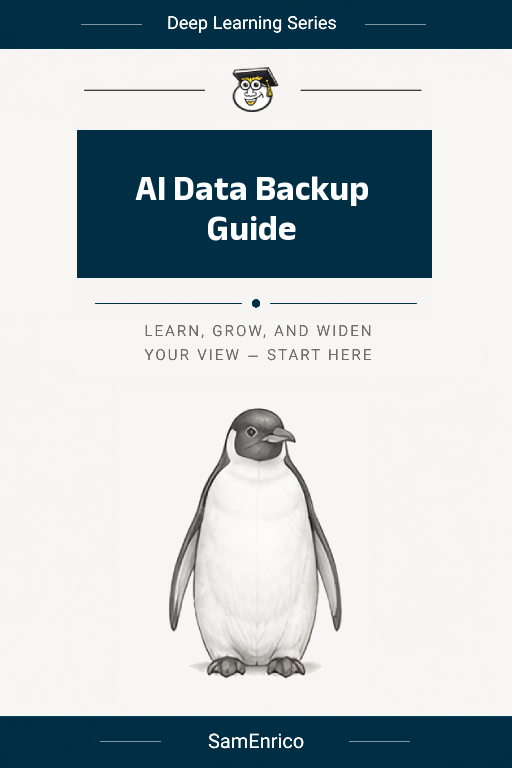
Non-FictionAnnual CheckupBackup AI
AI Data Backup Guide eBook
Use Backblaze, Carbonite, or IDrive AI to automate
by Barbour Ozie
Use Backblaze, Carbonite, or IDrive AI to automate business data backups.
Formats
Free sample
Chapter 1: The Midnight Illusion--The average business leader believes their data is safe because the backup runs every night at 1:00 AM. That belief is a dangerous illusion, and it has already bankrupted thousands of companies who discovered too late that the "nightly backup" is a relic of a slower, less hostile era. This chapter dismantles that illusion not with theory, but with hard numbers, real-world failure case studies, and a fundamental rethinking of what "protected" actually means in a 24/7 global economy. By the time you finish reading, the idea of waiting twelve hours between backups will seem as absurd as locking your doors only after the burglary has begun.The Myth of the Safe Overnight Window The nightly backup schedule made sense in the 1990s. Businesses operated on a 9-to-5 rhythm.
Data changed during working hours, then the office went quiet, and servers had an eight-hour window to copy everything to tape or a secondary drive. The assumption was simple: nothing important changed between 6 PM and 6 AM. That assumption has not merely aged poorly—it has become actively dangerous.Today, a business's "work day" never ends. A customer in Singapore places an order at 2 AM Eastern Time. A remote employee in California edits a contract at 11 PM.
A database replication runs at 3 AM across three continents. The cloud never sleeps, and neither does your data. Yet the majority of small and medium businesses still configure their backup software to initiate exactly once per day, often during a brief window between 1 AM and 4 AM. This creates what disaster recovery professionals call the vulnerability gap—the hours between the last successful backup and the moment of failure.Consider a typical mid-sized accounting firm with forty employees. Their primary file server holds client tax returns, financial statements, and payroll records.
They run a full backup nightly at 2 AM. On a busy Tuesday, a partner works late, updating five major client files between 9 PM and midnight. At 10:30 AM the next morning, a storage controller fails catastrophically. The recovery restores from the 2 AM backup. Every change made after that moment—including the partner's five hours of late-night work—is gone.
The firm's Recovery Point Objective (RPO), defined in the Introduction, was effectively twelve hours, but they believed it was zero.The problem is not laziness or incompetence. The problem is that traditional backup software was designed for a world where data creation happened in predictable bursts. Modern data creation is continuous, asynchronous, and often invisible. Emails sync across devices without user action. CRM systems auto-save every keystroke.
Collaboration platforms update files in real time. Your data changes constantly. Your backup frequency must match that cadence, or your RPO becomes a lie you tell yourself.The Ransomware Case That Broke Every Rule To understand why the midnight illusion is more dangerous today than ever before, we must examine a real attack that exploited this exact vulnerability. In early 2023, a mid-sized law firm in Chicago—let us call them Grayson & Associates—experienced a ransomware event that their insurance carrier later described as "textbook in its devastating simplicity."Grayson had what most IT professionals would consider a reasonable backup strategy. They used a reputable cloud backup service, not among the three covered in this book but architecturally similar to Carbonite's server product.
They performed daily backups at 1:00 AM. They tested restores quarterly. Their IT manager, who had fifteen years of experience, signed off on the setup as "industry standard."The attack began at 4:30 PM on a Wednesday. A partner in the litigation department received an email that appeared to be from a client, containing a link to "updated deposition schedules." The link deployed a ransomware variant that the security community later identified as Lock Bit 3.0. Unlike older ransomware that announced itself immediately, Lock Bit 3.0 includes a deliberate delay mechanism: it encrypts files at a rate of approximately 50 megabytes per minute, spreading slowly to avoid triggering anomaly detection.
By 6:00 PM, only 2% of the firm's 12 terabytes of data were encrypted. By 9:00 PM, 35% were encrypted. By 11:30 PM, the encryption reached 68%. The 1:00 AM backup ran as scheduled.Think about that sequence. The backup started at 1:00 AM, when more than half the firm's data was already encrypted.
The backup software saw modified files—because ransomware modifies files—and dutifully copied the encrypted versions over the previous clean copies. When the firm discovered the attack the next morning, their backup repository contained 68% encrypted data. Their "clean" restore point was not clean at all.The firm faced an impossible choice: pay the $850,000 ransom demand or lose nearly seven months of client work that had been overwritten during the backup window. They paid. The decryptor worked partially.
They lost four months of data anyway. They closed their doors nine months later.This case is not an outlier. The FBI's Internet Crime Complaint Center documented over 2,800 ransomware complaints in 2023 involving backup corruption, with average losses exceeding $2.3 million per incident. The common thread in nearly all of these cases is not weak encryption or poor security posture—it is that the backup itself became the vector for permanent data loss. When ransomware strikes during the hours before a scheduled backup, that backup becomes a weapon against you.Continuous Data Protection Versus the Clock The solution to the midnight illusion is not simply running backups more often.
Running a full backup every hour would solve the RPO problem but create a new catastrophe: your servers would spend all day backing up instead of doing productive work. The answer lies in understanding the difference between two fundamentally different backup paradigms: Continuous Data Protection and AI-driven snapshot logic.Continuous Data Protection (CDP) is the theoretical gold standard. True CDP, as implemented by IDrive (see Chapter 2 for architectural details), logs every byte change as it happens. When you modify a file, the backup agent records that change immediately—not at the next scheduled interval, but at the moment of modification. The change is written to a journal, and the backup system captures it before your finger even leaves the keyboard.
In a true CDP environment, your RPO is measured in seconds, not hours.The technical implementation is demanding. True CDP requires a kernel-level driver that intercepts write operations to the file system. Each write operation is captured, compressed, and queued for transmission. This is why IDrive uses a kernel driver while Backblaze and Carbonite take different approaches. The advantage is obvious: if ransomware begins encrypting at 4:30 PM, true CDP will capture every encrypted version and still retain the pre-encryption versions because each version is tracked as a separate change.
Recovery becomes a matter of rolling back to the last clean journal entry.AI-driven snapshot logic, used by Backblaze and Carbonite (and described in depth in Chapter 2), takes a different approach. Instead of capturing every single byte change, the AI agent monitors change patterns and decides when a change is "significant enough" to trigger a backup. For example, if a user types a single character in a 10-megabyte Word document, the AI may defer that change until the file is closed or until the volume of changes reaches a threshold. But if the same file suddenly shows 90% of its blocks changed within 60 seconds—a signature of encryption—the AI triggers an immediate backup of…
This is the end of the free sample. Get the eBook to keep going. Buy now
About this book
Details
- Author
- Barbour Ozie
- Publisher
- SamEnrico
- Language
- English
- Genre
- Non-Fiction, Annual Checkup, Backup AI
- Released
- 2026-05-29
- Pages (approx.)
- 141
- Available as
- eBook, Audiobook

Read better in the ZLOADR app
Your eBooks on your phone or tablet. Sign in with your SamEnrico account and start reading.
More by Barbour Ozie
 Loneliness During Holidays GuideBarbour Ozie$11.99
 CrossFit Rope Climb ProgressionsBarbour Ozie$11.99
 Teen Self Advocacy GuideBarbour Ozie$11.99
 Stalking Dating App Danger CasesBarbour Ozie$11.99
 Twitter Outrage Comparison TrapBarbour Ozie$11.99
 The Unlikely Alliance: How a Hip-Hop Mogul and a Conservative Senator United to Save Music EducationBarbour Ozie$11.99
 Echoes of Ice and Stone: Decoding Antarctica’s Forgotten LanguagesBarbour Ozie$11.99
 Understanding Duodenal Atresia Tetralogy of FallotBarbour Ozie$17.99
 Cinematic LightingBarbour Ozie$11.99
 Retail Union Collective BargainingBarbour Ozie$12.99
 How to Become a Carpet SewerBarbour Ozie$11.99
You may also like
 Hong Kong Handover 1997Dunn Johnnie$11.99
 Zumba For Postnatal Recovery CourseNeal Christian$11.99
 Zumba for BeginnersLadner Nikia$11.99
 YouTube Comment Mining GuideHumes Pandora$12.99
 Worry Box MeditationCarlin Rudy$11.99
 Workplace Stress MeditationNguyen Lynn$11.99
 Workplace Stress and Sleep RepairHawley Ivory$11.99
 Workplace Perfectionism CureDelaney Jeffry$11.99
 Workplace Injustice Anger GuideWallen Isabelle$11.99
 Work Addiction and Burnout LinkGreenwood Ester$11.99
 Women in Yoga and WellnessBeattie Galina$11.99
 Women in Stand Up ComedyChun Evangeline$11.99