
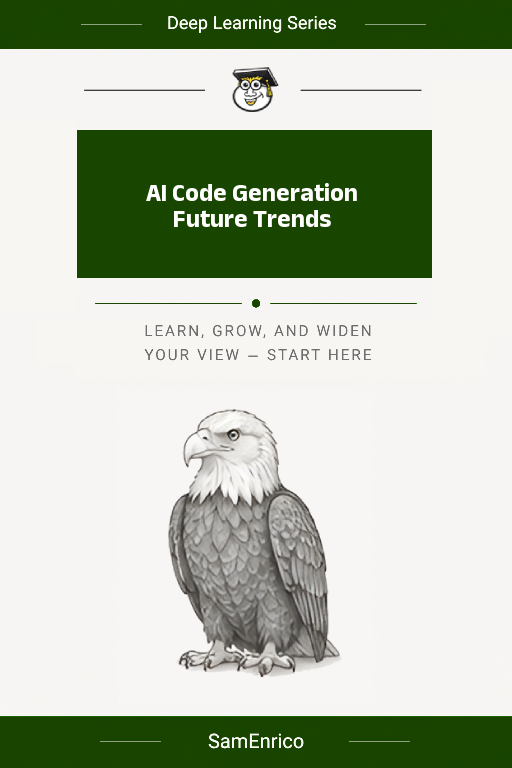
AI Code Generation Future Trends eBook
Prepare for autonomous coding agents and agentic w
Prepare for autonomous coding agents and agentic workflows coming in 2026.
Formats
Free sample
Chapter 1: The Orchestration Shift...--–- The morning of June 15, 2025, started like any other for Elena Vasquez, a senior engineering manager at a mid-sized fintech company. She grabbed her coffee, scanned her email, and opened the dashboard showing her team’s deployment pipeline. What she saw stopped her cold. At 3:14 AM, an autonomous coding agent she had configured the previous week had detected a memory leak in the payment processing service. Without human intervention, the agent had written a fix, generated twelve unit tests, run them against a staging environment, opened a pull request, and—because she had set the approval threshold to “high confidence only”—merged the change and deployed it to production.
The entire cycle took forty-seven minutes. Elena had slept through it. The agent had fixed a bug she didn’t know existed, deployed code she hadn’t reviewed, and the only sign of trouble was a single green checkmark on her dashboard.Her first reaction was terror. Her second was curiosity. Her third, after she read the agent’s detailed log of every reasoning step, was a quiet realization: My job just changed forever.This is the story of that change.
This is not a book about artificial intelligence theory, neural network architectures, or the philosophical nature of consciousness. This is a book about what happens when software development—the craft you have spent years or decades mastering—becomes fundamentally, irrevocably, and immediately different. The tools you used last year are already outdated. The workflows you optimized last quarter are already inefficient. The skills that made you a senior developer are still valuable, but not in the way you think.
By early 2026, the question will not be whether you use autonomous coding agents. The question will be whether you know how to orchestrate them.The Post-Assistant Era Let us name the era we are leaving behind. From roughly 2023 through late 2025, software developers lived in the Age of the Assistant. Git Hub Copilot, Chat GPT, Claude, and their competitors offered autocomplete on steroids. You could type a comment, and the assistant would suggest a function.
You could paste an error message, and the assistant would explain the bug. You could have a conversation about architecture, and the assistant would offer reasonable opinions. These tools were genuinely useful. They saved keystrokes. They reduced context switching.
They made junior developers feel like seniors and seniors feel like superheroes.But assistants have a hard ceiling. They wait for you to ask. They have no memory of yesterday’s conversation. They cannot execute code, run tests, or interact with your infrastructure. They are, for all their sophistication, fancy autocomplete with a chat interface.
And in 2026, that ceiling will shatter.The Age of the Agent is already beginning. An agent is not an assistant. An agent does not wait. An agent plans, acts, verifies, and corrects. An agent has persistent memory across sessions.
An agent can use tools—APIs, databases, terminals, file systems—without a human holding its hand. An agent can reflect on its own work, notice mistakes, and try a different approach. An agent, in short, does not help you code. An agent codes for you.This distinction is not semantic. It is the difference between a calculator and a mathematician.
A calculator assists with arithmetic; a mathematician designs the solution strategy. An assistant helps you write code; an agent writes code to achieve a goal you specify. The shift from assistance to agency is the most significant change in software engineering since the adoption of version control, possibly since the invention of the high-level programming language itself.Defining the Agent (Once, Clearly)Before we go any further, we need a definition that we will use consistently throughout this book. Because if every chapter means something different by “agent,” we will talk past each other. And because the tech industry loves to rebrand simple automation as “agentic AI,” we need a standard that separates true agents from mere scripts wearing a fancy label.In this book, an agent is a software system that possesses all four of the following capabilities:Autonomous decision-making.
The system can choose its own sequence of actions to achieve a goal, without step-by-step human direction. If a human must approve every action, it is not an agent. If the system follows a fixed script with no branching, it is not an agent.Tool use. The system can invoke external tools—APIs, databases, command-line interfaces, file systems, web browsers—and incorporate the results into its reasoning. If it can only generate text, it is not an agent.Persistent memory.
The system retains information across steps within a task and across separate tasks. It remembers what it has tried, what worked, what failed, and what it learned. If it starts each conversation with no memory of previous conversations, it is not an agent.Reflection and self-correction. The system can evaluate its own outputs, detect errors or suboptimal choices, and try a different approach. If it produces a single answer and stops, regardless of quality, it is not an agent.If a system lacks any of these four, we will call it a “script,” an “automation,” or an “assistant”—but not an agent.
This definition is intentionally strict. It excludes most of what vendors currently call “AI agents.” It also gives us a target to aim for when building our own agentic workflows.The Vibe Coding Interlude (What Worked, What Didn’t)To understand where we are going, we need to understand where we have been. Between roughly early 2024 and late 2025, a practice emerged that came to be called “vibe coding.” The name was semi-ironic, semi-accurate. Vibe coding meant sitting with an AI assistant, often a large language model like GPT-4 or Claude 3.5, and generating code through rapid iteration. You would type a prompt, the assistant would generate a function.
You would run it, see an error, paste the error back, the assistant would fix it. You would develop a rhythm, a “vibe,” a conversational flow that produced working code faster than writing it by hand.Vibe coding had genuine strengths. It lowered the barrier to prototyping. It made exploratory programming feel playful rather than tedious. It allowed developers to focus on behavior and outcomes rather than syntax and boilerplate.
Many successful products in 2024 and 2025 were built, at least partially, through vibe coding.But vibe coding had fatal weaknesses. First, it lacked memory. Each conversation started fresh. If you fixed a bug in one session and then started a new session a week later, the assistant had no idea. You had to re-explain, re-prompt, and re-discover solutions you had already found.
Second, it lacked tool use. The assistant could generate code but could not run it, test it, or deploy it. You were still the executor, still the integrator, still the deployer. Third, it lacked autonomous verification. The assistant would happily generate code that looked correct but had subtle errors—race conditions, security holes, performance cliffs—because it never had to watch that code run in production.Vibe coding was a necessary precursor.
It taught a generation of developers to trust AI outputs enough to delegate. It demonstrated that “intent over syntax” could work, at least for small tasks.…
This is the end of the free sample. Get the eBook to keep going. Buy now
About this book
Details
- Author
- Stjohn Deshawn
- Publisher
- SamEnrico
- Language
- English
- Genre
- Non-Fiction, AI Operator
- Released
- 2026-05-26
- Pages (approx.)
- 152
- Available as
- eBook, Audiobook

Read better in the ZLOADR app
Your eBooks on your phone or tablet. Sign in with your SamEnrico account and start reading.
More by Stjohn Deshawn
 Benzo Information for DoctorsStjohn Deshawn$11.99
 John Wayne Gacy's ChildhoodStjohn Deshawn$11.99
 LTC Insurance And Estate PlanningStjohn Deshawn$11.99
 Breath Awareness for Postpartum RecoveryStjohn Deshawn$11.99
 Affirmations For Betrayal RecoveryStjohn Deshawn$11.99
 Religious Extremist ChildhoodStjohn Deshawn$11.99
 FCPA Technology Sector CasesStjohn Deshawn$11.99
 Overcoming Love AddictionStjohn Deshawn$11.99
 Zero Day Exploit TrendsStjohn Deshawn$12.99
 TM For AthletesStjohn Deshawn$11.99
 The Phantom Pain: The Enigma of the 1951 Pont-Saint-Esprit Mass HysteriaStjohn Deshawn$11.99
 The Habsburg Codex: Vienna’s Secret RenaissanceStjohn Deshawn$11.99
You may also like
 Hong Kong Handover 1997Dunn Johnnie$11.99
 Zumba For Postnatal Recovery CourseNeal Christian$11.99
 Zumba for BeginnersLadner Nikia$11.99
 YouTube Comment Mining GuideHumes Pandora$12.99
 Worry Box MeditationCarlin Rudy$11.99
 Workplace Stress MeditationNguyen Lynn$11.99
 Workplace Stress and Sleep RepairHawley Ivory$11.99
 Workplace Perfectionism CureDelaney Jeffry$11.99
 Workplace Injustice Anger GuideWallen Isabelle$11.99
 Work Addiction and Burnout LinkGreenwood Ester$11.99
 Women in Yoga and WellnessBeattie Galina$11.99
 Women in Stand Up ComedyChun Evangeline$11.99