
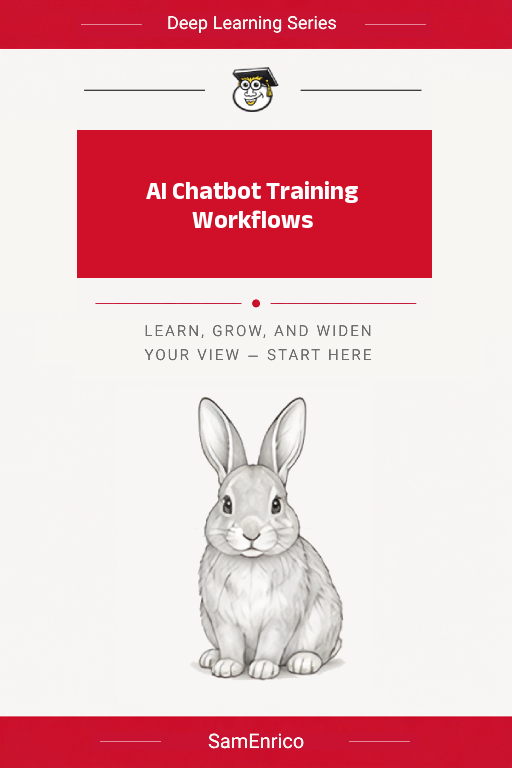
Non-FictionAI OperatorSupport Operations
AI Chatbot Training Workflows eBook
Train AI agents on knowledge bases, FAQs, and past
Train AI agents on knowledge bases, FAQs, and past conversations. Improve accuracy and reduce hallucinations.
Formats
Free sample
Chapter 1: The 95% Lie--–- On a Tuesday morning in May 2023, two attorneys sat in a federal courtroom in Manhattan watching their careers implode in real time. The judge, already skeptical of their filing, had just asked a simple question: "Can you please provide the full text of the cases you've cited?" The attorneys could not. Because the cases did not exist. They had been generated by Chat GPT, which had invented plausible-sounding case law with fake citations, fake docket numbers, and fake judicial opinions. The $5 million malpractice lawsuit that followed was not about AI.
It was about a much older failure: the belief that a powerful tool can replace disciplined process.This chapter is about why that belief is catastrophic, and why you are probably holding it right now without realizing it.The Gap Between Demo and Production Every week, somewhere in the world, a product manager watches a demo of a new chatbot and feels a thrill. The model answers complex questions. It summarizes documents. It sounds almost human. The product manager thinks: We can deploy this by Friday.And then they try.The chatbot that answered every demo question perfectly suddenly cannot remember the company's return policy.
It invents product features that do not exist. It tells a customer that their account has been deleted when the account is perfectly fine. The product manager is confused. Nothing changed. The model is the same.
The data is the same. So why is the production system failing?The answer is not in the model. The answer is in the difference between controlled conditions and reality. A demo is a curated performance. Production is a firefight.In a demo, you ask predictable questions.
In production, users ask things no one anticipated. In a demo, the context is clean. In production, the model must navigate conflicting information, ambiguous phrasing, and missing data. In a demo, failure is embarrassing. In production, failure costs money, trust, and sometimes legal standing.This book exists because that gap is not inevitable.
It is the result of missing workflows—systematic, repeatable processes for training, grounding, and maintaining AI agents. Without these workflows, even the most advanced model will hallucinate. With them, even a modest model can be reliable.The Statistics Everyone Misquotes (And Why It Matters)You have probably heard the statistic: 95% of AI pilots fail. You have probably heard it attributed to MIT Sloan. Neither the number nor the attribution is quite right, and understanding the nuance is essential for understanding the real problem.Here is what the research actually says.Gartner has tracked AI project failures for years.
Across all types of AI—traditional machine learning, computer vision, predictive analytics—approximately 85% of projects fail to deliver return on investment. That number includes projects that never launch, projects that launch but do not achieve their goals, and projects that are abandoned mid-way.In 2024, MIT Sloan published a more specific study focused on generative AI. They found that among enterprises that built pilots using LLMs, 95% of those pilots never made it to production at scale. The models worked in controlled tests. They answered the carefully crafted evaluation questions correctly.
But when deployed to real users with real confusion and real edge cases, the systems broke.Let us be precise about what this means. A "pilot" in this context is a working prototype—something that answers questions correctly on a test set. A "production system" is something real customers use, with real consequences. The gap between these two states is where careers go to die.The most important detail is not the number itself. It is the cause.
The MIT Sloan researchers did not find that the models were incapable. They found that organizations were unprepared. The failures were not technical. They were procedural.This changes everything. If the problem were the models, you would wait for better models.
But the problem is the process. Which means you can fix it starting today, with the models you already have.The $5 Million Hallucination: A Case Study in Process Failure The Manhattan attorneys did not set out to commit fraud. They were overworked. They were behind on a filing deadline. And they made a decision that seemed reasonable at the time: they asked Chat GPT to help find relevant case law.Chat GPT generated six cases.
Every one of them was fake. The case names sounded real. The citations followed the correct format. The summaries were plausible. But the cases did not exist.When the opposing counsel tried to locate the cases, they found nothing.
When the judge demanded explanations, the attorneys could not provide them. The sanctions included a $5,000 fine, but the real cost was much higher. Both attorneys faced disciplinary proceedings. Their reputations were destroyed. The law firm was embarrassed publicly.
And the entire legal profession began a painful conversation about AI that continues today.Here is what most people miss about this story. The problem was not that Chat GPT hallucinated. LLMs hallucinate. That is what they do. The problem was that no one had built a workflow to catch the hallucination before it caused harm.Ask yourself: what would a basic workflow have looked like?
A simple rule: "Never trust AI-generated citations without verification." A simple tool: a script that checks each citation against a legal database. A simple process: a second person reviews every AI-assisted filing before submission.None of these existed. The attorneys treated Chat GPT as an oracle rather than a probabilistic assistant. And they paid the price.This pattern repeats across every industry. A marketing team uses an LLM to write product descriptions.
The model invents a feature that sounds compelling but does not exist. The description goes live. Customers buy the product based on the fake feature. Chaos follows. A customer support team deploys a chatbot.
The chatbot tells a customer that their account has been credited $500 for the inconvenience. The credit does not exist. The customer calls angrily. The support team has no idea what happened.In every case, the model is not malicious. It is not even particularly wrong from its own perspective.
It is simply doing what LLMs do: generating the most probable sequence of tokens given the prompt. When the prompt is vague or the knowledge is missing, the most probable sequence might be a fiction.The only defense is a workflow.The Reliability Maturity Model: Where Are You Now?Before you can build better workflows, you need to know where you stand. The Reliability Maturity Model has five levels. Read each description honestly and place your organization.Level 1: Ad-hoc Prompting At this level, there is no formal process. Someone—usually an engineer or a product manager—opens a chat interface and starts typing prompts.
When the prompt works, they copy it into production. When it fails, they tweak it and try again. There is no version control. There are no test cases. There is no monitoring.
Deployment decisions are made based on vibes.Organizations at Level 1 are the most common and the most dangerous. They are also the most likely to experience a public failure. They treat LLMs like magic, and magic eventually fails.Signs you are at Level 1: You have ever said "It worked in…
This is the end of the free sample. Get the eBook to keep going. Buy now
About this book
Details
- Author
- Hurley Anastacia
- Publisher
- SamEnrico
- Language
- English
- Genre
- Non-Fiction, AI Operator, Support Operations
- Released
- 2026-05-29
- Pages (approx.)
- 122
- Available as
- eBook, Audiobook

Read better in the ZLOADR app
Your eBooks on your phone or tablet. Sign in with your SamEnrico account and start reading.
More by Hurley Anastacia
 Family Guide To MATHurley Anastacia$11.99
 Listening In Noisy EnvironmentsHurley Anastacia$11.99
 Gratitude Spending AlternativeHurley Anastacia$11.99
 Benzo Tearfulness ManagementHurley Anastacia$11.99
 The Fur Trade Kings: Canada’s Pathfinders of Commerce and EmpireHurley Anastacia$11.99
 Learn to Play the GarkleinHurley Anastacia$11.99
 Cymophane (Variety of Chrysoberyl) MiningHurley Anastacia$11.99
 How to Start a Netting Made of Plastic (not Woven or Knotted) Business (Beginners Guide)Hurley Anastacia$11.99
You may also like
 Hong Kong Handover 1997Dunn Johnnie$11.99
 Zumba For Postnatal Recovery CourseNeal Christian$11.99
 Zumba for BeginnersLadner Nikia$11.99
 YouTube Comment Mining GuideHumes Pandora$12.99
 Worry Box MeditationCarlin Rudy$11.99
 Workplace Stress MeditationNguyen Lynn$11.99
 Workplace Stress and Sleep RepairHawley Ivory$11.99
 Workplace Perfectionism CureDelaney Jeffry$11.99
 Workplace Injustice Anger GuideWallen Isabelle$11.99
 Work Addiction and Burnout LinkGreenwood Ester$11.99
 Women in Yoga and WellnessBeattie Galina$11.99
 Women in Stand Up ComedyChun Evangeline$11.99