
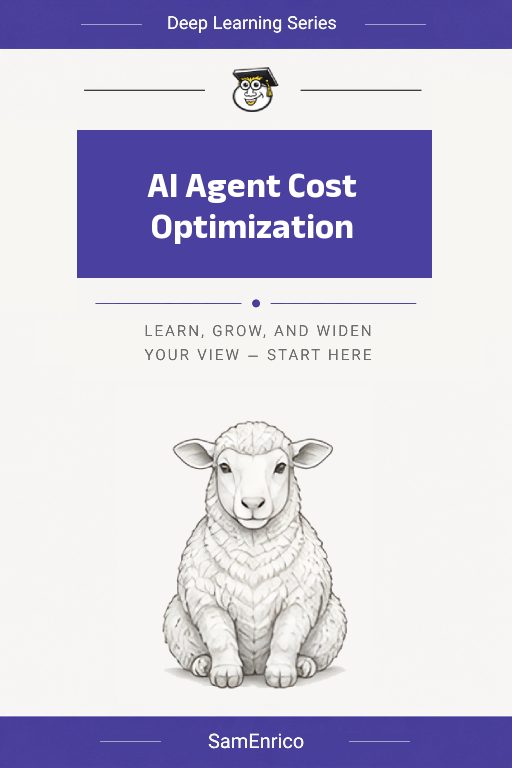
Non-FictionAI OperatorSupport Operations
AI Agent Cost Optimization eBook
Measure cost savings from AI agents. Calculate def
by Crain Carie
Measure cost savings from AI agents. Calculate deflection rates, reduced handle times, and staffing savings.
Formats
Free sample
Chapter 1: The $47M Blind Spot...--The email arrived at 6:47 PM on a Tuesday. Maya Chen, CFO of Logi Corp, had been in back-to-back meetings since 8 AM. She was tired, hungry, and not in the mood for surprises. The subject line read: “Q4 Support Cost Review – Urgent.”She opened it. Her stomach dropped.Logi Corp’s customer support costs had risen 34% year over year.
Not because volume had increased—it had actually gone down by 8%. Not because wages had spiked—those were up a standard 3%. The culprit was something far more insidious: exception handling.Every time a customer asked something slightly outside the script. Every time an agent had to toggle between five different systems to find an answer. Every time a ticket was escalated from Tier 1 to Tier 2 to Tier 3.
Each of these moments cost money. And collectively, they had eaten $47 million of Logi Corp’s operating budget.Maya had approved an “AI chatbot” project two years ago. The vendor promised 40% cost reduction. The chatbot launched. Six months later, costs were higher than before.
The chatbot could answer “What’s my order status?” but failed on anything remotely complex. Customers learned to type “speak to agent” immediately. The project was quietly shelved.Now her board was asking hard questions. Her CTO was proposing a new “agentic AI” solution at $5 million. And Maya had no framework to evaluate whether this would be any different from the last failure.This book is written for Maya.
For every CFO, COO, and CIO who has been burned by automation hype and needs a rigorous, finance-grade methodology to measure, capture, and optimize cost savings from AI agents. If you cannot put a dollar figure on every decision an AI agent makes, you should not deploy it. That is the core premise of this book.The Failure of First-Generation Automation To understand why agentic AI is different, we must first understand why traditional automation failed to deliver on its cost-saving promises. The past decade saw billions of dollars invested in chatbots, robotic process automation (RPA), and rules-based workflow tools. Yet most organizations saw flat or rising operational costs.
Why?The Linear Scaling Problem Traditional automation operates on a linear cost model. You have a certain volume of tickets, requests, or workflows. Each one requires a certain amount of human time. To handle more volume, you add more humans. Automation tools, at best, reduce the time per ticket by a fixed percentage.
But they do not change the fundamental relationship between volume and cost.Consider a customer support center handling 100,000 tickets per month. Each ticket averages 8 minutes of agent time at a fully loaded cost of 1perminute.Totalmonthlycost:1 per minute. Total monthly cost: 1perminute.Totalmonthlycost:800,000. A chatbot that handles 30% of tickets reduces the load to 70,000 human-handled tickets. Monthly cost: $560,000.
A 30% reduction is real savings.But here is the problem that vendors do not tell you. That 30% deflection only works for the simplest, most repetitive tickets—the ones that were already cheap to handle. The remaining 70% are the complex, variable, exception-heavy tickets that consume 90% of agent time. You have saved a little on the easy stuff while the hard stuff continues to bleed cash.The Exception Paradox Rules-based systems break on exceptions. Every “if this, then that” statement has an implicit “else” that requires human judgment.
In any moderately complex workflow, exceptions are not rare—they are the norm.Take IT support. A simple rule: “If user requests password reset, send email with reset link.” That works for 80% of requests. But what about the user who is locked out of their email and cannot receive the reset link? Or the user whose account is managed by a corporate directory that overrides the reset? Or the user who needs access within 10 minutes for an urgent client presentation?
Each exception requires a human to diagnose, escalate, and resolve.The cost of an exception is not the 2 minutes it takes to handle. It is the cumulative cost of finding the right human, toggling between systems, researching the issue, and then potentially escalating again. Most organizations underestimate exception costs by a factor of 3 to 5x.The Swivel Chair Tax We will dedicate significant attention to this concept in Chapter 2, but it deserves mention here. The average knowledge worker toggles between five or more systems to resolve a single ticket. CRM, ticketing system, knowledge base, ERP, email, Slack, internal wikis, monitoring dashboards—the list grows with every new tool.Each toggle costs 15-30 seconds of context switching.
Multiply that by 10 toggles per ticket, 100,000 tickets per month, and you are losing thousands of hours to pure friction. Traditional automation does not solve this. It often makes it worse by adding another system (the chatbot portal) to the toggle list.The Vanity Metric Trap Vendors love to report deflection rates. “Our chatbot deflected 65% of tickets!” they proclaim. But deflection alone is meaningless without measuring what was deflected and at what cost.A 65% deflection rate on 100,000 tickets means 65,000 tickets never reached a human.
Impressive. But if those 65,000 tickets were the 30-second “What’s my balance?” inquiries that cost 0.50eachtohandle,thesavingsareminimal.Meanwhile,the35,000escalatedticketsarethe20−minute“Myaccountislockedand Ihaveadeadline”emergenciesthatcost0.50 each to handle, the savings are minimal. Meanwhile, the 35,000 escalated tickets are the 20-minute “My account is locked and I have a deadline” emergencies that cost 0.50eachtohandle,thesavingsareminimal.Meanwhile,the35,000escalatedticketsarethe20−minute“Myaccountislockedand Ihaveadeadline”emergenciesthatcost20 each. The total cost before deflection: (65,000 × 0.50)+(35,000×0.50) + (35,000 × 0.50)+(35,000×20) = 32,500+32,500 + 32,500+700,000 = 732,500.Afterdeflection:35,000×732,500. After deflection: 35,000 × 732,500.Afterdeflection:35,000×20 = 700,000.Savings:700,000.
Savings: 700,000.Savings:32,500, or just 4.4%.The vendor reports 65% deflection. The CFO sees 4% savings. This is the vanity metric trap.Enter Agentic AI: A Different Economic Model Agentic AI represents a fundamental shift in how we think about automation. Instead of following fixed rules, an agentic system has a goal and the ability to choose actions to achieve that goal. It can use tools, access multiple systems, remember context, and adapt to novel situations.The Agentic Cost Curve The most important concept in this book is the Agentic Cost Curve.
Unlike human labor, which scales linearly (double the volume, double the cost), and rules-based automation, which scales with diminishing returns (you automate the easy 80% and the remaining 20% costs as much as the first 80%), agentic systems exhibit sub-linear cost growth.A single agentic system can handle 10 times the volume at roughly 2 times the cost. Why? Because the marginal cost of an additional transaction approaches zero once the agent is built. The agent does not get tired. It does not need training on new edge cases—it learns from each interaction.
It does not take vacation or require benefits.Consider a logistics company tracking 1 million shipments per day. A human team of 50 agents can handle status inquiries, each taking 2 minutes, at a cost of 100perhourfullyloaded.Dailycost:50agents×8hours×100 per hour fully loaded. Daily cost: 50 agents × 8 hours × 100perhourfullyloaded.Dailycost:50agents×8hours×100 = 40,000.Anagenticsystemthatqueriesthetracking API,interpretsexceptions,andcomposesresponsescosts40,000. An agentic system that queries the tracking API, interprets exceptions, and composes responses costs 40,000.Anagenticsystemthatqueriesthetracking API,interpretsexceptions,andcomposesresponsescosts5,000 per month to run—about $167 per day. That is a 99.6% cost reduction.But the real power is in the shape of the curve.
As volume doubles to 2 million shipments, the human team must double to 100 agents at 80,000perday.Theagenticsystemmightneedafewmoreservers,costing80,000 per day. The agentic system might need a few more servers, costing 80,000perday.Theagenticsystemmightneedafewmoreservers,costing6,000 per month…
This is the end of the free sample. Get the eBook to keep going. Buy now
About this book
Details
- Author
- Crain Carie
- Publisher
- SamEnrico
- Language
- English
- Genre
- Non-Fiction, AI Operator, Support Operations
- Released
- 2026-05-29
- Pages (approx.)
- 140
- Available as
- eBook, Audiobook

Read better in the ZLOADR app
Your eBooks on your phone or tablet. Sign in with your SamEnrico account and start reading.
More by Crain Carie
 Listening For Performance ReviewsCrain Carie$11.99
 Shopping Blackout PeriodsCrain Carie$11.99
 MAT Court Program GuideCrain Carie$11.99
 Benzo Taper Success StoriesCrain Carie$11.99
 From the Streets to the Stadium: The Rise of Middle Eastern Football LegendsCrain Carie$11.99
 Learn to Play the Subcontra BassCrain Carie$11.99
 Design SpecialistCrain Carie$11.99
 How to Become a LoaderCrain Carie$11.99
You may also like
 Hong Kong Handover 1997Dunn Johnnie$11.99
 Zumba For Postnatal Recovery CourseNeal Christian$11.99
 Zumba for BeginnersLadner Nikia$11.99
 YouTube Comment Mining GuideHumes Pandora$12.99
 Worry Box MeditationCarlin Rudy$11.99
 Workplace Stress MeditationNguyen Lynn$11.99
 Workplace Stress and Sleep RepairHawley Ivory$11.99
 Workplace Perfectionism CureDelaney Jeffry$11.99
 Workplace Injustice Anger GuideWallen Isabelle$11.99
 Work Addiction and Burnout LinkGreenwood Ester$11.99
 Women in Yoga and WellnessBeattie Galina$11.99
 Women in Stand Up ComedyChun Evangeline$11.99