
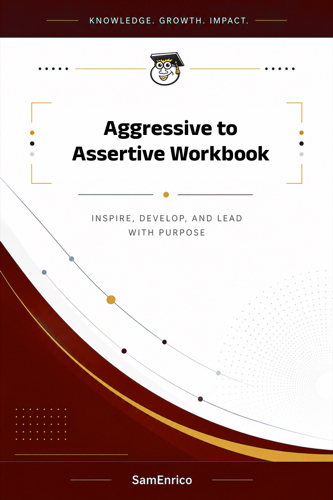
Non-FictionSelf-HelpAnger Management
Aggressive to Assertive Workbook eBook
Replace yelling and blaming with calm, direct comm
by Stern Cythia
Replace yelling and blaming with calm, direct communication that invites dialogue.
Formats
Free sample
Chapter 1: The Blame Monster Audit--–- You just lost your temper again. Maybe it was this morning, maybe last night. The dishes were left out, or a deadline slipped, or someone asked you a question you’d already answered twice. And then it happened. Your voice rose.
Your jaw tightened. Words came out that you regretted before the sentence even finished. Now there’s silence. Or tears. Or a door slam.
And underneath all of it, a familiar, sick feeling: There I go again. What is wrong with me?Nothing is wrong with you. You are not a “yeller.” You are not “an angry person.” You are a human being whose brain has learned a fast, dangerous shortcut from trigger to explosion. This chapter is not about shaming that pattern. It is about mapping it.
Because you cannot change what you cannot see.Every bestselling book on assertiveness, from Nonviolent Communication to Crucial Conversations, begins with the same counterintuitive step: do not try to be calmer yet. First, become a detective of your own aggression. Most people skip this part. They want the script, the technique, the magic phrase that will make their partner listen or their coworker back off. But without a clear audit of what you actually do, when you do it, and what sets you off, those scripts become hollow words that your own nervous system will override the second you feel threatened.This chapter is your aggression audit.
By the end, you will have named your dominant aggressive style, logged seven days of real-world triggers, and begun to see the predictable architecture of your blow-ups. You will also take the first step of the CALM method introduced in this book’s preface: C – Catch the trigger. You cannot anchor your body (Chapter 2), lead with curiosity (Chapter 3), or make a clear request (Chapter 4) if you do not even notice you are being triggered. This chapter teaches you to notice before you explode. Not to stop the explosion yet.
Just to see it coming.Let us begin with a question that most aggression workbooks are afraid to ask: What do you actually get from yelling?The Hidden Payoff of Aggression (And Why You Keep Doing It)Aggression works in the short term. That is why it is so addictive. When you yell, three things happen almost instantly:The other person stops. They freeze, go silent, or back down. This feels like victory.Your adrenaline spikes.
That rush is physiologically similar to a stimulant. It feels powerful.The problem seems solved. Because the conflict ends, your brain registers “yelling = solution.”But here is what your brain does not register in the moment: the other person did not stop because they agreed with you. They stopped because their nervous system went into fight, flight, freeze, or fawn. That silence is not consent.
That backing down is not understanding. That is survival behavior. And over time, survival behavior turns into resentment, withdrawal, or eventual explosion from the other side.The top ten assertiveness books agree on one hidden dynamic: aggression trades short-term relief for long-term trust. You get five seconds of release. You pay back five months of relational damage.
The math never works in your favor.But because the payoff is immediate and the cost is delayed, your brain keeps choosing aggression. This is not a character flaw. It is a classic reinforcement schedule. The same mechanism that keeps people playing slot machines keeps you yelling: intermittent, unpredictable rewards. Sometimes yelling works fast.
Sometimes it does nothing. That unpredictability makes it more addictive, not less.So let us hold two truths at once. You are not bad for having learned this pattern. And you are ready to replace it with something that works better, not just faster.The Four Communication Styles: A Clear Grid Before you can identify your aggressive patterns, you need a map of the full landscape. Every major assertiveness model uses some version of this four-quadrant grid.
Read each description carefully. Most people have a primary style and a backup style when stressed.Passive (The Silencer)Behavior: You stay quiet to keep the peace. You say “it’s fine” when it is not. You avoid conflict at all costs. You apologize for having needs.Internal experience: Resentment builds silently.
You feel invisible. You later explode over something small because the pressure had nowhere else to go.Typical phrases: “Never mind.” “It doesn’t matter.” “Whatever you want.” “I guess I’ll just do it myself.”Cost: Your needs go unmet. Others may not even know they are hurting you.Passive-Aggressive (The Indirect Avenger)Behavior: You express anger sideways. Sarcasm. The silent treatment.
“Forgetting” to do something you were asked. Compliments that are actually insults.Internal experience: You feel justified because you did not “technically” attack anyone. But you also feel cowardly and unseen.Typical phrases: “Wow, must be nice to have that much free time.” “I’m fine.” (said through clenched teeth). “Oh, I didn’t realize you were the boss of me.”Cost: Others feel confused and manipulated. They cannot address a problem you refuse to name directly.Aggressive (The Blamer)Behavior: You attack.
Yelling, blaming, labeling, name-calling, interrupting, threatening. You win by making the other person smaller.Internal experience: A rush of power followed by shame. You often do not remember everything you said.Typical phrases: “You always…” “You never…” “What is wrong with you?” “This is your fault.” “Shut up.”Cost: Others become defensive or shut down. They stop hearing your message because they are busy protecting themselves.Assertive (The Clear Speaker)Behavior: You state your needs directly, calmly, and respectfully. You listen without interrupting.
You hold your ground without attacking.Internal experience: Nervous at first, then grounded. You do not feel the adrenaline spike of aggression or the resentment of passivity.Typical phrases: “I feel frustrated when the dishes are left out. Would you be willing to rinse them before bed?” “I need ten minutes to finish this, then I can help you.” “I see this differently. Here is my view.”Cost (minimal): Some people may be surprised by your directness if they are used to your aggression or passivity. That discomfort fades.The goal of this book is not to become passive.
That is a common fear: “If I stop yelling, I’ll get walked all over.” Assertiveness is not the absence of aggression. It is the presence of clear, respectful strength. You can say “no” firmly without saying it loudly. You can hold a boundary without burning the relationship down.The Four Aggressive Styles: Which One Is You?Not all aggression looks the same. Based on clinical models from The Anger Management Workbook and When I Say No, I Feel Guilty, aggressive communicators tend to fall into four distinct profiles.
You may recognize yourself in one primarily, or you may shift between them depending on the situation.1. The Blamer Signature move: Pointing the finger outward. Nothing is your fault. Every problem is someone else’s mistake, laziness, or malice.Typical language: “This is on you.” “You messed up.” “If you had just listened…” “I wouldn’t be angry if you weren’t so…”Underlying need: Often a need for control, predictability, or to avoid shame. Blaming…
This is the end of the free sample. Get the eBook to keep going. Buy now
About this book
Details
- Author
- Stern Cythia
- Publisher
- SamEnrico
- Language
- English
- Genre
- Non-Fiction, Self-Help, Anger Management
- Released
- 2026-06-06
- Pages (approx.)
- 133
- Available as
- eBook, Audiobook

Read better in the ZLOADR app
Your eBooks on your phone or tablet. Sign in with your SamEnrico account and start reading.
More by Stern Cythia
 The Ten Minute Mindfulness Habit GuideStern Cythia$11.99The Ten Minute Mindfulness Habit GuideStern Cythia$11.99
 Dental Neglect StoryStern Cythia$11.99
 The Joy of Letting GoStern Cythia$11.99
 Senior Comparison Esteem GuideStern Cythia$11.99
 The Last Song of the DodoStern Cythia$11.99
 Becoming a Child AdvocateStern Cythia$11.99
 Gross Profit Formula PrimerStern Cythia$12.99
 Nvidia SWOT Analysis Library GuideStern Cythia$12.99Nvidia SWOT Analysis Library GuideStern Cythia$12.99Nvidia SWOT Analysis Library GuideStern Cythia$12.99Nvidia SWOT Analysis Library GuideStern Cythia$12.99
You may also like
 Hong Kong Handover 1997Dunn Johnnie$11.99
 Zumba For Postnatal Recovery CourseNeal Christian$11.99
 Zumba for BeginnersLadner Nikia$11.99
 YouTube Comment Mining GuideHumes Pandora$12.99
 Worry Box MeditationCarlin Rudy$11.99
 Workplace Stress MeditationNguyen Lynn$11.99
 Workplace Stress and Sleep RepairHawley Ivory$11.99
 Workplace Perfectionism CureDelaney Jeffry$11.99
 Workplace Injustice Anger GuideWallen Isabelle$11.99
 Work Addiction and Burnout LinkGreenwood Ester$11.99
 Women in Yoga and WellnessBeattie Galina$11.99
 Women in Stand Up ComedyChun Evangeline$11.99