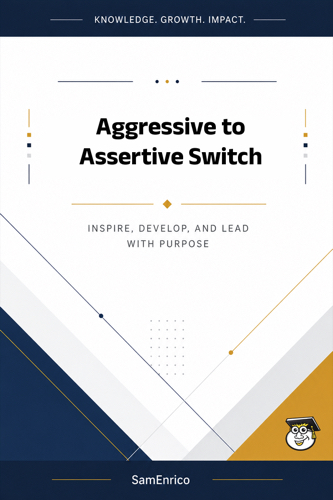
Aggressive to Assertive Switch eBook
Replace bullying language and tone with firm respe
Replace bullying language and tone with firm respectful communication.
Formats
Free sample
Chapter 1: The Hollow Win--–- The email was six sentences long. It took forty-seven seconds to write. And it cost him three years of trust.James didn't mean to become a bully. He was just right. The quarterly report was late—again—because Rachel's team had missed their deadline—again.
James had warned them twice. He had documented everything. So when he typed "I need you to explain why this keeps happening. Your team's lack of accountability is forcing the rest of us to work weekends," he felt justified. He felt honest.
He felt good.That feeling lasted about four hours.By the time James walked into the Monday morning meeting, something had shifted. Rachel sat at the far end of the table, arms crossed, eyes flat. Two other team members avoided his gaze entirely. The silence wasn't peaceful—it was armed. James opened his mouth to move the agenda forward, and Rachel cut him off.
"I think we should table this until James learns to send emails that don't attack people." Three people nodded. One of them was his own direct report.The meeting ended early. James walked back to his office alone, the echo of his own keyboard still rattling in his head. He had won the argument about the deadline. He had been factually correct.
And somehow, he had never felt more isolated.This is the paradox that opens our journey together: why do people who "win" arguments so often feel empty, disconnected, or even more angry afterward?If you are reading this book, you already know the feeling. Maybe it showed up in a work email that you regret. Maybe it exploded at your dinner table, leaving your partner or child in tears while you stood there wondering, How did we get here? Maybe it was a sarcastic comment that landed like a blade—and the silence afterward told you everything. You didn't mean to be a bully.
You were just right.But rightness is not a shield. And aggression is not strength—no matter how many arguments you "win."The Anatomy of a Hollow Victory Let us define our terms before we go any further. In this book, aggression means any communication that aims to control, punish, or diminish another person through volume, blame, sarcasm, exclusion, or intimidation. It is not about being "direct" or "honest" or "passionate." You can be all of those things without ever raising your voice or attacking someone's character. Aggression is the extra ingredient—the toxin that transforms feedback into a weapon.And here is the cruel trick: aggression feels effective in the moment.
Neuroscientists have studied what happens inside the aggressive brain during a confrontation. When you fire off an accusatory email or snap at your partner, your amygdala (the brain's ancient threat-detection center) floods your system with cortisol and adrenaline. Your heart rate spikes. Your pupils dilate. You feel alive.
And when the other person backs down, cries, or apologizes, your brain releases a small hit of dopamine—the same neurotransmitter involved in gambling and substance use.That rush is what hooks you. It is what makes aggression addictive.But here is what the addiction hides: the other person's brain is also responding. When you attack someone—whether through yelling, sarcasm, or a cold silent treatment—their amygdala activates as well. Their threat response kicks in. And when the human brain detects a threat, it does three things immediately: it stops listening, it starts defending, and it remembers.
The prefrontal cortex—the part of the brain responsible for rational problem-solving, empathy, and long-term planning—literally shuts down. Blood flow redirects away from it. The other person cannot hear you, cannot reason with you, and cannot cooperate with you. All they can do is survive.This is the neuroscientific reality of the hollow win. You get your dopamine hit.
They go into threat mode. The problem does not get solved. The relationship takes damage. And you walk away feeling right but alone.James learned this the hard way. His email triggered Rachel's threat response.
She didn't think, He has a point about the deadline. She thought, He is attacking my team. He is attacking me. I need to protect myself. Her crossed arms and flat eyes were not evidence of guilt—they were evidence of a nervous system bracing for impact.
And when she struck back in the meeting, she was not being irrational. She was returning fire.The deadline was still missed. The problem was still unsolved. And now two teams who needed to cooperate were locked in a cold war.The Seven Costs of Aggression (That No One Tells You About)We are taught, implicitly and explicitly, that aggression works. Watch any courtroom drama.
Any political debate. Any reality television show. The loudest voice "wins." The person who lands the sharpest insult gets the applause. But real life is not television, and the costs of aggression compound over time in ways that are invisible in the moment but devastating in retrospect.Cost 1: The Trust Tax Every aggressive interaction levies a small tax on trust. The first time you snap at a colleague, they might shrug it off.
The second time, they start documenting. The third time, they stop sharing information with you voluntarily. By the tenth time, they have built an entire internal firewall. They will comply with your requests—because they fear you—but they will never collaborate with you. Trust, once broken by aggression, takes three to five positive interactions to repair each single aggressive incident.
Most people never invest that repair time. They just wonder why no one trusts them anymore.Cost 2: The Influence Ceiling There is a ceiling to how much influence an aggressive person can have. Below that ceiling, you can force compliance. People will do what you say because they are afraid of the consequences. But above that ceiling—where genuine leadership, mentorship, and collaboration live—aggression cannot reach.
You cannot inspire loyalty through intimidation. You cannot mentor someone who is afraid of you. You cannot build a movement by belittling people. Aggressive people consistently hit this ceiling and mistake it for the limits of others. "No one wants to work hard anymore," they say.
When the truth is: No one wants to work hard for someone who makes them feel small.Cost 3: The Information Blackout Aggressive people are the last to know bad news. This is not a coincidence. When you punish the messenger, the messenger stops coming. Research on "organizational silence" has found that aggressive leaders are systematically shielded from negative information—not because people are hiding it maliciously, but because survival instinct kicks in. Don't tell James the project is behind.
He will explode. So James finds out when it is too late to fix, and he explodes anyway, confirming his own belief that everyone is incompetent. The information blackout is invisible to the aggressive person. They only see the results: surprise failures, missed deadlines, and a world that seems to conspire against them.Cost 4: The Relationship Erosion Aggression is sandpaper on relationships. Each interaction removes a thin layer of goodwill.
The other person starts to withdraw—not dramatically, but imperceptibly. They share less. They laugh less. They stop initiating conversations. The…
This is the end of the free sample. Get the eBook to keep going. Buy now
About this book
Details
- Author
- Beaudoin Magen
- Publisher
- SamEnrico
- Language
- English
- Genre
- Non-Fiction, Self-Help, Behavior
- Released
- 2026-06-06
- Pages (approx.)
- 153
- Available as
- eBook, Audiobook

Read better in the ZLOADR app
Your eBooks on your phone or tablet. Sign in with your SamEnrico account and start reading.
More by Beaudoin Magen
 Pet Loss Photo Album GuideBeaudoin Magen$11.99
 Battle Of Austerlitz Campaign GuideBeaudoin Magen$11.99
 The Project Manager Creative GuideBeaudoin Magen$11.99
 John G Lake Healing RoomsBeaudoin Magen$11.99
 The Oracle of Delphi: Secrets of the Greek MindBeaudoin Magen$11.99
 Understanding Sulfite and Xanthine Oxydase DeficiencyBeaudoin Magen$17.99
 How to Become a Stable AttendantBeaudoin Magen$11.99
 WRAP Certification ExportBeaudoin Magen$12.99
 Patent Lifecycle ValuationBeaudoin Magen$12.99
 Electrical Controls EngineerBeaudoin Magen$11.99