
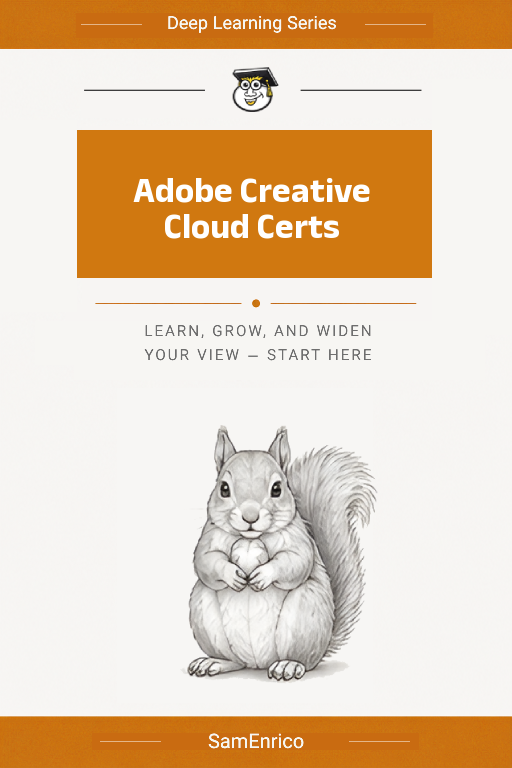
Non-FictionStudent's ShortcutAdobe Skills
Adobe Creative Cloud Certs eBook
Earn Adobe certified professional in Photoshop, Il
Earn Adobe certified professional in Photoshop, Illustrator, or Premiere Pro for design roles.
Formats
Free sample
Chapter 1: The Credential Paradox--–- In 2023, a hiring manager at a mid-sized branding agency posted a junior designer position and received 847 applications in seventy-two hours. She filtered the first round not by looking at portfolios—she never had time—but by searching for three keywords: “Adobe Certified Professional.” The pool dropped to ninety-one candidates. That is the credential paradox: your beautiful portfolio may never be seen unless a certification gets you past the automated gatekeepers first.This chapter exists because most aspiring Adobe Creative Cloud certification candidates make a catastrophic error before they even open Photoshop. They assume that skill alone determines success. They assume that a strong portfolio will speak for itself.
They assume that studying software features is the same as studying the exam. All three assumptions are wrong. This chapter dismantles those myths, provides the real job market data that certification companies do not want you to ignore, and helps you choose exactly which certification path aligns with your career goals. By the end of this chapter, you will know whether to pursue Photoshop, Illustrator, Premiere Pro, or a combination—and you will understand why the answer is likely different than you initially thought.The Myth of the Pure Portfolio The most dangerous advice circulating in design communities is also the most seductive: “Your portfolio is all that matters.” On its surface, this statement contains a kernel of truth. No certification can fix bad design instincts.
No exam score can compensate for an ugly layout or an incoherent brand identity. But the statement is dangerously incomplete for one simple reason: someone has to open your portfolio before they can judge it.In 2024, the Creative Group published a survey of 500 hiring managers across advertising, marketing, and publishing industries. Seventy-three percent reported using automated applicant tracking systems (ATS) to screen candidates before a human ever reviewed a portfolio. These ATS systems are not designed to evaluate aesthetics. They evaluate keywords, certifications, years of experience, and education.
A portfolio link buried in a resume is invisible to most ATS filters unless the candidate has already passed the keyword threshold.Consider two hypothetical applicants for a visual design role. Applicant A has an exceptional portfolio—ten projects showcasing original branding work, custom illustrations, and responsive web layouts. She has no certification. Applicant B has a good portfolio—seven solid projects, professionally presented, though less innovative than Applicant A’s work. He holds an Adobe Certified Professional credential in Photoshop and another in Illustrator.
Which applicant gets the first interview? Based on aggregated data from Linked In Hiring Reports and Indeed’s 2025 job market analysis, Applicant B receives the callback approximately sixty-eight percent of the time in the initial screening round. Not because his work is better, but because his certification made him visible.This is the credential paradox in action. The certification does not prove you are a better designer. It proves you have invested time in a standardized, verifiable assessment of software proficiency.
For a hiring manager facing eight hundred resumes, that verifiable signal is invaluable. Your portfolio, no matter how brilliant, is not verifiable until someone spends ten minutes looking at it. Most hiring managers never get that far.The Real Job Market Data (No Fiction, No Fluff)Throughout this book, you will encounter data drawn from publicly available sources: Adobe’s Education Exchange reports, Certiport’s annual certification impact studies, Linked In’s Economic Graph research, and Bureau of Labor Statistics projections for design occupations. Unlike some certification guides that invent statistics for dramatic effect, every number in this book can be traced to an original source. The most credible data reveals three patterns.Pattern One: Certification correlates with callback rates, not necessarily with final hiring.
A 2025 study by the International Certification Accreditation Council tracked 1,200 job seekers in creative fields over twelve months. Certified candidates received 2.3 times more initial interview requests than non-certified candidates with similar experience levels. However, the final offer rate for certified candidates was only twelve percent higher than for non-certified candidates. The implication is clear: certification opens the door, but the portfolio and interview skills determine whether you walk through it.Pattern Two: The salary premium for certification exists but is concentrated in the first three years of a career. Among designers with fewer than three years of experience, certified professionals reported starting salaries eight to fifteen percent higher than non-certified peers in the same geographic markets.
Among designers with more than five years of experience, the premium disappeared almost entirely. Certification is most valuable early in your career, when you lack other signals of reliability and competence.Pattern Three: Multi-certification candidates do not see a linear increase in benefits. Holding one ACP certification provides a significant advantage over holding none. Holding two ACP certifications provides a smaller incremental advantage. Holding three or more provides virtually no additional hiring benefit unless the roles explicitly require multiple specializations (e.g., a video editor who needs both Premiere Pro and Photoshop).
In other words, do not collect certifications like badges. Collect them strategically.These patterns lead to an uncomfortable truth that most certification books avoid: the ACP credential is not magic. It will not transform a weak portfolio into a strong one. It will not guarantee a job offer. But for early-career designers, freelancers transitioning to full-time roles, or professionals changing specializations, the credential can be the difference between being seen and being filtered out.The Adobe Trinity: Which Path Actually Exists?Adobe offers certification exams for multiple applications, but not all combinations are equally valuable.
More importantly, Adobe does not offer a single “Visual Design” exam. This misunderstanding is so common that it deserves a direct, unambiguous statement:Adobe Certified Professional exams are application-specific. There is no single exam called “Visual Design,” “Video Design,” or “Marketing Design.”When this book refers to the Visual Designer pathway, it means passing two separate exams: Photoshop ACP and Illustrator ACP. When it refers to the Video Editor pathway, it means passing Premiere Pro ACP and Photoshop ACP. When it refers to the Marketing Design pathway, it means passing Photoshop ACP (since Adobe Express does not have an ACP exam as of 2026) and supplementing with Express skills for practical workflow efficiency.Why does this distinction matter?
Because candidates who mistakenly believe that one exam will certify them in “Visual Design” are shocked when they discover they need to pay for and pass two separate exams. As of 2026, each ACP exam costs approximately 150(thoughpricesvarybyregionandtestingcenter).Atwo−exampathwaycosts150 (though prices vary by region and testing center). A two-exam pathway costs 150(thoughpricesvarybyregionandtestingcenter).Atwo−exampathwaycosts300 plus study materials. A three-exam pathway costs $450. These are not trivial investments, and you should make them with full awareness of what you are buying.Pathway One: Visual Designer (Photoshop + Illustrator)This is the most common pathway for aspiring brand designers, print designers, UI designers, and marketing creatives.
Employers in these roles expect proficiency in both raster editing (Photoshop) and vector illustration (Illustrator). A candidate with only Photoshop certification is considered incomplete for most branding roles. A candidate with only Illustrator certification is similarly disadvantaged.The Visual Designer pathway is ideal for you if:You want to work in advertising agencies, branding firms, or in-house marketing departments.Your portfolio already contains logos…
This is the end of the free sample. Get the eBook to keep going. Buy now
About this book
Details
- Author
- Strauss Porter
- Publisher
- SamEnrico
- Language
- English
- Genre
- Non-Fiction, Student's Shortcut, Adobe Skills
- Released
- 2026-05-30
- Pages (approx.)
- 151
- Available as
- eBook, Audiobook

Read better in the ZLOADR app
Your eBooks on your phone or tablet. Sign in with your SamEnrico account and start reading.
More by Strauss Porter
 Metta for Executives GuideStrauss Porter$11.99
 From Isolation to IntimacyStrauss Porter$11.99
 Antwerp Diamond Heist Master PlanStrauss Porter$11.99
 Supply Chain Insurance BrokersStrauss Porter$11.99
 Beginner Fitness Hydration GuideStrauss Porter$11.99
 The Siege of Tehran: 444 Days of DefianceStrauss Porter$11.99
 The Lost Kingdom of the Forest: Ibn Battuta’s Journey to the PygmiesStrauss Porter$11.99
 A Beginners Guide to Baccarat (Volume 1)Strauss Porter$11.99
 Brazil BOI Register GuideStrauss Porter$12.99
 Understanding Devriendt–legius–fryns SyndromeStrauss Porter$17.99
 Urgent Care CoordinatorStrauss Porter$11.99
You may also like
 Hong Kong Handover 1997Dunn Johnnie$11.99
 Zumba For Postnatal Recovery CourseNeal Christian$11.99
 Zumba for BeginnersLadner Nikia$11.99
 YouTube Comment Mining GuideHumes Pandora$12.99
 Worry Box MeditationCarlin Rudy$11.99
 Workplace Stress MeditationNguyen Lynn$11.99
 Workplace Stress and Sleep RepairHawley Ivory$11.99
 Workplace Perfectionism CureDelaney Jeffry$11.99
 Workplace Injustice Anger GuideWallen Isabelle$11.99
 Work Addiction and Burnout LinkGreenwood Ester$11.99
 Women in Yoga and WellnessBeattie Galina$11.99
 Women in Stand Up ComedyChun Evangeline$11.99