
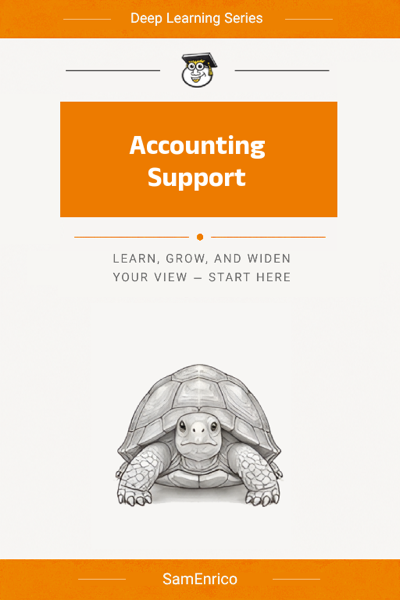
Non-FictionInformativeEducational
Accounting Support eBook
A Coursebook on Accounting Support
by Sager Ona
A Coursebook on Accounting Support
Formats
Free sample
Chapter 1: The Backbone Myth–- Walk into almost any accounting department and ask, “Who keeps this place running?” The controllers will point to their financial models. The CFO will point to the audit reports. The staff accountants will point to the closing binders. But watch closely for just one day, and you will see the truth. The person who keeps the department running is the one matching invoices at 9:00 AM, answering a vendor’s frantic email at 10:30 AM, reconciling the bank statement at 1:00 PM, and explaining to a new hire how to fill out their direct deposit form at 3:00 PM.
That person is the accounting support professional. And for too long, this role has been dismissed as “just data entry” or “a stepping stone” or—worst of all—“the backbone of the department” in a way that sounds complimentary but actually means invisible.This chapter exists to shatter that myth. You are not the backbone. You are the entire circulatory system. You are the hands, the eyes, and the memory of the finance function.
Without accurate transaction processing, the CFO’s strategic plan is built on sand. Without clean subsidiary ledgers, the controller’s financial statements cannot be trusted. Without your attention to detail, the audit becomes a nightmare. This chapter will redefine what it means to work in accounting support, map exactly where you fit in the accounting cycle, establish the ethical framework that will protect your career, and show you the career ladder that turns today’s invoice processing into tomorrow’s department leadership.The Three Levels of Accounting Work Most people outside the profession—and unfortunately, many inside it—imagine accounting as a single ladder. You start as a clerk, become a staff accountant, earn your CPA, become a manager, then a controller, then a CFO.
That model is incomplete and misleading. It erases the legitimate, skilled, and valuable career of the accounting support professional who may never want or need a CPA license to be indispensable.The reality is three distinct levels, each with different responsibilities, judgment requirements, and career trajectories.Entry-Level Support: The Foundation of Speed and Accuracy Data entry clerks, invoice processors, and payroll data entry staff occupy this level. Their work is highly procedural with clear rules for every transaction. A vendor invoice comes in. The system says where it goes.
The clerk enters it. An employee submits a time sheet. The clerk keys the hours. The primary metrics at this level are speed and accuracy—how many invoices per hour, how few keystroke errors. Judgment is intentionally limited because judgment introduces variation, and variation introduces risk.This is where most support professionals begin.
But it is not where they stay. The person who processes invoices for six months without an error is ready for more. The person who never asks “why” is ready to stagnate.Mid-Level Support: The Judgment Zone AP specialists, AR specialists, payroll assistants, and bookkeepers operate at this level. They do not merely enter transactions—they own entire subsidiary ledgers. The AP specialist does not just key invoices; she reviews them, codes them (using the framework from Chapter 3), performs three-way matches (Chapter 4), resolves discrepancies, communicates with vendors, and prepares the AP aging for review.
The AR specialist does not just generate invoices; he applies cash, researches short payments, manages collections, and reconciles the AR subsidiary ledger to the general ledger.This is the judgment zone. Company policy provides guardrails, but within those rails, the mid-level support professional makes dozens of decisions daily. Should I pay this invoice despite the price variance? Is this short payment legitimate or does the customer owe the full amount? Does this expense report violate policy or is it a reasonable business expense?
These decisions require training, experience, and confidence.Professional Accountants: The Strategy Layer Staff accountants, senior accountants, controllers, and CPAs operate at this level. They prepare financial statements, analyze results, design internal controls, manage tax compliance, and provide strategic advice. Their judgment is professional judgment—less constrained by detailed procedures and more guided by principles, standards, and materiality.The critical insight for the accounting support professional is this: you do not need to become a professional accountant to have a successful career. The mid-level support role pays well, offers increasing responsibility, and provides genuine satisfaction. Many people spend thirty years as AP specialists or payroll managers and retire proud of what they built.
The career ladder is not a single path upward—it is a tree with many branches.The Accounting Cycle: Where Your Work Lives The accounting cycle is the recurring process that turns raw business transactions into audited financial statements. Understanding this cycle is not theoretical exercise—it is the map that shows you exactly where your daily work fits. Every invoice you process, every payment you apply, every hour of payroll you calculate lives somewhere on this map.Here is the complete cycle. Commit it to memory.Step 1: Source Documents Every transaction begins with a source document—the original evidence that something happened. An invoice from a vendor.
A receipt from a purchase. A time sheet from an employee. A bank statement showing a deposit. A sales order from a customer. If there is no source document, there is no transaction.
This is the first line of defense against fraud and error. Support professionals are the custodians of source documents. You decide what counts as valid evidence.Step 2: Data Entry (Journal Entries)The source document must be recorded in the accounting system. This happens through journal entries—chronological records of the transaction showing which accounts are debited and which are credited. (You will master journal entries in Chapter 2.) Data entry is where speed matters but accuracy matters more.
A transposed number at this stage becomes a reconciliation nightmare later.Step 3: Subsidiary Ledgers Most journal entries do not go directly to the general ledger. They first populate subsidiary ledgers—detailed supporting ledgers that roll up to control accounts. The AP subsidiary ledger contains every unpaid vendor invoice. The AR subsidiary ledger contains every unpaid customer invoice. The payroll subsidiary ledger contains every employee’s year-to-date earnings and deductions.
Support professionals own the subsidiary ledgers. You are the expert on what lives in AP, AR, and payroll.Step 4: General Ledger The subsidiary ledgers periodically post summary totals to the general ledger—the master set of accounts that rolls up everything. The AP control account in the general ledger shows the total of all unpaid vendor invoices. The AR control account shows the total of all unpaid customer invoices. If the subsidiary ledgers are accurate, the general ledger is accurate.
If the subsidiary ledgers have errors, the general ledger inherits them.Step 5: Trial Balance At the end of each accounting period, the accountant runs a trial balance—a listing of every general ledger account with its balance. The trial balance verifies that total debits equal total credits. If they do not balance, someone made an entry that violates double-entry accounting. The search for the error begins.Step 6: Adjusting Entries Accrual accounting requires adjusting entries at period end. Prepaid expenses must be recognized as they are used.
Accrued expenses must be recorded before the invoice arrives. Depreciation must be calculated. These adjustments are the subject of Chapter…
This is the end of the free sample. Get the eBook to keep going. Buy now
About this book
Details
- Author
- Sager Ona
- Publisher
- SamEnrico
- Language
- English
- Genre
- Non-Fiction, Informative, Educational
- Released
- 2026-05-06
- Pages (approx.)
- 158
- Available as
- eBook, Audiobook

Read better in the ZLOADR app
Your eBooks on your phone or tablet. Sign in with your SamEnrico account and start reading.
More by Sager Ona
 The Praise Fallacy WorkbookSager Ona$11.99
 TM for Archivists GuideSager Ona$11.99
 Values And Mission Alignment Crisis Management GuideSager Ona$11.99
 The Toxic Workplace Survival GuideSager Ona$11.99
 The Menopause Weight Sleep LinkSager Ona$11.99
 The Hidden Brushes of Edo: Japan's First Animated ShadowsSager Ona$11.99
 Understanding Treponema InfectionSager Ona$17.99
 Investment Ready Business PlanSager Ona$12.99
 Cloud Business Plan TemplatesSager Ona$12.99
 How to Start a Doubling Machinery for Textiles Business (Beginners Guide)Sager Ona$11.99
You may also like
 Hong Kong Handover 1997Dunn Johnnie$11.99
 Zumba For Postnatal Recovery CourseNeal Christian$11.99
 Zumba for BeginnersLadner Nikia$11.99
 YouTube Comment Mining GuideHumes Pandora$12.99
 Worry Box MeditationCarlin Rudy$11.99
 Workplace Stress MeditationNguyen Lynn$11.99
 Workplace Stress and Sleep RepairHawley Ivory$11.99
 Workplace Perfectionism CureDelaney Jeffry$11.99
 Workplace Injustice Anger GuideWallen Isabelle$11.99
 Work Addiction and Burnout LinkGreenwood Ester$11.99
 Women in Yoga and WellnessBeattie Galina$11.99
 Women in Stand Up ComedyChun Evangeline$11.99