
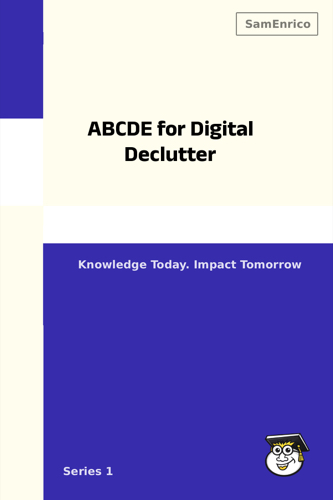
ABCDE for Digital Declutter eBook
Rank and delete digital files and subscriptions us
Rank and delete digital files and subscriptions using the ABCDE method with this guide.
Formats
Free sample
Chapter 1: The Ranking Revolution--The average person will make 35,000 decisions today. Most of them will be trivial – what to eat, which shoe to tie first, whether to hit snooze. But when you stare at a folder named "Miscellaneous" containing 1,847 files, each one a tiny ghost of a decision you never made, something different happens. Your brain freezes. Not because the files are important, but because you have no system for judging them.
You are not lazy. You are not disorganized by nature. You are simply missing a framework that turns "maybe" into "no" and "keep" into "delete now." This chapter provides that framework.Let me tell you about Sarah. She was a marketing director at a mid-sized tech firm, and when we first sat down to look at her digital life, she apologized for the mess. Her laptop had 4,213 files on the desktop alone.
Her downloads folder contained 2,847 items, some dating back to 2017. She had seventeen different folders named "Archive" and another twelve named "Old." She was paying for eight subscription services she could not name without checking her credit card statement. When I asked her how she decided what to keep and what to delete, she laughed. "I don't decide," she said. "I just keep everything because I'm terrified of deleting the wrong thing."Sarah is not unusual.
She is every knowledge worker I have ever coached. The difference between Sarah before the ABCDE method and Sarah after is not that she became more disciplined or more ruthless. It is that she stopped making decisions emotionally and started making them numerically. She learned to rank instead of guess.The Core Problem: "Need" Is a Useless Word Every decluttering book, every productivity guru, every well-meaning article tells you the same thing: delete what you don't need. This advice is technically correct and practically useless because the word "need" is a trap.
Your brain cannot process "need" in the abstract. Need for what? Need for when? Need according to whom?When you open a folder and ask yourself "Do I need this file?", your brain immediately generates a cascade of anxious questions. What if my boss asks for it next quarter?
What if this spreadsheet contains a formula I'll want to reference? What if I delete it and then regret it at 2 AM on a Sunday? The fear of future regret overpowers the logic of present reality. You close the folder. You keep the file.
The clutter grows.This is not a character flaw. It is a cognitive bias called the endowment effect – the tendency to overvalue what you already own simply because you own it. Behavioral economists have demonstrated this with coffee mugs and chocolate bars. The same bias applies to digital files, apps, and subscriptions. That PDF you downloaded three years ago and never opened feels more valuable than an identical PDF you just found online because you already possess it.
Your brain is lying to you.The solution is not to suppress the bias. The solution is to replace the vague question "Do I need this?" with a precise, quantifiable, emotion-resistant question: "On a scale of 1 to 5, how much value does this deliver to my life right now?"The 1–5 Scoring System Explained The ABCDE method begins with a ranking system so simple that it feels almost childish. That is by design. Complexity is the enemy of action. You will assign every file, every app, every subscription, every digital artifact a single number from 1 to 5.
There are no decimals, no half-points, no conditional modifiers. Just one number.Here is what each number means.A score of 1 means mission-critical, used daily or weekly, impossible to replace without significant effort. Your password manager is a 1. Your active project files for work are 1s. The app you use to pay your rent is a 1.
If you lost a 1, you would notice within hours and take immediate action to recover it. Most people have between five and fifteen 1s across their entire digital footprint. Everything else is lower.A score of 2 means useful but not critical, used monthly or quarterly, replaceable with moderate effort. Your reference documents, your archived tax returns from the past three years, the photo editing app you open every few weeks – these are 2s. If you lost a 2, you would notice eventually but not urgently.
You might spend an afternoon replacing it.A score of 3 means occasionally useful, used every few months, nice to have but not painful to lose. Templates you reuse infrequently, old presentations you might reference someday, apps you open seasonally – these are 3s. If you lost a 3, you might not notice for months. When you finally did, you would shrug and move on.A score of 4 means unsure, might need someday, cannot clearly articulate a specific future use but feel anxious about deleting. This is the danger zone.
Four is not a real score – it is a placeholder for anxiety. In the ABCDE system, 4s are not kept. They are moved to a thirty-day quarantine folder (detailed in Chapter 5). After thirty days, if you have not retrieved them, they are deleted automatically. Most 4s die in quarantine.A score of 5 means completely useless, never opened, broken, duplicated, expired, or otherwise worthless.
Screenshots of screenshots. Installer files for software you no longer own. Newsletters you never read. Subscriptions you forgot existed. Fives are deleted immediately, without guilt, without review, without hesitation.The genius of the 1–5 system is that it externalizes the decision.
You are not saying "this file is bad" or "I was stupid to save this." You are simply observing its score. A 5 carries no moral weight. It is just a number. And numbers are easy to act upon.Why Ranking Beats Categorizing Many organization systems ask you to categorize your digital items: work vs. personal, old vs.
new, important vs. not important. Categorization fails because categories are static and binary. A file is either work or personal, but what about the expense receipt that is both? A file is either old or new, but what about the project that finished last month but might resurrect next quarter?Ranking is dynamic and granular.
A file's score can change over time. A project that was a 1 during active development becomes a 3 after completion. A subscription that was a 2 when you used it weekly becomes a 5 when you realize you have not logged in for six months. The ranking system invites you to reassess continuously, not to make a single permanent decision.Furthermore, ranking creates a natural deletion order. You do not delete everything at once.
You delete your 5s today. You quarantine your 4s tomorrow. You review your 3s next quarter. You protect your 1s and 2s with backups and systems. This hierarchy prevents the paralysis that comes from facing an undifferentiated mass of files.
When everything looks equally important, nothing gets deleted. When everything has a score, the path forward is obvious.The Marketing Manager Who Deleted 80% of Her Files Let me return to Sarah, the marketing director. When I introduced her to the 1–5 scoring system, she was skeptical. "You want me to rate four thousand files?" she asked. "That will take weeks."I asked her to try it for one hour on one folder –…
This is the end of the free sample. Get the eBook to keep going. Buy now
About this book
Details
- Author
- Rivas Tonette
- Publisher
- SamEnrico
- Language
- English
- Genre
- Non-Fiction, Self-Help, Digital Minimalism
- Released
- 2026-06-07
- Pages (approx.)
- 131
- Available as
- eBook, Audiobook

Read better in the ZLOADR app
Your eBooks on your phone or tablet. Sign in with your SamEnrico account and start reading.
More by Rivas Tonette
 The VAK Induction SystemRivas Tonette$11.99
 Iranian Revolution PhotographyRivas Tonette$11.99
 GAD PTSD Overlap GuideRivas Tonette$11.99
 API Ecosystem MapRivas Tonette$11.99
 Frozen in Time: The Last Echoes of Franklin's Lost ExpeditionRivas Tonette$11.99
 The Clay Tablet ConspiracyRivas Tonette$11.99
 College Application Essay That Opens DoorsRivas Tonette$12.99
 Agentic Artificial Intelligence OutlookRivas Tonette$12.99
 Understanding Halal SyndromeRivas Tonette$17.99
 Wafer BondingRivas Tonette$11.99
 A Beginners Guide to Careers (Volume 1)Rivas Tonette$11.99
You may also like
 Unsubscribe Marketing EmailsCarrington Cassidy$11.99
 Digital Minimalism for ComparersPak Tamela$11.99
 Default Off Notification Philosophy GuideSessions Lavonia$11.99
 The Digital Declutter DawnHoffmann Georgeann$11.99
 Social Media BlockingMorin Fawn$11.99
 Tech Free Morning GuideBachman Ahmed$11.99
 Smartphone Screen Time ResetWilliam Xuan$11.99
 Digital Minimalism GuideFarias Petronila$11.99
 The Phone Free Work Block PlanHorsley Warner$11.99
 No Phone Morning RulePinkston Alex$11.99
 The Phone Distraction Detox PlanKoch Lucie$11.99
 The Mindful Digital Detox PlanPeacock Dawna$11.99