
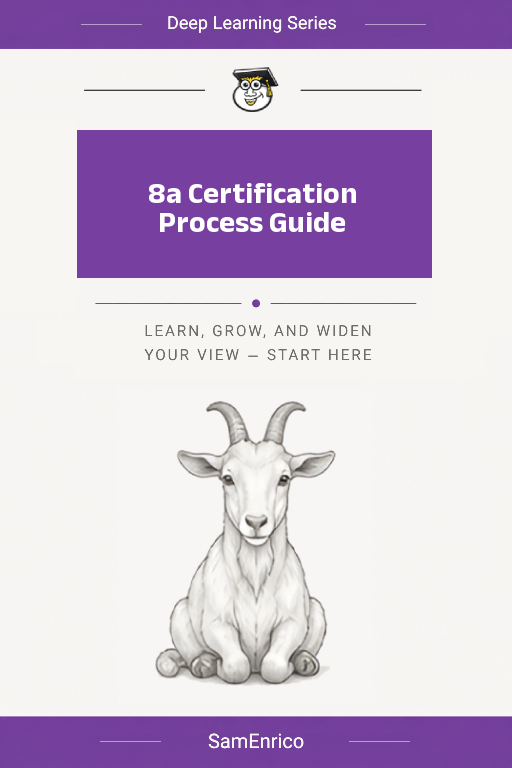
8a Certification Process Guide eBook
Complete the SBA 8a application for socially and e
by Chang Velva
Complete the SBA 8a application for socially and economically disadvantaged firms, including required documents and common rejection reasons.
Formats
Free sample
Chapter 1: The $37 Billion Door--–- The first time Maria Santos checked her email on a Tuesday morning in March, she wasn't expecting her life to change. She was expecting a rejection—the same kind she had received seventeen times before when bidding on federal contracts as a small, Hispanic-owned IT consulting firm in Phoenix. What she found instead was a notice from the Small Business Administration: "Your application for the 8(a) Business Development Program has been approved." Maria sat in silence for three minutes, then called her husband. "We're in," she said. "We're actually in."Within eighteen months of that email, Maria's firm—previously surviving on 400,000inannualrevenuefromsmallcommercialclients—wona400,000 in annual revenue from small commercial clients—won a 400,000inannualrevenuefromsmallcommercialclients—wona4.2 million sole-source contract with the Department of Homeland Security.
Two years after that, she graduated from the 8(a) program with a business valued at 18million,forty−threeemployees,andawaitinglistoffederalagencieswantingtoworkwithher.Mariaisnotspecial.Sheisnotagenius,aprodigy,orapoliticalinsider.Sheissimplyoneoftheroughly4,300businessownerswho,atanygiventime,holdthekeytoa18 million, forty-three employees, and a waiting list of federal agencies wanting to work with her. Maria is not special. She is not a genius, a prodigy, or a political insider. She is simply one of the roughly 4,300 business owners who, at any given time, hold the key to a 18million,forty−threeemployees,andawaitinglistoffederalagencieswantingtoworkwithher.Mariaisnotspecial.Sheisnotagenius,aprodigy,orapoliticalinsider.Sheissimplyoneoftheroughly4,300businessownerswho,atanygiventime,holdthekeytoa37 billion annual marketplace that most small business owners don't even know exists.That key is called the 8(a) Business Development Program. And this chapter is about whether you should pick it up.The $37 Billion Blind Spot Before we discuss the mechanics of the 8(a) program—the forms, the deadlines, the documents, the nine-year lifecycle—we must first address a more fundamental question.
Not "how do I get in?" but rather "should I even try?" This may seem like a strange question to ask in Chapter 1 of a book titled The 8(a) Certification Process Guide. After all, if you have purchased this book, you have likely already decided that you want to pursue 8(a) certification. But here is a truth that most consultants will not tell you: the 8(a) program is not for everyone. In fact, for approximately 40 percent of the businesses that apply each year, the program is either a poor fit or an active distraction from more profitable paths.The federal government sets aside approximately 37billionannuallyforsmallbusinesses.Ofthat,roughly37 billion annually for small businesses. Of that, roughly 37billionannuallyforsmallbusinesses.Ofthat,roughly25 billion flows through the 8(a) program specifically—not through set-asides for women-owned businesses, veteran-owned businesses, or HUBZone firms, but through the single most powerful contracting vehicle available to socially and economically disadvantaged owners.
To put that number in perspective: $37 billion is more than the gross domestic product of more than fifty countries. It is roughly equivalent to the entire annual budget of the state of Nevada. And it is available to businesses that most Americans have never heard of, operating out of spare bedrooms and shared office spaces, run by owners who, like Maria, had been told their entire lives that the system was not built for them.But here is the catch. The $37 billion door does not open simply because you are disadvantaged, minority-owned, or struggling. It opens only for those who meet three specific, non-negotiable conditions: (1) you must be socially disadvantaged (a term that, after the Ultima decision of 2024, means something very different than it did five years ago), (2) you must be economically disadvantaged (a term defined by three hard financial caps that most applicants miscalculate), and (3) your business must be unconditionally controlled by the disadvantaged owner—not 51 percent, not "effective control," but actual, documented, verifiable control that cannot be overruled by any spouse, board member, or silent investor.If you meet these three conditions, the 8(a) program can transform your life.
If you do not, applying is a waste of time—and worse, a distraction from building your business through other means. The purpose of this chapter is to help you determine, before you spend a single dollar on consultants or a single hour on paperwork, whether you belong on the other side of that $37 billion door.The Nine-Year Clock: Understanding the Lifecycle The 8(a) program is not a grant, a loan, or a handout. It is a nine-year business development program with a fixed beginning, a structured middle, and a mandatory end. Unlike other small business certifications (such as WOSB or VOSB, which have no expiration), the 8(a) program operates on a strict timeline. Once you enter, the clock starts ticking, and it never stops.Years 1 through 4: The Developmental Stage The first four years of the program are called the Developmental Stage.
During this period, the SBA assumes that your business is still maturing—that you need mentoring, technical assistance, and protected access to federal contracts to build capacity. This is when the program is most generous. You have access to sole-source contracts (meaning you do not have to compete against other bidders) up to 4.5millionforstandardgoodsandservicesandupto4.5 million for standard goods and services and up to 4.5millionforstandardgoodsandservicesandupto7 million for manufacturing. You are also eligible for set-aside contracts where only other 8(a) firms can compete, giving you a playing field that excludes the massive, well-funded primes that usually dominate federal procurement.During the Developmental Stage, the SBA also provides formal business development assistance: training in government contracting, access to procurement center representatives who can introduce you to contracting officers, and—if you qualify—a mentor-protégé relationship with an established federal contractor who can teach you the ropes without competing against you. These four years are when you should be aggressive, bidding on everything you can reasonably perform, and building a track record of successful performance that will carry you through the rest of the program.Years 5 through 9: The Transitional Stage At the start of Year 5, you move into the Transitional Stage.
The SBA's theory is that after four years of protected contracting, you should no longer need a completely sheltered marketplace. During these five years, your sole-source contracting limits begin to decline (though the exact reduction depends on your performance and the SBA's annual budget), and you are expected to increasingly compete for contracts on the open market. The SBA also reduces its direct business development support, shifting you toward self-sufficiency.This is where most 8(a) firms make their first catastrophic mistake. They spend the Developmental Stage enjoying sole-source contracts and never building a sales pipeline outside the program. Then, when Year 5 arrives and the sole-source opportunities begin to shrink, they have no backlog, no relationships with non-8(a) contracting officers, and no experience competing against non-8(a) firms.
Their revenue collapses, and they spend the remaining five years scrambling to survive rather than thriving.The firms that succeed treat the Developmental Stage not as the destination but as the training ground. They use sole-source contracts to build past performance, hire staff, and develop systems. Then, starting in Year 3—two full years before the Transitional Stage begins—they actively pursue non-8(a) contracts, ensuring that by Year 5, at least 30 percent of their revenue comes from outside the program. By Year 9, that number should reach 70 percent.The One-Time Rule: No Second Chances Here is the most important sentence in this chapter. When you graduate from the 8(a) program—whether you complete the full…
This is the end of the free sample. Get the eBook to keep going. Buy now
About this book
Details
- Author
- Chang Velva
- Publisher
- SamEnrico
- Language
- English
- Genre
- Non-Fiction, Business Brief, Government Certification, Small Business
- Released
- 2026-06-01
- Pages (approx.)
- 128
- Available as
- eBook, Audiobook

Read better in the ZLOADR app
Your eBooks on your phone or tablet. Sign in with your SamEnrico account and start reading.
More by Chang Velva
 The Mayor's 24 Hour CallChang Velva$11.99
 Parenting Grief And Loss GuideChang Velva$11.99
 LinkedIn Connection EnvyChang Velva$11.99
 Validating Suicidal IdeationChang Velva$11.99
 Thyroid Eye Disease GuideChang Velva$11.99Thyroid Eye Disease GuideChang Velva$11.99
 Coping With Car Repossession FearChang Velva$11.99
 Reputation Recovery LeadershipChang Velva$11.99
 Material Boundary GuideChang Velva$11.99
 Earplugs For Deep SleepChang Velva$11.99
 Quantum Leap: The Man Who Cracked Time with a ComputerChang Velva$11.99
 The Red River Campaign: Grant’s Bloody Misadventure in the WestChang Velva$11.99