
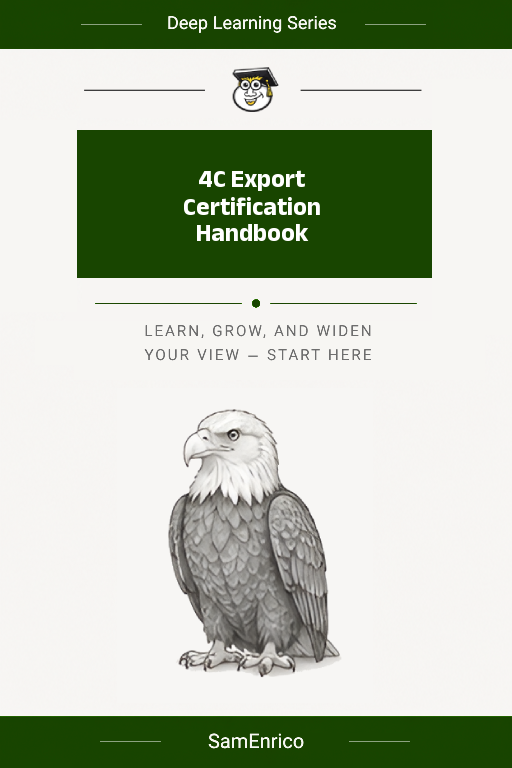
4C Export Certification Handbook eBook
Common Code for the Coffee Community for sustainab
Common Code for the Coffee Community for sustainable coffee export markets.
Formats
Free sample
Chapter 1: Beyond the Bean...--–- The morning mist still clung to the coffee cherries when Miguel Vargas, a third-generation producer from Huila, Colombia, received the email that would change everything. His family had exported their arabica to the same European roaster for eighteen years. The email was brief: "Effective January 1, your shipments must be accompanied by verifiable proof of deforestation-free production and due diligence documentation. Without compliance, we cannot accept delivery." Miguel had heard rumors about new European regulations, but like many producers, he assumed it would take years to materialize. He was wrong.
Within six months, four of his regular buyers had either cancelled contracts or demanded price reductions to cover their own compliance risks. Miguel was not alone. Across coffee-producing regions from Vietnam to Brazil, thousands of exporters and cooperatives found themselves caught between rising demand for sustainable coffee and the bewildering complexity of proving it.This book exists because Miguel's story is not an exception—it is rapidly becoming the norm. The Common Code for the Coffee Community, known simply as 4C, emerged from a multi-stakeholder process in the early 2000s as an industry-driven response to growing concerns about labor conditions, environmental degradation, and economic viability in coffee production. Today, 4C occupies a unique position: it is the most widely adopted baseline sustainability certification for coffee, covering millions of bags annually and recognized by virtually every major roaster and trader.
Yet for the exporter opening the 4C website for the first time, the experience can be overwhelming. System regulations, codes of conduct, annexes, checkpoints, certification body lists, transaction certificates, mass balance calculations—the terminology alone forms a foreign language. And now, layered on top of this already complex system, new European regulations on deforestation and corporate due diligence have transformed sustainability from a voluntary marketing choice into a legal requirement for market access.The purpose of this chapter—and indeed this entire handbook—is to translate that complexity into practical, actionable knowledge. We will begin by answering the most fundamental question: why should an exporter invest time, money, and operational capacity into 4C certification when there are other sustainability labels available? The answer requires understanding three converging forces: the regulatory tsunami from Europe, the shifting procurement policies of major coffee buyers, and the underlying economics of certification as a market access tool rather than a cost center.The Regulatory Earthquake: How EU Laws Changed the Game For most of coffee trading history, sustainability was voluntary.
Buyers who wanted certified coffee paid a premium; those who did not could still source conventional beans without legal consequence. That era ended between 2023 and 2025, when the European Union enacted two pieces of legislation that fundamentally altered the legal landscape for any coffee entering the European market.The first and most immediately impactful is the EU Deforestation Regulation (EUDR) . Enacted to address the EU's role in global deforestation, the EUDR requires that any operator placing specific commodities—including coffee, cocoa, palm oil, soy, and timber—on the European market must prove that the products are "deforestation-free." The legal definition is precise: land must not have been converted from forest to agricultural use after December 31, 2020. For coffee exporters, this means that every shipment must be accompanied by a due diligence statement that includes geolocation coordinates (polygons or points) for every farm where the coffee was grown, along with evidence that those farms did not contribute to deforestation after the cutoff date.Crucially, the EUDR shifts legal liability to the entire supply chain. The European importer is ultimately responsible, but that importer will demand documentation from their direct supplier—the exporter—who must in turn collect data from producers.
Failure to provide adequate documentation can result in fines, seizure of goods, and exclusion from the EU market. The regulation carries teeth: member states are required to conduct regular inspections, and non-compliant operators face penalties of at least four percent of their annual EU turnover. No coffee exporter serving the European market can ignore the EUDR, and few can meet its requirements without a structured system for data collection and verification.The second major regulation is the Corporate Sustainability Due Diligence Directive (CSDDD) . While the EUDR focuses specifically on deforestation, the CSDDD has a broader scope: it requires large companies operating in the EU to identify, prevent, mitigate, and account for adverse human rights and environmental impacts throughout their supply chains. For coffee, this means that buyers must conduct due diligence on risks including forced labor, child labor, land rights violations, water pollution, and excessive pesticide use.
Unlike the EUDR, which applies to all operators regardless of size, the CSDDD phases in based on company size and revenue. However, large buyers will cascade requirements down to their suppliers. An exporter who cannot demonstrate that their supply chain is free from forced labor or that their production methods respect water quality will find it increasingly difficult to secure contracts with major European roasters.Taken together, these regulations represent a paradigm shift. Sustainability is no longer a marketing claim or a niche differentiator—it is a legal condition for market access. And this is precisely where 4C certification becomes strategically valuable.
The 4C System was not designed specifically for EUDR or CSDDD, but its structure—requiring documented compliance with a code of conduct, maintaining a business partner map, undergoing regular audits, and implementing improvement plans—provides the kind of verifiable evidence that regulators and buyers demand. An exporter with a mature 4C certification is not starting from zero; they already have much of the documentation, traceability, and risk management infrastructure required for European compliance.The Buyer's Perspective: Why Volume Roasters Prefer 4CUnderstanding why 4C has become the baseline standard for large-scale coffee purchasing requires stepping into the shoes of a procurement manager at a major European roaster. Imagine overseeing the purchase of hundreds of thousands of tons of green coffee annually, sourced from dozens of countries, thousands of cooperatives, and millions of smallholder farmers. Your job is to ensure supply continuity, manage price risk, maintain quality, and—increasingly—prove to your board, your customers, and European regulators that your supply chain is sustainable.You have a choice. You could require every supplier to hold Rainforest Alliance certification, which is comprehensive and respected.
But Rainforest Alliance audits are expensive, require significant farm-level investment, and not all producing regions have available certification bodies. You could require Fairtrade, which addresses smallholder empowerment but does not cover environmental practices in the same depth. You could require Organic, which prohibits synthetic inputs but does not address social conditions or deforestation. Or you could require 4C. The 4C System was explicitly designed as an entry-level or baseline certification—accessible enough that large volumes of coffee can be brought into compliance without excluding smallholders, yet rigorous enough that buyers can trust the underlying claims.Several factors explain 4C's dominance in volume purchasing.
First, its risk-based audit approach means that not every farm is inspected every year. The Managing Entity (ME)—typically a cooperative, exporter, or large estate—is audited as a unit, with sampling of individual Business Partners (BPs) based on risk criteria. This keeps costs manageable at scale. Second, the continuous improvement model means that a 4C certificate is not a static pass-fail; it…
This is the end of the free sample. Get the eBook to keep going. Buy now
About this book
Details
- Author
- Gorman Marine
- Publisher
- SamEnrico
- Language
- English
- Genre
- Non-Fiction, Business Brief, 4C
- Released
- 2026-05-30
- Pages (approx.)
- 160
- Available as
- eBook, Audiobook

Read better in the ZLOADR app
Your eBooks on your phone or tablet. Sign in with your SamEnrico account and start reading.
More by Gorman Marine
 Stress and Dental Health GuideGorman Marine$11.99
 The Growth Mindset for AthletesGorman Marine$11.99
 Multiple Job Loss RecoveryGorman Marine$11.99
 Divorce and Living AloneGorman Marine$11.99
 Kegel Exercise HandbookGorman Marine$11.99
 Gratitude Evening ReflectionGorman Marine$11.99
 Diabetes Related ED GuideGorman Marine$11.99Diabetes Related ED GuideGorman Marine$11.99
 Group Creativity for ArchitectsGorman Marine$11.99
 The Surgeon of the Great North Road: A Victorian Highwayman's Deadly SecretGorman Marine$11.99
 The Battle of Dogali: Italy's Bloody Wake-Up Call in AfricaGorman Marine$11.99
 How to Produce Paintball Harnesses and PacksGorman Marine$11.99
You may also like
 Hong Kong Handover 1997Dunn Johnnie$11.99
 Zumba For Postnatal Recovery CourseNeal Christian$11.99
 Zumba for BeginnersLadner Nikia$11.99
 YouTube Comment Mining GuideHumes Pandora$12.99
 Worry Box MeditationCarlin Rudy$11.99
 Workplace Stress MeditationNguyen Lynn$11.99
 Workplace Stress and Sleep RepairHawley Ivory$11.99
 Workplace Perfectionism CureDelaney Jeffry$11.99
 Workplace Injustice Anger GuideWallen Isabelle$11.99
 Work Addiction and Burnout LinkGreenwood Ester$11.99
 Women in Yoga and WellnessBeattie Galina$11.99
 Women in Stand Up ComedyChun Evangeline$11.99