
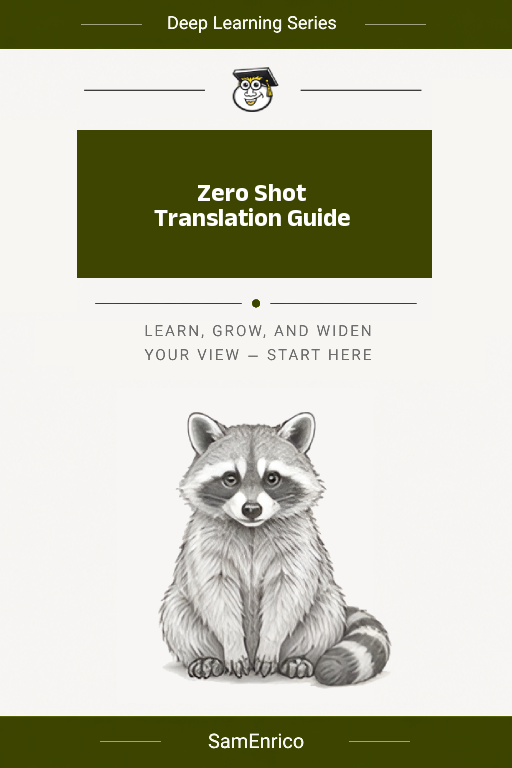
Zero Shot Translation Guide
Translate rare languages using zero-shot NMT techn
by Timm Leatha
Translate rare languages using zero-shot NMT techniques. Combine with human review for indigenous and low-resource language pairs.
Formats
About this book
Free sample
Chapter 1: The Digital Grave--At 3:47 on a Tuesday afternoon in 2023, a 74-year-old woman named Ngaanyatjarra did something no human had done in forty years. She spoke a full sentence in Wangkajunga, her mother's tongue, to her granddaughter. The sentence was simple: "The goanna lizard sleeps under the red sand until the rain comes." Her granddaughter, who grew up speaking English and a simplified pidgin, understood the words but could not form a response. She replied in English: "That's cool, Grandma."The old woman died eighteen months later. With her died a complete theory of animal tracks, a classification system for desert stars that differs from Western astronomy in every fundamental way, a grammatical structure that encodes certainty differently than any European language, and a word for a specific kind of silence that follows a dust storm—a word that took three English sentences to approximate.Wangakjunga is what linguists call a "zero-resource language." It has no dictionary.
No grammar book. No Bible translation. No school curriculum. No social media presence. No recorded telephone conversation.
No written corpus at all. What it has is six elderly speakers, the youngest of whom is sixty-eight years old, and a granddaughter who can understand but not speak.This book is about building translation technology for Wangkajunga. And for Bribri. And for Mizo. And for the seven thousand other languages that exist in the digital dark—languages that together represent ninety percent of human linguistic diversity but receive less than two percent of natural language processing research funding.But first, you need to understand why this matters.
Not as an engineering problem. As a human one.The Rich-Get-Richer Catastrophe Here is a number that should shock you: between 2010 and 2024, the number of academic papers published on machine translation for English increased by 1,400 percent. For Chinese, 900 percent. For Spanish, 700 percent. For Wangkajunga?
Zero. For Bribri? Zero. For the five hundred languages of Papua New Guinea that collectively have fewer than a million speakers? A single paper, published in 2019, co-authored by a missionary linguist who has since retired.This is not malice.
It is economics. The same forces that made English the language of aviation, diplomacy, and the internet have made it…
This is the end of the free sample. Get the eBook to keep going. Buy now
Contents
- Chapter 1
- Chapter 2
- Chapter 3
- Chapter 4
- Chapter 5
- Chapter 6
- Chapter 7
- Chapter 8
- Chapter 9
- Chapter 10
- Chapter 11
- Chapter 12
Details
- Author
- Timm Leatha
- Publisher
- SamEnrico
- Language
- English
- Genre
- Non-Fiction, AI Operator
- Released
- 2026-05-29
- Pages (approx.)
- 143
- Available as
- eBook, Audiobook

Read better in the ZLOADR app
Your eBooks on your phone or tablet. Sign in with your SamEnrico account and start reading.
More by Timm Leatha
 Navajo Code Talker MemoirTimm Leatha$11.99
 Trichotillomania Guide for MenTimm Leatha$11.99
 Emotional Intelligence Journal WorkbookTimm Leatha$11.99
 Stress Management for Long DistanceTimm Leatha$11.99
 Tulips and Tides: The Dutch Golden Age and the Birth of Global TradeTimm Leatha$11.99
 C# Software EngineerTimm Leatha$11.99
 10 Ways to Use Alberta Wheat Pool (Recipe Book)Timm Leatha$11.99
 How to Produce Body Hair BleachTimm Leatha$11.99
You may also like
 Hong Kong Handover 1997Dunn Johnnie$11.99
 Zumba For Postnatal Recovery CourseNeal Christian$11.99
 Zumba for BeginnersLadner Nikia$11.99
 YouTube Comment Mining GuideHumes Pandora$12.99
 Worry Box MeditationCarlin Rudy$11.99
 Workplace Stress MeditationNguyen Lynn$11.99
 Workplace Stress and Sleep RepairHawley Ivory$11.99
 Workplace Perfectionism CureDelaney Jeffry$11.99
 Workplace Injustice Anger GuideWallen Isabelle$11.99
 Work Addiction and Burnout LinkGreenwood Ester$11.99
 Women in Yoga and WellnessBeattie Galina$11.99
 Women in Stand Up ComedyChun Evangeline$11.99