
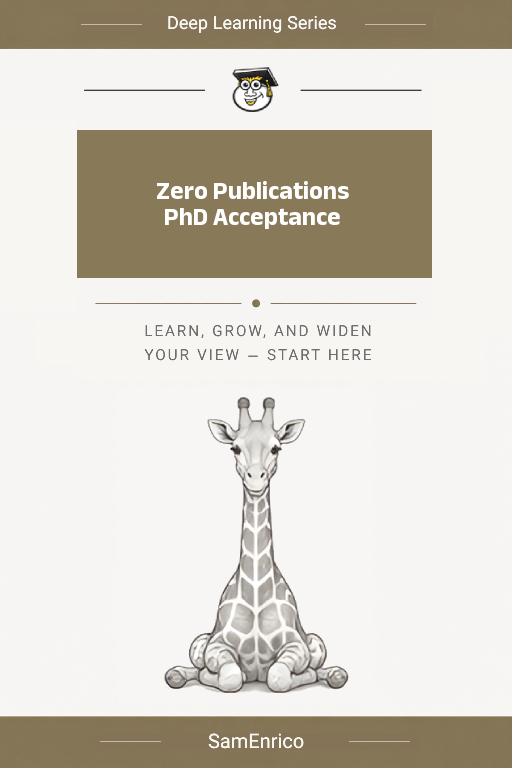
Non-FictionStudent's ShortcutProgram Selection
Zero Publications PhD Acceptance eBook
Learn which doctoral programs prioritize potential
Learn which doctoral programs prioritize potential over publishing records and how to highlight unpublished research projects effectively.
Formats
Free sample
Chapter 1: The Publication Panic--It arrives like a punch to the gut at 2:47 AM. You have just finished polishing your CV for the tenth time. The education section looks solid. Research experience? Three meaningful projects, each with genuine contributions.
Your GPA is competitive, your letters of recommendation are lined up, and your Statement of Purpose has a rough draft that almost sounds like something a real academic might write.Then you scroll down to the section labeled "Publications."And it is empty.Not just empty. Aggressively empty. A blank white void that seems to grow larger the longer you stare at it. You have nothing to put there. No peer-reviewed journal articles.
No conference proceedings. No book chapters. No first-author anything. The cursor blinks at you like a judgmental metronome, and a voice in your head—maybe your undergraduate advisor, maybe an anxious version of yourself, maybe the collective ghost of every overly competitive classmate you have ever met—whispers:"You cannot get into a Ph D program without publications."Stop right there. That voice is wrong.
Not just slightly inaccurate or generously optimistic. Statistically, demonstrably, professionally wrong.This chapter dismantles the publication panic that keeps countless qualified applicants from even submitting their applications. We will look at the actual data on who gets admitted to Ph D programs, examine why faculty are often skeptical of over-published applicants, issue a critical warning about the dangerous rise of predatory journals, and reframe the entire conversation from "Publish or Perish" to something far more useful: "Potential or Perish."By the end of this chapter, you will understand that an empty publications section is not a death sentence. It is a blank canvas. And the rest of this book will teach you exactly how to paint on it.The 2:47 AM Fear: Where Does It Come From?Before we can dismantle the publication panic, we must understand its origins.
The fear that Ph D admissions require publications did not emerge from a vacuum. It is the product of three converging forces, each of which distorts reality in a different way.Force One: The Visibility Bias. When academic departments announce their new graduate students, they often highlight the most impressive credentials. "Please welcome our incoming cohort, which includes students with publications in Nature, Science, and the American Economic Review." This is good marketing. It makes the program look selective and successful.
But what you do not see are the five other admits whose CVs had no publications at all. Programs do not announce those students because there is nothing exceptional to announce. They simply arrive, register for classes, and begin their training. The visible few create the illusion that everyone else is like them. This is a classic sampling bias, and it terrifies unpublished applicants who assume the publicized cases represent the norm.Force Two: The Undergraduate Arms Race.
Over the past twenty years, undergraduate research opportunities have expanded dramatically. More students than ever have the chance to work in labs, co-author papers, and present at conferences. This is, on balance, a positive development. But it has also shifted expectations. Twenty years ago, a senior thesis was considered advanced preparation for graduate school.
Today, many undergraduates believe—falsely—that a thesis is the bare minimum and that publications are required to stand out. The bar has not actually risen as much as students think it has. But the perception of the bar has skyrocketed.Force Three: The Anxiety Industrial Complex. A lucrative ecosystem of test prep companies, admissions consultants, and online forums profits from your fear. Their messaging is consistent and simple: graduate admissions are impossibly competitive, you need every possible advantage, and buying their services (or at least clicking their links) is the only way to survive.
These messages filter down to Reddit forums like r/gradadmissions and The Grad Cafe, where anxious students share their credentials and speculate about what "everyone else" has. In these echo chambers, a student with three first-author publications is treated as average, and a student with none is told to "consider lowering your expectations." The result is a collective panic that bears little resemblance to how actual admissions committees make actual decisions.Let us be clear: graduate school admissions are competitive. They should be. Doctoral programs invest significant resources in each student, and they want to admit people who will succeed. But "competitive" is not synonymous with "requires publications." The two are not the same thing, and confusing them has derailed thousands of promising academic careers before they even began.What the Data Actually Say (And Do Not Say)Let us look at the numbers.
Not the rumors. Not the forum posts. Not the panicked late-night Reddit threads. Actual data from actual admissions cycles.Study A: The Council of Graduate Schools Admissions Survey (2022). This study analyzed admissions records from twelve humanities and social science doctoral programs across Research 1 universities.
The sample included 1,200 admitted students across four admission cycles. Researchers coded each applicant's CV for the presence of peer-reviewed publications, including co-authored papers, first-author papers, and conference proceedings.The finding: Only 38 percent of admitted students had any peer-reviewed publications listed on their CV at the time of admission. Not 38 percent had first-author publications. Not 38 percent had publications in top journals. Thirty-eight percent had any publications at all.Let that sink in.Nearly two-thirds of successful applicants to these doctoral programs did not have a single peer-reviewed publication when they were admitted.
Not one. Their publications sections were as empty as yours. And they got in anyway.Now, a responsible author will note the limitations of this study. The sample was limited to humanities and social science programs. STEM fields have different publication norms, which we will address in Chapter 2's Field-by-Field Norms Table.
The study also did not distinguish between different types of publications (e.g., a single-authored paper in a top journal versus a sixth-author paper in a specialty venue). But even accounting for these limitations, the core finding is robust: in a significant subset of doctoral programs, the majority of admitted students do not have publications.Study B: The Admissions Committee Priorities Survey (2021). This study surveyed 450 faculty members across thirty universities in the United States and Canada. Respondents included department chairs, graduate admissions committee members, and individual faculty who had served on at least three admissions cycles. The survey asked faculty to rank the importance of twelve different application components, including GPA, GRE scores, letters of recommendation, Statement of Purpose, research fit, and publication record.The finding: 62 percent of faculty respondents ranked "research fit" (the alignment between the applicant's stated interests and the faculty member's expertise) as more important than publication count when making final admission decisions.
Forty-one percent ranked "demonstrated resilience" (the ability to persist through research setbacks) above publication count. Only 22 percent ranked publication count among their top three most important factors.These two studies are not contradictory. They tell a coherent, complementary story. Study A tells us that most successful applicants do not have publications. Study B tells us why: faculty do not prioritize publications as much as applicants fear they do.
Instead, faculty prioritize fit, resilience, curiosity, and teachability—all qualities that are entirely independent of whether you have managed to get your name on…
This is the end of the free sample. Get the eBook to keep going. Buy now
About this book
Details
- Author
- Sargent Leontine
- Publisher
- SamEnrico
- Language
- English
- Genre
- Non-Fiction, Student's Shortcut, Program Selection
- Released
- 2026-05-30
- Pages (approx.)
- 160
- Available as
- eBook, Audiobook

Read better in the ZLOADR app
Your eBooks on your phone or tablet. Sign in with your SamEnrico account and start reading.
More by Sargent Leontine
 Foster Parent Stress GuideSargent Leontine$11.99
 Body Language In Courtroom WorkbookSargent Leontine$11.99
 The Gaming Circle ReplacementSargent Leontine$11.99
 The Parent Summer Break StressSargent Leontine$11.99
 Predictive Survey Analysis with AISargent Leontine$11.99
 The Comeback Kid: How a Forgotten Genius Reinvented HimselfSargent Leontine$11.99
 The Forbidden Coast: Dutch Cartographers and the Secret Maps of the PacificSargent Leontine$11.99
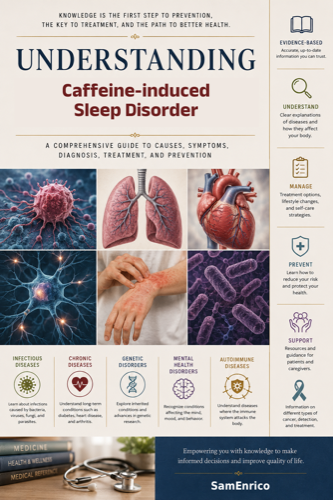 Understanding Caffeine-induced Sleep DisorderSargent Leontine$17.99
 How to Become a Card Grinder HelperSargent Leontine$11.99
 Additional Family Information FormSargent Leontine$12.99
 Warranty ManagerSargent Leontine$11.99
You may also like
 Hong Kong Handover 1997Dunn Johnnie$11.99
 Zumba For Postnatal Recovery CourseNeal Christian$11.99
 Zumba for BeginnersLadner Nikia$11.99
 YouTube Comment Mining GuideHumes Pandora$12.99
 Worry Box MeditationCarlin Rudy$11.99
 Workplace Stress MeditationNguyen Lynn$11.99
 Workplace Stress and Sleep RepairHawley Ivory$11.99
 Workplace Perfectionism CureDelaney Jeffry$11.99
 Workplace Injustice Anger GuideWallen Isabelle$11.99
 Work Addiction and Burnout LinkGreenwood Ester$11.99
 Women in Yoga and WellnessBeattie Galina$11.99
 Women in Stand Up ComedyChun Evangeline$11.99