
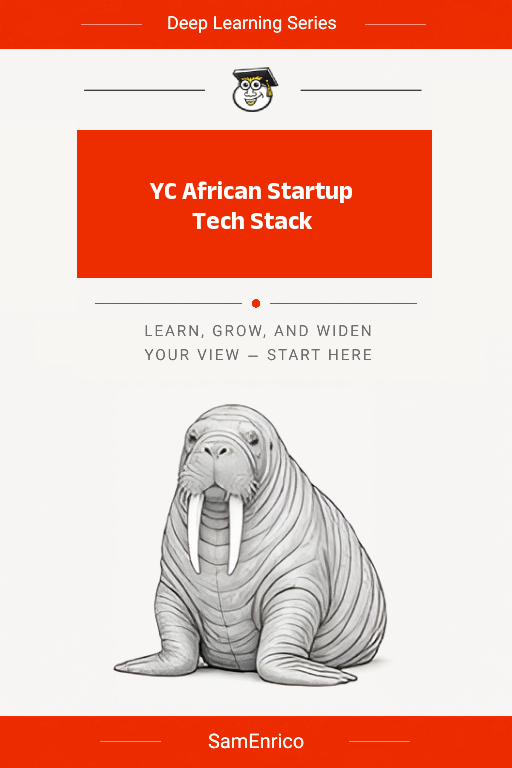
Non-FictionStartup GuideAccelerator Prep
YC African Startup Tech Stack Audiobook
Choose technology stack for Y Combinator applicati
by Hong David
Choose technology stack for Y Combinator application. Scalable architecture for African markets.
Formats
Free sample
Chapter 1: The Leapfrog Paradox--–- On a humid Tuesday morning in Lagos, two technical founders sat side by side preparing their Y Combinator applications. One had spent the previous six weeks architecting a stunning distributed system—Kubernetes clusters spanning three cloud providers, a service mesh for inter-service communication, and a real-time data pipeline using Apache Kafka. His dashboard showed 47 microservices, 12 databases, and a cloud bill that had already reached 340beforewritingasinglelineofbusinesslogic.Theotherfounderhadbuiltasingle Next.jsapplicationdeployedon Vercel′sfreetier,a Postgre SQLdatabaseon Supabase,andaqueueusing Bull MQrunningona340 before writing a single line of business logic. The other founder had built a single Next.js application deployed on Vercel's free tier, a Postgre SQL database on Supabase, and a queue using Bull MQ running on a 340beforewritingasinglelineofbusinesslogic.Theotherfounderhadbuiltasingle Next.jsapplicationdeployedon Vercel′sfreetier,a Postgre SQLdatabaseon Supabase,andaqueueusing Bull MQrunningona5 Redis instance. Her entire infrastructure cost $7.23 for the month, and she had already onboarded 89 beta users who were actively testing her logistics platform.Both applied to Y Combinator.
The distributed systems architect received a rejection email within three weeks. The founder with the $7.23 monolith received an interview invitation.This is not a hypothetical. It is a pattern that repeats every single batch. And it reveals the central paradox of building an African startup worthy of Y Combinator's attention: the technologies that seem "advanced" to a Silicon Valley engineer are often the very signals that get your application rejected, while the technologies that seem "basic" or "behind" are precisely what enable the speed, cost structure, and customer empathy that YC partners actually fund.This chapter reframes the concept of "starting late" not as a disadvantage to overcome, but as a strategic weapon that African founders can wield against over-engineered, capital-intensive competition. We will dismantle the mythology of technical sophistication, introduce the phased roadmap that guides this entire book, and establish why the most successful YC companies from Africa look nothing like the architecture diagrams that win awards at tech conferences.The Myth of the "Modern Stack"Before we can leverage the leapfrog advantage, we must first identify and discard a dangerous assumption: that the technology choices of well-funded Silicon Valley startups represent progress that African founders should emulate.
This assumption is not merely wrong—it is actively harmful to your YC application.Consider what a typical "modern" US startup builds today. They inherit a legacy of technical debt: integrations with banks running COBOL mainframes from the 1970s, healthcare systems built…
This is the end of the free sample. Get the Audiobook to keep going. Buy now
About this book
Details
- Author
- Hong David
- Publisher
- SamEnrico
- Language
- English
- Genre
- Non-Fiction, Startup Guide, Accelerator Prep
- Released
- 2026-05-30
- Pages (approx.)
- 145
- Available as
- eBook, Audiobook

Listen in the VoxFlicks app
Audiobooks and audio dramas wherever you go. Sign in with your SamEnrico account and press play.
More by Hong David
 Disability Accommodation AngerHong David$11.99
 Professional Ethics and Addiction RecoveryHong David$11.99
 Portfolio Management InnovationHong David$11.99
 Ceiling Height InfluenceHong David$11.99
 The Ransom of Fort Pillow: The Betrayal That Shook the NationHong David$11.99
 VAT and EducationHong David$12.99
 Understanding TularemiaHong David$17.99
 How to Become a Planimeter OperatorHong David$11.99
 Design CoordinatorHong David$11.99
You may also like
 Hong Kong Handover 1997Dunn Johnnie$11.99
 Zumba For Postnatal Recovery CourseNeal Christian$11.99
 Zumba for BeginnersLadner Nikia$11.99
 YouTube Comment Mining GuideHumes Pandora$12.99
 Worry Box MeditationCarlin Rudy$11.99
 Workplace Stress MeditationNguyen Lynn$11.99
 Workplace Stress and Sleep RepairHawley Ivory$11.99
 Workplace Perfectionism CureDelaney Jeffry$11.99
 Workplace Injustice Anger GuideWallen Isabelle$11.99
 Work Addiction and Burnout LinkGreenwood Ester$11.99
 Women in Yoga and WellnessBeattie Galina$11.99
 Women in Stand Up ComedyChun Evangeline$11.99