
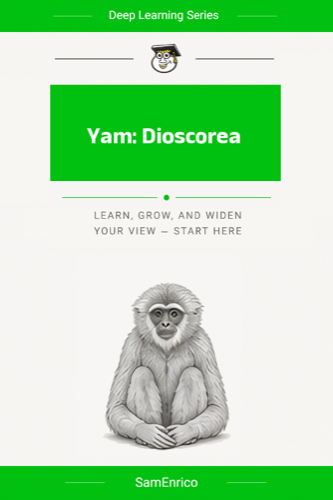
Yam: Dioscorea
This harvesting publication, published by SamEnric
This harvesting publication, published by SamEnrico, covers Yam: Dioscorea
Formats
About this book
Free sample
Chapter 1: The Forgotten Tuber...--–- The first thing you need to know about yams is that you have almost certainly confused them with something else. Walk into any grocery store in North America or Europe, and you will find a bin of orange-fleshed roots labeled "yams." They are not yams. They are sweet potatoes—Ipomoea batatas—and the mislabeling is a century-old marketing trick that has buried the true yam in obscurity. Walk into a market in Lagos, Abidjan, or Accra, and you will find the real thing: tubers the size of a human torso, with rough, bark-like brown skin and flesh that ranges from white to yellow to purple. These are Dioscorea, and they feed over 300 million people daily.
Yet outside the tropics, almost no one knows their name. This book is here to fix that.The true yam is one of agriculture's most remarkable and most neglected crops. It is also one of the oldest. Archaeological evidence places yam cultivation in West Africa and Southeast Asia at least 11,000 years ago, making yams one of the earliest domesticated plants—contemporary with wheat and barley in the Fertile Crescent, older than rice in China, and millennia ahead of maize in the Americas. Yams sustained ancient kingdoms, powered transatlantic slave ships (as provisions for enslaved Africans), and remain the foundation of food security across the yam belt today.
Yet yams have received a fraction of the research funding, breeding attention, and market development given to potatoes, cassava, or sweet potatoes.This neglect is not merely historical curiosity. It is an emergency. Climate change is destabilizing staple crop production across the tropics. Cassava, maize, and rice are struggling with rising temperatures, erratic rainfall, and new pest pressures. Yams, by contrast, possess remarkable resilience: many species tolerate drought, heat, and poor soils that would devastate other crops.
But that resilience is untapped. Yields remain low. Post-harvest losses run as high as 40 percent. And the knowledge needed to grow yams well—the accumulated wisdom of millennia—is at risk of being lost as younger generations leave farming for cities.This chapter introduces you to the…
This is the end of the free sample. Get the eBook to keep going. Buy now
Contents
- Chapter 1
- Chapter 2
- Chapter 3
- Chapter 4
- Chapter 5
- Chapter 6
- Chapter 7
- Chapter 8
- Chapter 9
- Chapter 10
- Chapter 11
- Chapter 12
Details
- Author
- Mcdowell Amie
- Publisher
- SamEnrico
- Language
- English
- Genre
- Non-Fiction, Informative, Educational
- Released
- 2026-06-02
- Pages (approx.)
- 154
- Available as
- eBook, Audiobook

Read better in the ZLOADR app
Your eBooks on your phone or tablet. Sign in with your SamEnrico account and start reading.
More by Mcdowell Amie
 Memrise for Language LearningMcdowell Amie$11.99
 Pain as Weather MeditationMcdowell Amie$11.99
 Alcoholism Brain Recovery ScienceMcdowell Amie$11.99
 Bengal Jungle Tiger HunterMcdowell Amie$11.99
 The Financial Stress and HolidaysMcdowell Amie$11.99
 Open Innovation for BusinessMcdowell Amie$11.99
 Daily Planning RitualsMcdowell Amie$11.99
 Meditation for IBS PainMcdowell Amie$11.99
 The Golden Road of the Kingdom of Ghana: Trade, Wealth, and WisdomMcdowell Amie$11.99
 Whispers of the Celestial Weavers: The Lost Art of Star-Mapping NomadsMcdowell Amie$11.99
 How to Produce a Reaper-binderMcdowell Amie$11.99
 The Essential Guide to HealingMcdowell Amie$11.99