
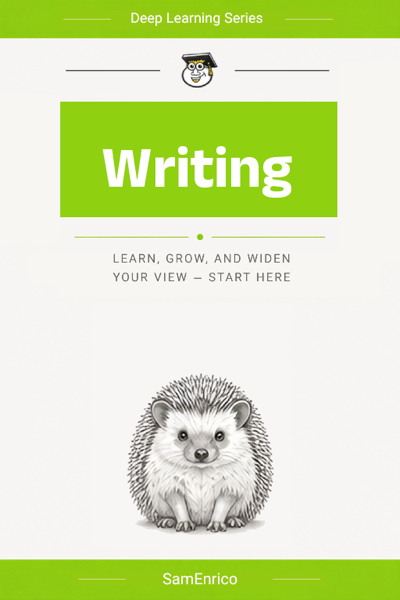
Non-FictionInformativeEducational
Writing eBook
A Coursebook on Writing
A Coursebook on Writing
Formats
Free sample
Chapter 1: The Permission to Suck--–- Every writer I have ever met—from first-time novices to prize-winning novelists—carries the same secret fear. It lives in the chest, just behind the sternum, and it whispers the same four words at the same four moments: right before you sit down to write, right after you read something beautiful, right when someone asks what you are working on, and right now. The four words are these: I am a fraud. You believe that real writers—the ones who deserve the title—wake up inspired, pour coffee into a ceramic mug, and watch sentences arrange themselves like magnetic poetry on a refrigerator. You believe they never stare at a blinking cursor for forty-five minutes.
You believe they never write a sentence, hate it, delete it, rewrite it, hate it again, and then close the laptop to watch television in ashamed silence. You believe this because every book about writing, every workshop, every well-meaning teacher has accidentally taught you the opposite of the truth. They have taught you that writing is a mystical act reserved for the gifted few. They have taught you that talent is a birthright, not a muscle. They have taught you to worship the finished product—the perfect paragraph, the seamless chapter, the novel that feels inevitable—and to despise the ugly, sweating, swearing process that produces it.This chapter exists to unteach all of that.
Here is the truth that the bestselling writers know and the beginners do not: every good writer is a bad writer who refused to quit. The difference between the person who finishes a draft and the person who talks about finishing a draft is not talent, not education, not a muse, not a cabin in the woods. The difference is permission. Permission to write badly. Permission to be confused.
Permission to produce something embarrassing and then fix it later. Without that permission, you will never write more than three paragraphs. With it, you can write anything.The Myth of the Tortured Genius Let us name the enemy. The enemy is not your lack of skill. The enemy is a story you have been told so many times that you mistake it for reality.
It is the myth of the tortured genius—the writer who drinks whiskey from a coffee mug, stares out a rain-streaked window, and produces a thousand perfect words before breakfast. This writer does not exist. Or rather, this writer exists only in movies and in the carefully curated memoirs of writers who have forgotten their own struggles. Ernest Hemingway, who is often held up as the archetype of the macho genius, rewrote the ending of A Farewell to Arms thirty-nine times. Thirty-nine.
He did not brag about this. He did not put it on his book jacket. But the evidence sits in archives for anyone who cares to look. The genius you admire spent more time failing than you have spent trying.I want you to perform a small experiment. Go to your bookshelf.
Pull down a novel you love—one that feels effortless, inevitable, as if the author simply transcribed a dream. Now open it to any page. Look at the sentences. They are not magic. They are choices.
Someone chose every word, every comma, every line break. That someone probably chose badly a hundred times before choosing well. You are seeing the final draft, the tenth draft, the twentieth draft. You are seeing the fossil of a living process. The dinosaur did not become a fossil overnight.The myth of the tortured genius does more than lie about the writing process.
It also lies about the writer's psychology. It suggests that pain is necessary for art—that if you are not suffering, you are not doing it right. This is not only false; it is dangerous. The best writing comes from curiosity, not misery. It comes from engagement with the world, not withdrawal from it.
The writers who sustain long careers are not the ones who suffered the most; they are the ones who built sustainable habits, found joy in the craft, and learned to separate their self-worth from their daily word count.The Two Enemies: Fear and Perfectionism If the myth of the tortured genius is the story, then fear and perfectionism are the characters who enforce it. They work together, a tag-team of paralysis.Fear wears many masks. Fear of failure: What if I write this whole thing and it's terrible? Fear of judgment: What will my friends think? What if they laugh?
Fear of the blank page: I have nothing to say. Who am I to speak? Fear of success: What if I actually finish? What would I do then? Fear of exposure: If I write what I really think, people will see who I am.Perfectionism is fear's more sophisticated sibling.
Perfectionism does not say "don't write." Perfectionism says "write, but make sure it's good on the first try." Perfectionism is the voice that tells you to delete the first paragraph because it isn't quotable. Perfectionism is the voice that makes you research for three hours instead of drafting for thirty minutes. Perfectionism is the voice that convinces you that you are "just not ready yet" — that you need to read one more book, take one more class, find one more insight before you begin.Here is what perfectionism actually is: a coward's excuse. Perfectionism is not a commitment to quality; it is a commitment to not finishing. If you never finish, you can never be judged.
If you never finish, you can always tell yourself that your unwritten novel would have been brilliant. The perfect unwritten book is always better than the flawed finished one. But the perfect unwritten book is also not a book. It is a fantasy. And fantasies keep you warm at night, but they do not pay rent.The only cure for perfectionism is permission.
Permission to write a sentence that is merely adequate. Permission to write a page that you will later throw away. Permission to write a scene that goes nowhere, a character who is boring, an ending that fizzles. You cannot fix what does not exist. You cannot polish a blank page.
The first draft is not the product; the first draft is the raw material from which the product will be made.Anne Lamott's Shitty First Draft In 1994, the writer Anne Lamott published a book called Bird by Bird. In it, she introduced a concept that has since become scripture in writing workshops across the world: the Shitty First Draft. Lamott writes that all good writers write shitty first drafts. They do not write elegant sentences on the first pass. They write something closer to a child's diary—clunky, repetitive, self-indulgent, meandering.
And then they fix it. The second draft is for making it look like you knew what you were doing all along. The third draft is for making it sing.Lamott tells the story of her father, a writer, who would sit at the kitchen table and type. When she asked him what he was doing, he would say, "I'm writing a shitty first draft." He said it cheerfully, without shame. He normalized failure as…
This is the end of the free sample. Get the eBook to keep going. Buy now
About this book
Details
- Author
- Omarah Sharice
- Publisher
- SamEnrico
- Language
- English
- Genre
- Non-Fiction, Informative, Educational
- Released
- 2026-05-06
- Pages (approx.)
- 147
- Available as
- eBook, Audiobook

Read better in the ZLOADR app
Your eBooks on your phone or tablet. Sign in with your SamEnrico account and start reading.
More by Omarah Sharice
 Video Call Efficiency GuideOmarah Sharice$11.99
 Food Addiction in Bariatric PatientsOmarah Sharice$11.99
 Flow and ExerciseOmarah Sharice$11.99
 The Brainwriting Technique GuideOmarah Sharice$11.99
 Real Estate Agent Small TalkOmarah Sharice$11.99
 The Navigators of the Indian Ocean: The Swahili Mariners and Their Golden AgeOmarah Sharice$11.99
 Ghana Startup Cost GuideOmarah Sharice$12.99
 Founder Medication ManagementOmarah Sharice$12.99
 Understanding Winkelman–bethge–pfeiffer SyndromeOmarah Sharice$17.99
 Ultimate Handbook Guide to Bengbu : (China) Travel GuideOmarah Sharice$11.99
You may also like
 Hong Kong Handover 1997Dunn Johnnie$11.99
 Zumba For Postnatal Recovery CourseNeal Christian$11.99
 Zumba for BeginnersLadner Nikia$11.99
 YouTube Comment Mining GuideHumes Pandora$12.99
 Worry Box MeditationCarlin Rudy$11.99
 Workplace Stress MeditationNguyen Lynn$11.99
 Workplace Stress and Sleep RepairHawley Ivory$11.99
 Workplace Perfectionism CureDelaney Jeffry$11.99
 Workplace Injustice Anger GuideWallen Isabelle$11.99
 Work Addiction and Burnout LinkGreenwood Ester$11.99
 Women in Yoga and WellnessBeattie Galina$11.99
 Women in Stand Up ComedyChun Evangeline$11.99