
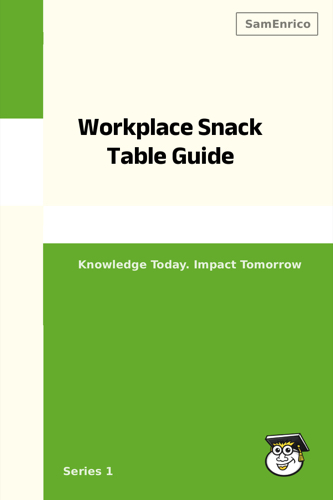
Non-FictionSelf-HelpOffice Eating
Workplace Snack Table Guide eBook
Survives office treats and birthdays.
Survives office treats and birthdays.
Formats
Free sample
Chapter 1: The Donut Lie--–- The first lie you are told at work is not about salary, promotion prospects, or job security. It comes on a cardboard box, glazed in sugar, and sits on a folding table next to a stack of napkins that are too thin to be useful. The lie whispers: This is free. This is a gift. This is for you.No one says it aloud, of course.
But the implication hangs in the air like the faint smell of stale coffee and artificial vanilla. Your employer—or your well-meaning coworker, or the manager who wants to be liked—has provided these donuts as a kindness. A perk. A small bright spot in the otherwise gray landscape of spreadsheets and email threads. And because it is free, because it is offered, because everyone else is reaching for one, you feel not just invited but obligated to participate.This is the Donut Lie, and it is the most expensive free food you will ever eat.Not expensive in dollars.
The donut itself costs your employer maybe two dollars, probably less if they bought in bulk from a big-box store. But the cost to you—to your waistline, your energy levels, your digestive system, your carefully maintained nutritional goals, and your sense of autonomy—is orders of magnitude higher. That two-dollar donut, consumed mindlessly at 10:30 AM because it was there and because Kevin from accounting was on his third one and you did not want to seem stuck-up, costs you something real. It costs you a choice. It costs you a moment of agency.
And over the course of a year, it costs you an entire toddler's worth of body weight.Let us do the math, because the math does not lie even when the donut does. The average American office worker consumes approximately 1,300 hidden calories per week from workplace snacks. That is not lunch. That is not the meal you packed or bought. That is the extra stuff: the birthday cake, the leftover pizza, the "surprise" cookie tray, the bagel Wednesday, the Friday donuts, the jar of candy on the reception desk that you walk past twelve times a day.
Those calories add up to 67,600 per year. Divide by 3,500—the approximate number of calories in a pound of body fat—and you get 19.3 pounds. You are, in effect, eating nineteen pounds of free office snacks annually without ever sitting down for a meal.That is the weight of an average two-year-old child. You are eating a toddler every year, one free donut at a time.And here is the crueler truth: no one is forcing you. No one is holding a gun to your head and demanding you consume the stale croissant.
The pressure is softer, more insidious, and therefore harder to resist. It is the pressure of belonging. The pressure of politeness. The pressure of scarcity—the fear that if you do not grab a slice now, Kevin will eat the whole pizza and you will have missed your chance. That fear, that subtle social engineering, is not an accident.
It is not a bug in the system. It is a feature.The snack table is not innocent. It is not a neutral gathering place where food happens to appear. It is a carefully designed environment, whether intentionally or not, that exploits known weaknesses in human psychology. And until you understand how it works—until you can see the invisible architecture of temptation that surrounds you every single day—you will continue to lose a battle you did not even know you were fighting.This chapter is your first weapon.
It is not a diet book. It does not tell you what to eat or shame you for what you have already eaten. It does not demand willpower, because willpower is a finite resource and the snack table is infinite. What it offers instead is something rarer and more useful: awareness. The ability to see the snack table for what it really is.
The ability to recognize the psychological traps before you fall into them. And the ability to make a choice—a real choice, not a reflex—about whether and what to eat.By the end of this chapter, you will understand the three hidden forces that make office snacks so irresistible: the Mindless Margin, the Scarcity Loop, and the Visual Trap. You will learn why your brain treats a free donut differently than a paid one, even when the donut is identical. You will complete a simple exercise that maps the danger zones in your own breakroom. And you will walk away with a single, actionable strategy that works for unplanned snack attacks—the random donut box, the surprise cookie delivery, the jar of candy that seems to refill itself overnight.The donut is not a gift.
It is a test. And you are about to learn how to pass it.The Mindless Margin: Why You Eat Twenty Percent More at Work Let us start with a study that should terrify anyone who has ever worked in an office. Behavioral economist Brian Wansink, author of the seminal work Mindless Eating, spent decades researching how environment shapes consumption. His most famous finding is deceptively simple: people eat more when they are distracted, stressed, or eating socially than when they are focused, calm, and alone. And offices are factories of distraction, stress, and social pressure.Wansink coined the term Mindless Margin to describe the gap between how much we think we are eating and how much we actually eat.
In controlled studies, he found that people consistently underestimate their calorie consumption by about twenty percent when eating in distracting environments. Twenty percent. That is one out of every five calories you eat at work—calories you did not plan for, did not account for, and probably do not remember consuming an hour later.Why does this happen? Three reasons, each one amplified by the office environment.First, distraction. When you eat at your desk while answering emails, you are not tasting your food.
You are shoveling it in while your brain focuses on something else. The result is that your body's satiety signals—the hormones that tell you when you have had enough—never reach your conscious awareness. You eat past fullness because you never noticed you were full in the first place. A donut eaten while scrolling through Slack is not a donut; it is a calorie delivery system that bypasses your internal regulation.Second, stress. Cortisol, the stress hormone, does two things to your appetite.
In the short term, it suppresses hunger—which is why you might forget to eat during a crisis. But in the aftermath of stress, cortisol spikes your craving for high-fat, high-sugar foods. This is an evolutionary holdover: when our ancestors faced a threat and survived, their bodies demanded energy-dense foods to replenish depleted reserves. The problem is that modern office stress—a passive-aggressive email, a looming deadline, a difficult conversation with your manager—is not a physical threat. You did not run from a predator.
You do not need a donut to replenish glycogen stores. But your body does not know the difference. It only knows cortisol, and cortisol wants…
This is the end of the free sample. Get the eBook to keep going. Buy now
About this book
Details
- Author
- Haney Brunilda
- Publisher
- SamEnrico
- Language
- English
- Genre
- Non-Fiction, Self-Help, Office Eating
- Released
- 2026-06-06
- Pages (approx.)
- 153
- Available as
- eBook, Audiobook

Read better in the ZLOADR app
Your eBooks on your phone or tablet. Sign in with your SamEnrico account and start reading.
More by Haney Brunilda
 Resettled From Aysha CampHaney Brunilda$11.99
 Uber Driver Earnings StrategyHaney Brunilda$11.99
 Submission NonverbalsHaney Brunilda$11.99
 Psychological Relapse Prevention for Older AdultsHaney Brunilda$11.99
 Anticipatory Grief PoetryHaney Brunilda$11.99
 The Real Estate Agent ODHaney Brunilda$11.99
 Bedtime Stretching for Better Sleep ManualHaney Brunilda$11.99
 The Revenge of the Royal Mistress: A Sex Tape That Shook a KingdomHaney Brunilda$11.99
 The Ghost in the Machine: How a Teen Hacker Took Down a SuperpowerHaney Brunilda$11.99
 Blood and Bronze: The Forgotten Forge of TroyHaney Brunilda$11.99
 Understanding AthetosisHaney Brunilda$17.99
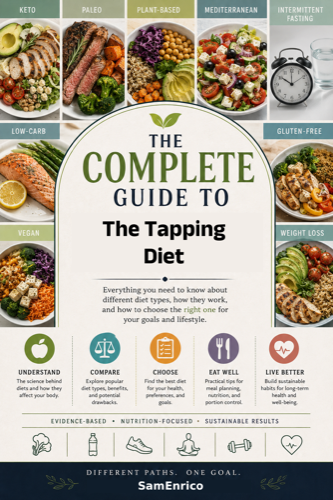 The Complete Guide to the Tapping DietHaney Brunilda$11.99
You may also like
 Hong Kong Handover 1997Dunn Johnnie$11.99
 Zumba For Postnatal Recovery CourseNeal Christian$11.99
 Zumba for BeginnersLadner Nikia$11.99
 YouTube Comment Mining GuideHumes Pandora$12.99
 Worry Box MeditationCarlin Rudy$11.99
 Workplace Stress MeditationNguyen Lynn$11.99
 Workplace Stress and Sleep RepairHawley Ivory$11.99
 Workplace Perfectionism CureDelaney Jeffry$11.99
 Workplace Injustice Anger GuideWallen Isabelle$11.99
 Work Addiction and Burnout LinkGreenwood Ester$11.99
 Women in Yoga and WellnessBeattie Galina$11.99
 Women in Stand Up ComedyChun Evangeline$11.99