
Non-FictionSelf-HelpBreathwork
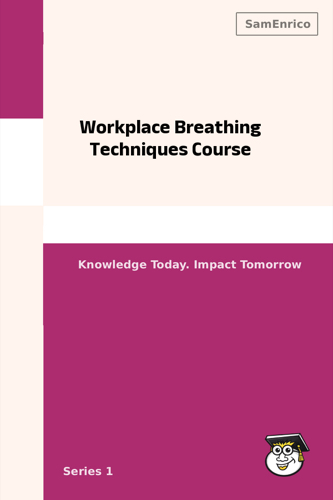
Workplace Breathing Techniques Course eBook
Teaches discreet breathing exercises to lower cort
by Acuna Golden
Teaches discreet breathing exercises to lower cortisol during stressful work moments.
Formats
Free sample
Chapter 1: The Tiger in Your Gmail--You are sitting at your desk. It is 10:47 AM on a Tuesday. You have been working for exactly two hours and thirty-seven minutes. In that time, you have checked your email eleven times, received four Slack messages, attended one back-to-back Zoom meeting that ran over by nine minutes, and eaten a cold granola bar over the keyboard because you did not have time for breakfast. Your shoulders are somewhere around your ears.
Your jaw is clenched. Your breathing is shallow—you have not taken a full inhale since approximately 9:15 AM.And you have no idea why you feel like screaming.This is not a moral failing. This is not weakness. This is not a sign that you cannot "handle" your job. This is your nervous system doing exactly what it evolved to do over hundreds of thousands of years.
The problem is not your biology. The problem is that your biology has not received the memo that the saber-toothed tiger is extinct and the passive-aggressive email is not, in fact, going to eat you.Let me tell you about Sarah.The Woman in the Parking Garage Sarah is a 34-year-old marketing director at a mid-sized software company. She is good at her job—really good. She has been promoted twice in four years. Her team likes her.
Her boss trusts her. By every external metric, Sarah is successful.But Sarah has a secret.Every morning, she arrives at the office parking garage at 7:45 AM. She sits in her car. She does not get out. For five to ten minutes, she stares at the concrete wall in front of her parking space.
Her heart races. Her palms sweat. She feels a sensation she cannot name—not quite fear, not quite dread, but something in between. A low hum of alarm, like a smoke detector with a dying battery.She thinks about the emails waiting for her. She thinks about the Slack messages she saw on her phone while brushing her teeth.
She thinks about the project timeline that slipped last week and the client who has not signed off and the meeting at 9:30 AM that she is not fully prepared for.And she thinks: Why am I like this?Here is what Sarah does not know: she is not "like this." She is not broken. She is not weak. She is a mammal with a functioning nervous system that has been triggered into a state of chronic, low-grade emergency—and she has been in that state for so long that she has forgotten what calm feels like.By the time you finish this chapter, you will understand exactly why Sarah sits in her car every morning. More importantly, you will understand why the solution is not a vacation, not a promotion, not a meditation app, and not a glass of wine. The solution is already happening right now, as you read these words.
You are breathing. You have always been breathing. You have simply been breathing wrong for the modern workplace.The Saber-Toothed Tiger and the Passive-Aggressive Email Let us travel back in time. Way back. Picture a savanna, 100,000 years ago.
You are a hominid. You are standing in tall grass, looking for berries, when suddenly—movement. A saber-toothed tiger, thirty feet away, locked onto you with yellow eyes.What happens next is a masterpiece of biological engineering.Your hypothalamus (a tiny structure deep in your brain) sounds the alarm. It activates your sympathetic nervous system—the "fight or flight" branch. Your adrenal glands dump epinephrine (adrenaline) and cortisol into your bloodstream.
Your heart rate jumps from 70 to 140 beats per minute. Your breathing becomes rapid and shallow, maximizing oxygen intake. Your pupils dilate. Blood rushes away from your digestive system (you do not need to digest berries right now) and toward your large muscle groups (you do need to run or fight). Your non-essential systems shut down.
Your peripheral vision narrows, focusing entirely on the threat.This is the stress response. It is fast, powerful, and life-saving. You either outrun the tiger, fight it off, or you do not. Either way, the event is over in minutes. Your body returns to baseline.
You digest your berries. You live to see another sunrise.Now travel forward 100,000 years. You are sitting at your desk. The tiger is gone. But your inbox has 247 unread messages.
Your boss just sent a message that says, in part, "Per my last email..." Your coworker is typing something in a Slack channel that you are mentioned in. A calendar notification just popped up for a meeting that starts in four minutes and you have not reviewed the agenda.Your body does not know the difference.Here is the brutal truth that every stressed professional needs to understand: your nervous system cannot distinguish between a saber-toothed tiger and a passive-aggressive email. The same cascade of hormones. The same racing heart. The same shallow breathing.
The same tunnel vision. The same shutdown of non-essential systems.The only difference is that the tiger attack is over in five minutes. The email sits in your inbox. The Slack notification remains unread. The meeting is still on your calendar.
The cortisol stays in your bloodstream. And another email arrives. And another. And another.This is not acute stress. This is chronic stress.
And chronic stress is a slow poison.The Concept That Will Change How You See Stress: Allostatic Load In the 1990s, a neuroscientist named Bruce Mc Ewen introduced a concept that revolutionized our understanding of chronic stress. He called it allostatic load.Here is the simple version: Your body has a remarkable ability to adapt to challenges. When a stressor appears, your systems ramp up (heart rate increases, cortisol spikes, breathing changes). When the stressor disappears, your systems ramp back down. This process of ramping up and down is called allostasis—maintaining stability through change.Allostatic load is the wear and tear that accumulates when your systems ramp up too often, or when they fail to ramp back down.Think of your body as a car.
The stress response is like revving the engine. Revving the engine occasionally—when you need to merge onto a highway or pass a slow truck—is fine. The car is designed for that. But revving the engine for hours, days, weeks, months? That damages the engine.
The oil breaks down. The belts wear out. The transmission starts to slip.Allostatic load is the accumulated damage of chronic revving.Here is what allostatic load looks like in human terms:You wake up tired, even after eight hours of sleep You get sick more often than your coworkers You have trouble concentrating on tasks that used to be easy You snap at your partner or children over small things You reach for caffeine, sugar, or alcohol to regulate your mood You lie awake at night thinking about the email you sent at 4:47 PMYou have gained weight, especially around your midsection (cortisol belly)You cannot remember the last time you felt genuinely relaxed If you recognize yourself in any of these symptoms, you are not imagining things. You are not "bad at handling stress." You have accumulated allostatic load. And the only way to reduce it…
This is the end of the free sample. Get the eBook to keep going. Buy now
About this book
Details
- Author
- Acuna Golden
- Publisher
- SamEnrico
- Language
- English
- Genre
- Non-Fiction, Self-Help, Breathwork
- Released
- 2026-06-08
- Pages (approx.)
- 136
- Available as
- eBook, Audiobook

Read better in the ZLOADR app
Your eBooks on your phone or tablet. Sign in with your SamEnrico account and start reading.
More by Acuna Golden
 Academic Stress and Academic ProbationAcuna Golden$11.99
 Body Scan for Stress ReliefAcuna Golden$11.99
 Loneliness for Empty NestersAcuna Golden$11.99
 The White Rose and the Red: The Bloody Inheritance of York and LancasterAcuna Golden$11.99
 London Waste Management GuideAcuna Golden$12.99
 How to Produce BagpipesAcuna Golden$11.99
 Symphony of FearAcuna Golden$11.99
 How to Start a Dial for Telephone Business (Beginners Guide)Acuna Golden$11.99
You may also like
 Hong Kong Handover 1997Dunn Johnnie$11.99
 Zumba For Postnatal Recovery CourseNeal Christian$11.99
 Zumba for BeginnersLadner Nikia$11.99
 YouTube Comment Mining GuideHumes Pandora$12.99
 Worry Box MeditationCarlin Rudy$11.99
 Workplace Stress MeditationNguyen Lynn$11.99
 Workplace Stress and Sleep RepairHawley Ivory$11.99
 Workplace Perfectionism CureDelaney Jeffry$11.99
 Workplace Injustice Anger GuideWallen Isabelle$11.99
 Work Addiction and Burnout LinkGreenwood Ester$11.99
 Women in Yoga and WellnessBeattie Galina$11.99
 Women in Stand Up ComedyChun Evangeline$11.99