
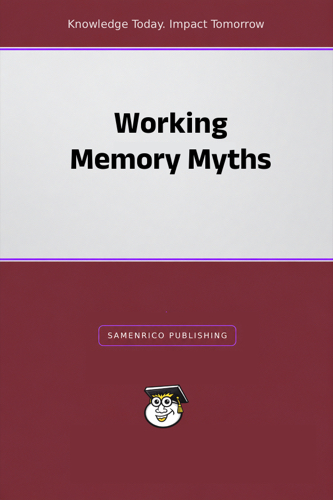
About this book
Free sample
Chapter 1: The Invisible Workbench...--Every morning, millions of people perform a quiet ritual of self-judgment. They walk out their front door, pull it shut, and then immediately pat their pockets. Keys? Wallet? Phone?
For a split second, panic rises. Did I remember everything? Then relief—or frustration. The keys are there. The wallet is there.
But the grocery list? Still on the kitchen counter. Another thing forgotten. Another small failure to add to the accumulating evidence that their memory is, somehow, broken.This experience is so universal that we have stopped questioning what it actually means. We accept the conclusion without examining the premises: I forgot because my memory is bad.
My memory is bad because it is too small, or too disorganized, or getting old. Something is wrong inside my head. But what if the premise is wrong? What if you are not forgetting because your memory is broken? What if you are forgetting because you are asking your memory to do something it was never designed to do?This chapter will introduce you to the single most important idea in this entire book: working memory is not a storage device.
It is a workbench. And once you understand the difference between storage and workbenches, everything about your cognitive life will make more sense—including why you keep forgetting your grocery list.The Metaphor That Controls Your Life Without Your Permission Before we can rebuild your understanding of working memory, we must first demolish the old one. The demolition target is a metaphor so deeply embedded in our culture that most people do not even recognize it as a metaphor. They think it is a fact.The metaphor is this: memory is a container. A box.
A filing cabinet. A hard drive. Something that holds things. Something that can be full or empty, organized or messy, large or small.This metaphor appears everywhere. When we say "I need to hold that thought," we are treating thoughts as objects that can be held.
When we say "My brain is full," we are treating the brain as a container with limited volume. When we…
This is the end of the free sample. Get the eBook to keep going. Buy now
Contents
- Chapter 1
- Chapter 2
- Chapter 3
- Chapter 4
- Chapter 5
- Chapter 6
- Chapter 7
- Chapter 8
- Chapter 9
- Chapter 10
- Chapter 11
- Chapter 12
Details
- Author
- Baum Su
- Publisher
- SamEnrico
- Language
- English
- Genre
- Non-Fiction, Self-Help
- Released
- 2026-06-06
- Pages (approx.)
- 153
- Available as
- eBook, Audiobook

Read better in the ZLOADR app
Your eBooks on your phone or tablet. Sign in with your SamEnrico account and start reading.
More by Baum Su
 Nap Environment SetupBaum Su$11.99
 Road Rage for Delivery DriversBaum Su$11.99
 Alternative Depreciation System GuideBaum Su$11.99
 Loving Kindness for a Teenage RebelBaum Su$11.99
 Stress And Hives ScienceBaum Su$11.99
 Immigrant SaaS Unicorn Builder GuideBaum Su$11.99
 Benigno AquinoBaum Su$11.99
 Anger Transformation With NVCBaum Su$11.99
 The Great Balloon Blunder: How a Skyward Empire Fell to EarthBaum Su$11.99
 The Dragon’s Last Lament: A Breton Ballad of Fire and SorrowBaum Su$11.99
 Liza with a Z: The Unstoppable Force of Liza MinnelliBaum Su$11.99
 Web App Development BusinessBaum Su$11.99
You may also like
 Workplace Stress MeditationNguyen Lynn$11.99
 Volcano Monitoring ScientistCox Alexis$11.99
 The Tech Professional NetAguiar Nevada$11.99
 The Morning Metta RitualCanales Anya$11.99
 The Chunking Memory TechniqueClanton Hyacinth$11.99
 The Beginner Mistake FixAmmons Cassondra$11.99
 Surrendering to What IsGrimm Reatha$11.99
 Self Hypnosis for Fear of FireBillups Eli$11.99
 Road Rage for Professional DriversBrackett Janise$11.99
 Psychiatric Ward Nurse StressDunning Wyatt$11.99
 Observation vs Evaluation NVCTimmons Alda$11.99
 Networking for Nonprofit ProfessionalsPoole Jesse$11.99