
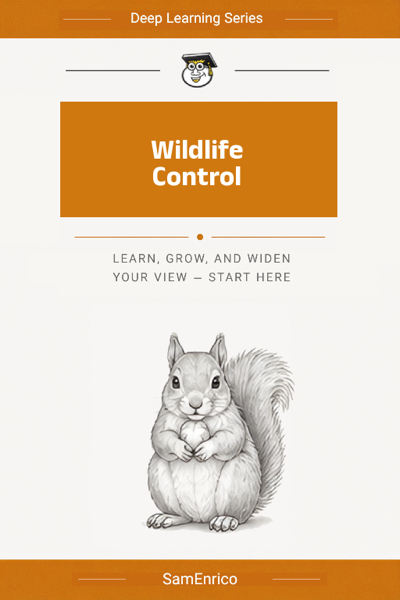
Non-FictionInformativeEducational
Wildlife Control eBook
A Coursebook on Wildlife Control
by Sams Mollie
A Coursebook on Wildlife Control
Formats
Free sample
Chapter 1: The Skunk Under the Porch--The first time I ever heard a wildlife control professional called to a job, it was three in the morning, and the homeowner was standing in her bathrobe on the front lawn, holding a flashlight like a weapon. She had heard scratching beneath her bedroom floor for three nights—a sound she first dismissed as mice, then recognized as something larger, and finally, at two forty-seven that morning, confirmed as a skunk that had clawed through the lattice work and taken up residence directly beneath her newborn's nursery.Her question was not philosophical. She did not ask about the North American Model of Wildlife Conservation or the ethical nuances of lethal versus non-lethal control. She asked one thing: "How do I get it out without getting sprayed?"That question—practical, urgent, and deeply human—is the reason this book exists.Wildlife control is not pest control. It is not hunting, though it sometimes uses hunting tools.
It is not animal rescue, though it frequently involves compassion. It is a distinct profession at the intersection of ecology, construction, law, public health, and ethics. The woman on the lawn did not need a lecture on conservation theory. She needed someone who understood skunk behavior well enough to predict that the animal would not leave voluntarily, who knew that excluding it without providing an exit would trap it to die in the walls, and who had the equipment to handle the situation without creating a biohazard or a neighborhood-wide stink.This chapter establishes the foundation for everything that follows. It traces the history of human-wildlife conflict from subsistence hunting to suburban sprawl, introduces the legal and ethical framework that separates professional wildlife control from extermination, and defines the role of the Wildlife Control Operator as a steward rather than a killer.
Most importantly, it introduces the Ethical Thresholds Framework—a decision-making tool that resolves the apparent contradiction between caring for animals and sometimes having to remove them permanently.By the end of this chapter, you will understand why wildlife control exists as a separate discipline, what principles guide professional practice, and how to determine—in any situation—whether intervention is justified and what form it should take.The Long History of Conflict Human beings have never lived apart from wildlife. For most of our existence, the relationship was asymmetrical: we were prey as often as predator. Our ancestors competed with wolves for carcasses, lost stored grain to rodents, and occasionally became meals for large cats and bears. The response was simple: kill what threatened you, drive away what competed with you, and tolerate what left you alone.The shift from subsistence to agriculture changed everything. Permanent settlements meant stored food, which attracted rodents.
Domesticated animals attracted predators. Crops concentrated edible plants into vulnerable monocultures. For the first time, humans had a sustained economic interest in excluding wildlife from specific spaces—not just surviving encounters, but protecting investments.The Industrial Revolution and subsequent urbanization created the modern wildlife conflict landscape. As cities expanded into former forests and farmlands, we did not push wildlife away. We created edge habitats—the transition zones between wilderness and development—where many species thrive.
Raccoons, skunks, opossums, squirrels, deer, and coyotes discovered that suburbs offered ideal conditions: abundant food (unsecured garbage, pet food, bird feeders, gardens), reliable water (ornamental ponds, irrigation runoff, swimming pools), and shelter (attics, crawl spaces, chimneys, decks, porches) with significantly fewer predators than rural or wild areas.The result is a paradox of conservation success. Many species that were locally extirpated a century ago have rebounded dramatically. White-tailed deer populations in the eastern United States, estimated at fewer than 500,000 in 1900, now exceed 30 million. Raccoons, once trapped heavily for fur, are now more abundant in cities than in rural areas. Canada geese, protected during population crashes in the mid-20th century, now form permanent resident populations that never migrate and foul parks, golf courses, and suburban ponds.This success has created conflict.
A deer that eats hostas is not a threat to the species. A raccoon that tears open a trash bag is not an ecological disaster. But to the homeowner who spent three hundred dollars on those hostas or the business owner who cleans up garbage every morning, the animal is a problem requiring a solution. Wildlife control exists to provide that solution within a framework that respects the animal's welfare, the law, and the client's legitimate interests.Defining the Terms: Nuisance vs. Damage Before any intervention is justified, the nature of the problem must be clearly understood.
Wildlife professionals distinguish between two categories: nuisance wildlife and damage management.Nuisance wildlife refers to situations where an animal causes subjective annoyance without measurable economic or health impact. A woodpecker pecking at a metal chimney cap at dawn, creating noise that wakes a homeowner, is a nuisance. A squirrel that nests in an attic but causes no structural damage and creates no health hazard is a nuisance. A flock of geese grazing on a public lawn, leaving droppings that are aesthetically unpleasant but not a documented disease vector, is a nuisance.Nuisance conflicts are real. They disrupt quality of life, cause stress, and create legitimate frustration.
But from a legal and ethical standpoint, they do not justify lethal intervention in most jurisdictions. The Migratory Bird Treaty Act, for example, prohibits killing the woodpecker regardless of how annoying it is. The ethical frameworks discussed later in this chapter require operators to exhaust non-lethal options before considering removal, and removal itself should prioritize relocation over euthanasia when feasible and legal.Damage management involves quantifiable harm. This includes economic damage (crops destroyed, livestock killed, irrigation lines chewed, electrical fires caused by gnawed wiring, foundations undermined by burrowing), health threats (zoonotic disease transmission, rabies exposure, histoplasmosis from accumulated droppings, parasites), and safety hazards (animals on airport runways, wildlife-vehicle collisions, aggressive behavior toward humans or pets).Damage management justifies more aggressive intervention, including lethal removal in many cases. A groundhog that destroys a farmer's soybean crop is causing measurable economic loss.
A raccoon that bites a child requires rabies testing, which necessitates euthanizing the animal. A deer population that causes dozens of vehicle collisions annually may require culling to reduce public safety risks.The distinction matters because it determines what tools are appropriate, what permits are required, and what ethical obligations apply. A nuisance call might be resolved with exclusion and habitat modification alone. A damage management call might require trapping, relocation, or lethal removal. The professional operator assesses the situation honestly, documents the damage, and selects interventions proportional to the threat.The North American Model of Wildlife Conservation Understanding wildlife control requires understanding the legal framework that governs it.
That framework is the North American Model of Wildlife Conservation, a set of principles developed in the late 19th and early 20th centuries in response to the market hunting crisis that decimated continent-wide wildlife populations.Before the model's adoption, wildlife was treated as an open-access resource. Anyone could kill anything at any time, for any purpose including commercial sale. The result was catastrophic: bison reduced from tens of millions to a few hundred, passenger pigeons driven from billions to extinction, egrets slaughtered for plumes, deer eliminated from entire…
This is the end of the free sample. Get the eBook to keep going. Buy now
About this book
Details
- Author
- Sams Mollie
- Publisher
- SamEnrico
- Language
- English
- Genre
- Non-Fiction, Informative, Educational
- Released
- 2026-05-11
- Pages (approx.)
- 160
- Available as
- eBook, Audiobook

Read better in the ZLOADR app
Your eBooks on your phone or tablet. Sign in with your SamEnrico account and start reading.
More by Sams Mollie
 Hypnotic Glove Analgesia TechniqueSams Mollie$11.99
 Remote Work Sick Day GuideSams Mollie$11.99
 Conversation Starters for Volunteer EventsSams Mollie$11.99
 Self Esteem for Job SeekersSams Mollie$11.99
 Jaw Clenching AngerSams Mollie$11.99
 Nominal Group Technique GuideSams Mollie$11.99
 Problem Definition in DesignSams Mollie$11.99
 Anger at Childs EstrangementSams Mollie$11.99
 The Queen of Covent Garden: Adelina Patti's Golden Age TriumphSams Mollie$11.99The Queen of Covent Garden: Adelina Patti's Golden Age TriumphSams Mollie$11.99
 The Iron Marshal: Hindenburg's Mastery at TannenbergSams Mollie$11.99
 A Collector's Handbook to the Standard Vanguard Phase IiSams Mollie$11.99
You may also like
 Hong Kong Handover 1997Dunn Johnnie$11.99
 Zumba For Postnatal Recovery CourseNeal Christian$11.99
 Zumba for BeginnersLadner Nikia$11.99
 YouTube Comment Mining GuideHumes Pandora$12.99
 Worry Box MeditationCarlin Rudy$11.99
 Workplace Stress MeditationNguyen Lynn$11.99
 Workplace Stress and Sleep RepairHawley Ivory$11.99
 Workplace Perfectionism CureDelaney Jeffry$11.99
 Workplace Injustice Anger GuideWallen Isabelle$11.99
 Work Addiction and Burnout LinkGreenwood Ester$11.99
 Women in Yoga and WellnessBeattie Galina$11.99
 Women in Stand Up ComedyChun Evangeline$11.99