
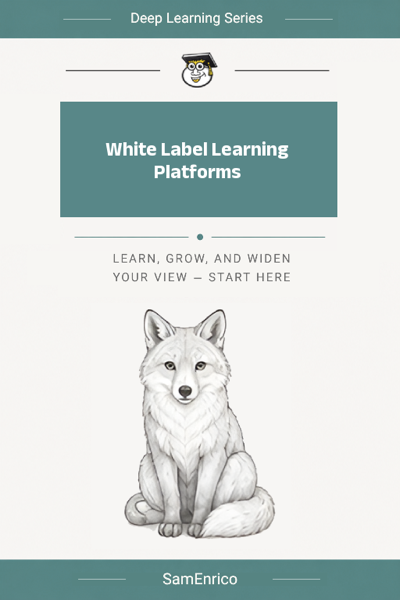
White Label Learning Platforms eBook
A Coursebook on White Label Learning Platforms
A Coursebook on White Label Learning Platforms
Formats
Free sample
Chapter 1: The Million-Dollar Footer--The email arrived at 11:47 PM on a Tuesday. Sarah, the VP of Learning at a mid-sized healthcare company, had been working eighteen-hour days for three months preparing for the largest client presentation of her career. Her team had built 147 custom courses. They had branded every email template. They had negotiated a six-figure contract with a white label learning platform vendor who promised total brand control.
The client—a national hospital network with 12,000 employees—was ready to sign a $2.1 million deal.At 11:48 PM, the client’s procurement director replied with four words: “We need to talk.”The attached screenshot showed the hospital network’s branded training portal—beautifully designed, custom domain, the client’s logo prominently displayed. But at the very bottom of the page, in 9-point gray type, was a line of text Sarah had never noticed before. It read: “Powered by Learn Corp LMS.” Learn Corp was the white label vendor. And just below that, in even smaller type: “Patent pending. All rights reserved.”The procurement director’s note was devastating: “Our legal team says this violates our contract clause 14.3, which requires all third-party branding to be removed.
You told us this platform would be 100% ours. Why is your vendor’s name on our footer? We are pausing the signature until this is resolved.”Sarah spent the next four days in crisis mode. The vendor claimed the footer was “standard across all implementations” and removing it would require a $50,000 custom development fee. The contract Sarah had signed—the one she had skimmed because her CEO told her to “just get it done”—had no mention of the footer.
Clause 14.3 existed only in the hospital network’s contract, not in Sarah’s agreement with Learn Corp. She had promised something she could not deliver.The deal fell apart. The hospital network signed with a competitor. Sarah’s CEO called it “the most expensive footer in company history.” Sarah was reassigned to a non-client-facing role within six weeks.The worst part? She had done everything right—or so she thought.
She had chosen a white label platform. She had branded the login page. She had customized the certificates. But she had missed the footer. And that one oversight cost her company over two million dollars.This book exists because of Sarah’s story.
And because of a hundred other stories just like it—from universities that launched branded portals only to discover their vendor’s logo on student transcripts, from associations that promised members a seamless experience only to have learners ask “What is this other company’s name doing on my dashboard?” from startups that built entire businesses on white label platforms only to find they could never leave because they didn’t own their own data.The Post-LMS Era Has Arrived—And Most Organizations Are Unprepared For the past twenty years, organizations have approached learning technology as a utility. You buy an LMS the way you buy electricity or water: you need it to work, you want it to be reliable, and you don’t particularly care what the infrastructure looks like as long as your building has power. This approach made sense when learning was a compliance function, when “training” meant annual harassment prevention videos and safety certifications, when learners tolerated ugly interfaces because they had no choice.That era is over.Consider what your employees and customers experience every day outside of your training portal. They use Netflix, which remembers where they paused and suggests what to watch next. They use Duolingo, which celebrates their streaks with delightful animations and personalized reminders.
They use Amazon, which shows them products based on their browsing history and makes one-click purchasing feel like magic. They use their bank’s mobile app, which recognizes their face and lets them deposit checks from their couch.Then they log into your learning platform.If you are like most organizations, your training portal looks like it was designed in 2012. The colors are generic. The fonts are default. The login screen still has your vendor’s logo in the corner.
The learner dashboard shows a list of courses in a gray table with no images, no progress indicators, no sense of community. The email notifications come from “no-reply@vendorplatform.com” instead of “learning@yourcompany.com.” The mobile experience is a shrunk-down version of the desktop site, requiring pinch-to-zoom and constant sideways scrolling.Your learners don’t consciously notice these things. Their brains are too busy processing the task at hand. But their subconscious registers every friction point, every broken expectation, every moment where the experience feels amateur or untrustworthy. And over time, that subconscious accumulation erodes something precious: your brand’s credibility.The gap between consumer-grade learning experiences and enterprise-grade learning platforms is not a technical problem.
It is a strategic problem. And white label platforms are the solution that most organizations get dangerously wrong.What White Label Actually Means—And What It Does Not Before we go any further, we need to establish a clear definition. The term “white label” has been abused by software vendors for so long that it has lost much of its meaning. I have seen vendors claim “full white label support” when all they offered was a logo swap on the login page. I have seen contracts that promised “100% brand control” but excluded email headers, mobile app icons, and certificate generation.
I have seen organizations pay premium prices for white label platforms that were, in reality, portals with a few CSS variables changed.Here is the definition we will use throughout this book:A white label learning platform is a learning management system that allows the purchasing organization to replace all vendor-branded elements with its own branding, including domain, user interface, communications, certificates, and mobile presence, while the vendor retains responsibility for infrastructure, security, and core functionality.Let me emphasize the word “all.” If your vendor’s name appears anywhere in the learner experience—login page, dashboard, email footers, error messages, certificate watermarks, mobile app splash screen, API documentation, support portal—you do not have a white label platform. You have a themed platform. The distinction is not semantic. It is the difference between owning your learning ecosystem and renting someone else’s with a fresh coat of paint.A true white label platform treats your brand as the primary interface and the vendor’s infrastructure as invisible plumbing. Your learners should never know that a third-party vendor powers their experience.
They should never see a “Powered by” footer. They should never receive an email from a domain other than yours. They should never download a certificate that bears another company’s name.This is a high bar. Most vendors cannot clear it. Many who claim they can clear it are lying, or at least stretching the truth until it becomes transparent.
Part of this book’s mission is to give you the tools to separate real white label capabilities from marketing fiction.The Three Architectural Options: A Framework for Decision-Making Every organization that wants to deliver branded learning experiences faces the same fundamental question: How much control do we want, and how much are we willing to pay for it? The answer usually falls into one of…
This is the end of the free sample. Get the eBook to keep going. Buy now
About this book
Details
- Author
- Taggart Shandra
- Publisher
- SamEnrico
- Language
- English
- Genre
- Non-Fiction, Informative, Educational
- Released
- 2026-05-07
- Pages (approx.)
- 151
- Available as
- eBook, Audiobook

Read better in the ZLOADR app
Your eBooks on your phone or tablet. Sign in with your SamEnrico account and start reading.
More by Taggart Shandra
 The Empty Cupboard PanicTaggart Shandra$11.99
 Mindfulness for Busy ParentsTaggart Shandra$11.99
 Meeting Maker App GuideTaggart Shandra$11.99
 Children's Dream Decoder GuideTaggart Shandra$11.99
 Assertiveness For Faith CommunitiesTaggart Shandra$11.99
 The Monk Who Smiled Through TortureTaggart Shandra$11.99
 SlidesAI Power UserTaggart Shandra$11.99
 Counter Reformation Sacred Music GuideTaggart Shandra$11.99
 Secular Anticipatory GriefTaggart Shandra$11.99
 The Healers of the Black Sea: Byzantine Dromons and the Plague of 747 ADTaggart Shandra$11.99
 Echoes of the Deep: The Unsinkable Mystery of the SS BaychimoTaggart Shandra$11.99
 The Forgotten Telegraph: Stuart's Impossible Crossing and the Birth of Global CommunicationTaggart Shandra$11.99