
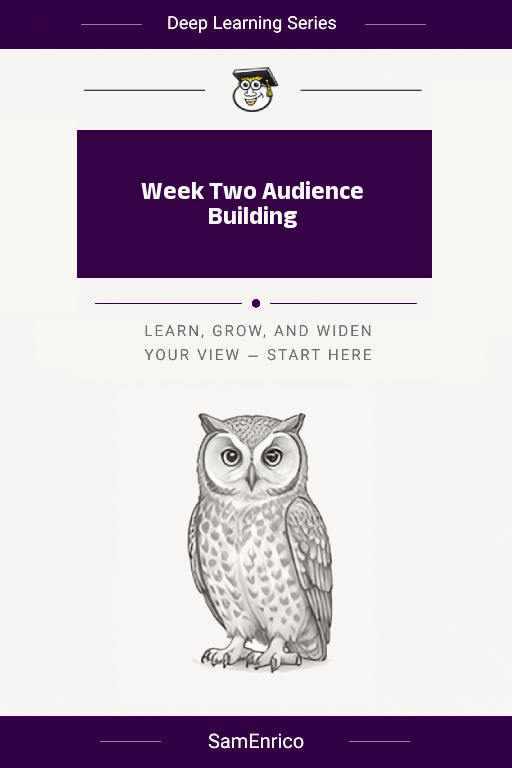
Non-FictionFirst 30 DaysWeek Two
Week Two Audience Building
Builds custom audiences, lookalike audiences, and
by Renfrew Bo
Builds custom audiences, lookalike audiences, and interest-based targeting during second week of Facebook ads prep.
Formats
About this book
Free sample
Chapter 1: The Hidden Logic--Most Facebook advertisers fail before they ever open Ads Manager. They fail in the way they think about time, data, and the relationship between the two. They treat every day of their campaign like it is the same as the day before, and they treat every dollar of their budget like it should produce a profit immediately. This is not just inefficient. It is a fundamental misunderstanding of how the Meta advertising platform actually works.The truth is that Facebook advertising operates on a weekly cycle that most marketers never bother to understand.
Week One is not for profits. Week One is for data collection, creative validation, and audience discovery. Week Two is for building the engine that will drive Week Three and beyond. The advertisers who grasp this distinction consistently outperform those who do not, often by a factor of three to five times in return on ad spend. This chapter explains why Week One exists, how to extract maximum value from it, and exactly how to pivot into Week Two with a clean, actionable dataset.The Seven-Day Fallacy There is a dangerous assumption that runs through most Facebook marketing education: that you can launch a campaign on Monday, check results on Tuesday, and declare a winner by Wednesday.
This assumption ignores the mathematical reality of how Meta's delivery system operates.Facebook's algorithm does not optimize for your convenience. It optimizes for probability. Every time you launch a new ad set, the system enters what Meta formally calls the Learning Phase. During this phase, the algorithm is exploring different delivery patterns, testing which users are most likely to take your desired action, and gathering statistical confidence. The Learning Phase does not end until an ad set has generated approximately fifty optimization events—typically purchases, leads, or add-to-carts—within a rolling seven-day window.Fifty events is not an arbitrary number.
It is the threshold at which Meta's machine learning models have enough data to predict future outcomes with reasonable accuracy. Below fifty events, the algorithm is still guessing. Above fifty events, the algorithm begins to specialize. It…
This is the end of the free sample. Get the eBook to keep going. Buy now
Contents
- Chapter 1
- Chapter 2
- Chapter 3
- Chapter 4
- Chapter 5
- Chapter 6
- Chapter 7
- Chapter 8
- Chapter 9
- Chapter 10
- Chapter 11
- Chapter 12
Details
- Author
- Renfrew Bo
- Publisher
- SamEnrico
- Language
- English
- Genre
- Non-Fiction, First 30 Days, Week Two
- Released
- 2026-05-29
- Pages (approx.)
- 126
- Available as
- eBook, Audiobook

Read better in the ZLOADR app
Your eBooks on your phone or tablet. Sign in with your SamEnrico account and start reading.
More by Renfrew Bo
 Voice Actor Documentary NarratorRenfrew Bo$11.99
 Menopause Friendly Diet CookbookRenfrew Bo$11.99
 Beauty Influencer PressureRenfrew Bo$11.99
 The BRCA Genetic Testing GuideRenfrew Bo$11.99
 Teen PTSD Self Esteem GuideRenfrew Bo$11.99
 The Stolen Code: How a Rogue Engineer Sabotaged Silicon ValleyRenfrew Bo$11.99
 Advanced Full Stack Application SystemsRenfrew Bo$11.99
 Ultimate Handbook Guide to Caracas : (Venezuela) Travel GuideRenfrew Bo$11.99
 Impact Measurement FrameworkRenfrew Bo$12.99
 Understanding Zlotogora SyndromeRenfrew Bo$17.99
You may also like
 Hong Kong Handover 1997Dunn Johnnie$11.99
 Zumba For Postnatal Recovery CourseNeal Christian$11.99
 Zumba for BeginnersLadner Nikia$11.99
 YouTube Comment Mining GuideHumes Pandora$12.99
 Worry Box MeditationCarlin Rudy$11.99
 Workplace Stress MeditationNguyen Lynn$11.99
 Workplace Stress and Sleep RepairHawley Ivory$11.99
 Workplace Perfectionism CureDelaney Jeffry$11.99
 Workplace Injustice Anger GuideWallen Isabelle$11.99
 Work Addiction and Burnout LinkGreenwood Ester$11.99
 Women in Yoga and WellnessBeattie Galina$11.99
 Women in Stand Up ComedyChun Evangeline$11.99