
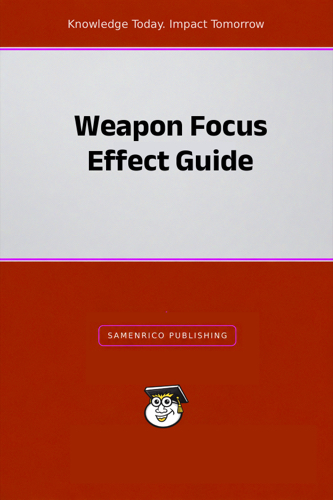
Weapon Focus Effect Guide eBook
Explains how visible weapons narrow attention, har
Explains how visible weapons narrow attention, harming facial recall.
Formats
Free sample
Chapter 1: The Smoking Gun--–- The fluorescent lights of the Burlington, North Carolina police station hummed overhead on the night of July 28, 1984. Jennifer Thompson, a twenty-two-year-old college student, sat trembling in an interview room, her hands wrapped around a paper cup of cold coffee she would not drink. Less than an hour earlier, a stranger had broken into her apartment, held a knife to her throat, and raped her. Now, she was doing what every crime victim is taught to do: she was trying to remember.She closed her eyes and built the face in her mind. She studied it like a test she could not afford to fail.
The angular jaw. The high cheekbones. The eyes—cold, dark, utterly unforgettable. She repeated the details to herself like a prayer. She would later tell a jury that she had made a deliberate choice during the attack: she would memorize every feature of her attacker's face so that she could send him to prison.
She stared at him with such intensity that she was certain the image had been burned into her memory forever.She was right about one thing: she would never forget that night.She was wrong about everything else.The man she identified, the man she picked from a lineup, the man she testified against with absolute certainty, was named Ronald Cotton. He was innocent. Eleven years later, DNA evidence proved that Jennifer Thompson had sent the wrong man to prison. The actual rapist, Bobby Poole, had been in the same prison as Cotton for years, bragging about the crime Cotton was serving time for.How could this happen? How could a victim who stared directly at her attacker for several minutes—who made a conscious, deliberate effort to remember his face—be so catastrophically wrong?The answer lies in a small, dark object that Jennifer Thompson barely mentioned in her initial police interview: the knife.The Phenomenon That Changes Everything The Weapon Focus Effect, or WFE, is one of the most reliably replicated phenomena in the history of forensic psychology.
It refers to a simple but devastating cognitive bias: when a weapon is visible during a crime, the witness's attention narrows toward that weapon and away from the perpetrator's face. The result is a memory that feels vivid, complete, and absolutely certain—but that is systematically missing the one detail that matters most in a courtroom: who the person behind the weapon actually was.This is not a failure of character. It is not cowardice, stupidity, or inattention. It is a predictable, measurable, and deeply embedded feature of how the human brain processes threat. Your visual system did not evolve to help you pick criminals out of lineups.
It evolved to help you survive. And when survival is on the line, your brain makes a ruthless calculation: identifying the weapon matters more than identifying the face.Why This Book Exists Over the past four decades, dozens of studies have confirmed the Weapon Focus Effect. Researchers have used eye-tracking technology, forced-choice identification tasks, and real-world archival data to measure its strength. They have debated whether it is caused by fear or surprise, whether training can reduce it, and how long the effect lasts. The scientific consensus is clear: the effect is real.But the legal system has been slow to catch up.Most judges have never heard of the Weapon Focus Effect.
Most police officers have not been trained to interview witnesses who have experienced it. Most jurors believe, with the same certainty as Jennifer Thompson, that a confident eyewitness must be an accurate one. And every year, innocent people go to prison because a witness stared at a gun instead of a face.This book exists to change that.Over the next twelve chapters, you will learn the complete science of the Weapon Focus Effect. You will understand the two competing theories that explain why it happens. You will see the landmark studies that proved it exists.
You will learn how stress, time, training, and context moderate the effect. You will discover why lab studies show stronger effects than real-world crimes—and why that does not make the science invalid. And most importantly, you will learn what to do about it.But before we dive into the data, we need to understand the stakes.The Scale of the Problem In the United States alone, approximately 75,000 suspects are identified by eyewitnesses each year. Most of those identifications are accurate. But a substantial minority are not.According to the Innocence Project, mistaken eyewitness identifications contributed to approximately 69 percent of the first 375 wrongful convictions overturned by DNA evidence.
That is nearly seven out of every ten innocent people exonerated. No other factor—not false confessions, not jailhouse informants, not flawed forensic science—comes close.To be clear: not all of those mistaken identifications involved a weapon. Some occurred in poor lighting. Some involved cross-racial identification, which is notoriously unreliable. Some were contaminated by suggestive lineup procedures.
The Weapon Focus Effect is only one piece of a much larger puzzle.But it is a critical piece.When researchers reanalyzed the Innocence Project data, they found that in cases involving a weapon, the rate of mistaken identification was significantly higher than in cases without a weapon. The presence of a gun or knife did not just make the crime more frightening. It made the witness more likely to pick the wrong person.A Note on Tone: Science, Not Sensationalism Before we go further, a word about what this book is not.This is not a manifesto claiming that all eyewitnesses are unreliable. It is not an attack on victims, police officers, or prosecutors. It is not a call to abolish eyewitness testimony.The vast majority of eyewitnesses are honest people trying their best to help.
The vast majority of identifications are accurate. The criminal justice system depends on eyewitnesses, and for good reason: they are often the only source of evidence linking a suspect to a crime.But honest people can be wrong. And when they are wrong, the consequences are catastrophic.Ronald Cotton spent eleven years in prison for a crime he did not commit. He lost his twenties, his freedom, his reputation. When he was finally exonerated, he had to learn how to use a cell phone, how to navigate a grocery store, how to be a father to a daughter who had grown up without him.
Jennifer Thompson, the woman who identified him, has spent the rest of her life grappling with the knowledge that her certainty destroyed an innocent man's life.The goal of this book is not to assign blame. It is to prevent the next Ronald Cotton from ever being arrested in the first place.What the Weapon Focus Effect Is (And Is Not)Let us define our terms with precision.The Weapon Focus Effect refers to the phenomenon in which the presence of a visible weapon during a crime impairs a witness's ability to later identify the perpetrator's face. This impairment is specific to peripheral details—features not directly related to the weapon itself. Witnesses who experience WFE typically remember the weapon with exceptional clarity. They can describe its color, size, shape, and location in vivid detail.…
This is the end of the free sample. Get the eBook to keep going. Buy now
About this book
Details
- Author
- Almeida Arlean
- Publisher
- SamEnrico
- Language
- English
- Genre
- Non-Fiction, True Crime, Attention
- Released
- 2026-06-06
- Pages (approx.)
- 125
- Available as
- eBook, Audiobook

Read better in the ZLOADR app
Your eBooks on your phone or tablet. Sign in with your SamEnrico account and start reading.
More by Almeida Arlean
 Investor Pitch PersuasionAlmeida Arlean$11.99
 Paleo Autoimmune Protocol DietAlmeida Arlean$11.99
 Advanced Peg Systems CourseAlmeida Arlean$11.99
 Zion Canyon Mystery DisappearancesAlmeida Arlean$11.99
 Sunflower Seeds Quit AidAlmeida Arlean$11.99
 Image Rehearsal Therapy ManualAlmeida Arlean$11.99
 Fat Soluble Vitamins GuideAlmeida Arlean$11.99
 The Sole Revolution: How America Laced Up the WorldAlmeida Arlean$11.99
 The Rollin' Pioneers: How South Africa's First Skateboarders Defied ApartheidAlmeida Arlean$11.99
 How to Produce Space HeatersAlmeida Arlean$11.99
 10 Ways to Use Purple Sprouting Broccoli (Recipe Book)Almeida Arlean$11.99
 Generation Skipping Transfer TaxAlmeida Arlean$12.99