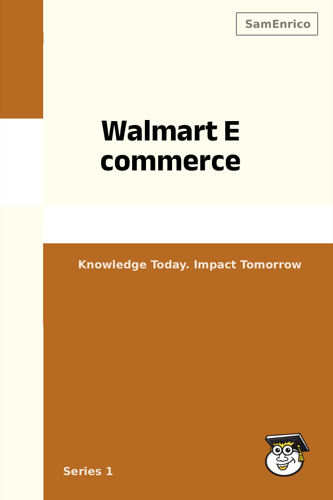
Walmart E commerce eBook
Chronicles the late response to Amazon.
by Foss Lean
Chronicles the late response to Amazon.
Formats
Free sample
Chapter 1: The Tyranny of Pallets--– In the summer of 2005, a senior Walmart logistics executive named Tom Schoewe sat in a fluorescent-lit conference room in Bentonville, Arkansas, listening to a presentation that would haunt him for the next decade. A young analyst from the e-commerce team was explaining a new service called Amazon Prime. The analyst described a subscription model where customers paid $79 per year for unlimited two-day shipping. Schoewe, who had spent his entire career perfecting the art of moving pallets of toothpaste and toilet paper from distribution centers to store shelves, did the math in his head. It took him about thirty seconds to declare the idea "financial suicide." He was not wrong.
He was also not right. And that contradiction—being correct about the math but catastrophically wrong about the future—would become the defining paradox of Walmart’s lost decade.To understand why the world’s largest retailer spent nearly twenty years fumbling its response to Amazon, you must first understand the religion of Everyday Low Prices. EDLP was not merely a pricing strategy for Sam Walton’s creation. It was a theology, a cosmology, a complete theory of how the universe of retail operated. The logic was seductive in its simplicity: drive costs out of every corner of the supply chain, pass those savings to customers, and watch sales volume explode.
More volume meant more purchasing power with suppliers, which meant even lower costs, which meant even lower prices. The flywheel of physical retail had worked for half a century. Walmart had used it to crush competitors like Kmart, Woolworth, and Montgomery Ward. And in 2005, that same flywheel seemed to prove that Amazon Prime was a delusional fantasy.But the flywheel was built for a different world. It was built for pallets, not parcels.
For trucks, not doorsteps. For the average customer who drove to a store, not the individual consumer who waited by the mailbox. Walmart had optimized every molecule of its operation for the movement of goods in bulk. Cross-docking—Sam Walton’s great logistical innovation—meant that trucks arriving from suppliers would transfer their cargo directly to outbound trucks headed for stores, with no expensive warehousing in between. The system was a masterpiece of industrial engineering.
It was also completely incompatible with the emerging logic of e-commerce, where the unit of transaction was not a pallet of sixty-four rolls of paper towels but a single box containing exactly one roll.This chapter is not a celebration of Walmart’s past. It is an autopsy of its paralysis. The tyranny of pallets—the intellectual and emotional grip that Walmart’s own success exerted on its decision-makers—explains why the company watched Amazon build a trillion-dollar empire while Walmart.com languished as a digital afterthought. The story involves billion-dollar write-offs, internal civil wars between Bentonville and Silicon Valley, and a fundamental misunderstanding of what customers actually wanted. But most of all, it is a story about the Innovator’s Dilemma, a concept first articulated by Harvard professor Clayton Christensen.
The dilemma is simple and brutal: successful companies fail not because they make bad decisions but because they make perfectly rational decisions that serve their existing customers so well that they blind themselves to disruptive innovations. Walmart was a textbook case.The Origins of Efficiency Sam Walton did not invent discount retail. He perfected it. When he opened the first Walmart in Rogers, Arkansas, in 1962, the retail landscape was dominated by regional department stores and downtown merchants who treated inventory as an afterthought. Walton’s insight was that retail was not about selling things.
It was about moving things. The faster merchandise moved from supplier to customer, the less capital was tied up in unsold goods, and the lower prices could go. This obsession with inventory turns became the genetic code of Walmart.By the 1980s, Walmart had developed the most sophisticated supply chain in the history of commerce. The company built its own fleet of trucks, its own network of distribution centers, and its own satellite communication system to connect every store to headquarters in real time. When a cashier scanned a tube of toothpaste at a Walmart in Tulsa, that purchase data was transmitted to Bentonville within seconds, triggering a reorder from Procter & Gamble within minutes.
The system was so efficient that Walmart could restock shelves faster than any competitor, which meant it could operate with less inventory, which meant it could offer lower prices. The flywheel spun faster and faster.Cross-docking was the crown jewel of this system. In a traditional retail model, suppliers ship products to a warehouse, where they are stored until stores order them. That warehousing costs money—rent, labor, insurance, taxes. Walmart eliminated the warehouse.
In a cross-docking facility, incoming trucks from suppliers pull up to one side of the building. Outgoing trucks headed to stores pull up to the other side. Forklifts move pallets directly from one truck to another, sometimes in less than thirty minutes. The product never sits still. It flows.
This single innovation reduced Walmart’s cost of goods sold by an estimated 2-3 percent compared to competitors. In the razor-thin margins of discount retail, that difference was the difference between survival and bankruptcy.But cross-docking was optimized for full pallets. A pallet of paper towels contains roughly sixty-four individual packages. A pallet of toothpaste contains about two hundred tubes. The economics of cross-docking depend on moving large quantities of identical items in bulk.
When Walmart’s distribution centers receive a pallet of toothpaste, they do not open it. They do not repackage it. They do not break it down into smaller units. They simply move the whole thing onto a truck headed for a store. This is efficient because the marginal cost of moving one additional tube of toothpaste on a pallet is essentially zero.
The toothpaste is already there. The truck is already going. The driver is already paid.Now contrast that with the economics of e-commerce. When a customer orders a single tube of toothpaste from Amazon, someone has to find that tube on a shelf, put it in a box, add padding to prevent damage, seal the box, print a shipping label, and hand it to a carrier who will drive it to a house. The cost of that process is not measured in pennies per unit.
It is measured in dollars. In 2005, the all-in cost to pick, pack, and ship a one-pound package via UPS ground was roughly $5 to $7, depending on distance. That was the cost for a single item. Walmart’s profit margin on that tube of toothpaste was about 3 percent, or roughly ten cents. The math was not difficult: paying $5 to ship a ten-cent profit item was impossible.This is what Tom Schoewe understood in that Bentonville conference room.
He was not stupid. He was not old-fashioned. He was rational. Amazon Prime, as presented in 2005, genuinely did look like financial suicide. The problem was that rationality itself had become a trap.The Prime Anomaly Amazon launched Prime in February 2005 with little fanfare.
The concept was simple: customers paid $79 per year in exchange for unlimited two-day shipping on eligible items. Wall Street thought Jeff Bezos had lost his…
This is the end of the free sample. Get the eBook to keep going. Buy now
About this book
Details
- Author
- Foss Lean
- Publisher
- SamEnrico
- Language
- English
- Genre
- Non-Fiction, Biography, Ecommerce
- Released
- 2026-06-09
- Pages (approx.)
- 145
- Available as
- eBook, Audiobook

Read better in the ZLOADR app
Your eBooks on your phone or tablet. Sign in with your SamEnrico account and start reading.
More by Foss Lean
 GST Registration for Startups Action WorkbookFoss Lean$11.99
 Ericksonian ScriptingFoss Lean$11.99
 Assertive Communication for MenFoss Lean$11.99
 Broadway Child Burnout GuideFoss Lean$11.99
 The Freelance Corporation CreationFoss Lean$11.99
 Laci Peterson Memorial SitesFoss Lean$11.99
 DoorDash Delivery Efficiency CourseFoss Lean$11.99
 Assertiveness at Family GatheringsFoss Lean$11.99
 The Forgotten Navigator: Piri Reis and the Lost Map of the WorldFoss Lean$11.99
 Bardic Echoes: The Celtic Sages and Their Sacred SongsFoss Lean$11.99
 The Last Waltz: How a Single Song Defined a GenerationFoss Lean$11.99
 HR TechnicianFoss Lean$11.99