
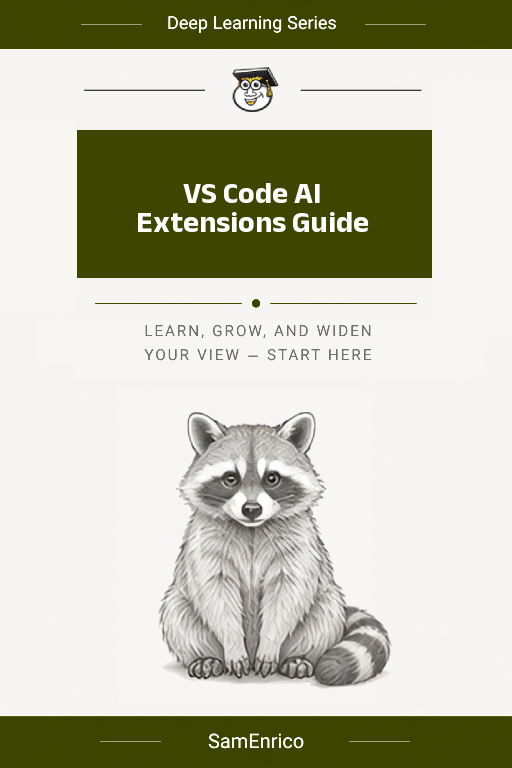
VS Code AI Extensions Guide eBook
Install and configure AI coding assistants in your
Install and configure AI coding assistants in your Visual Studio Code editor.
Formats
Free sample
Chapter 1: The Digital Workbench–- Every craftsman knows that a cluttered bench breeds mistakes. For the modern developer working with AI, this ancient truth has never been more urgent. You are about to invite artificial intelligence into the most intimate corners of your coding environment—your editor, your shortcuts, your muscle memory. If that environment is chaotic, the AI will learn your chaos. If it is slow, the AI will become sluggish. If it is riddled with conflicting extensions, the AI will hallucinate, misfire, and frustrate you to the point of abandonment. This chapter is not about installing AI. It is about preparing sacred ground.The Clean Slate Philosophy: Why Starting Fresh Wins Most developers accumulate VS Code extensions like winter coats. You installed that Python formatter two years ago for a single project. You enabled that rainbow-colored bracket highlighter because it looked cool on Twitter. You left that deprecated Live Server extension running because you forgot it existed. These are "zombie extensions"—undead pieces of code that consume memory, fire background processes, and create subtle conflicts that manifest only when you least expect them.AI extensions are uniquely sensitive to this chaos. Unlike a simple syntax highlighter, AI tools like Copilot, Continue, and Cline perform real-time inference. They scan your open files, analyze your cursor position, and query language models. Every zombie extension running alongside them competes for CPU cycles, memory bandwidth, and event listeners. The result? Latency spikes, incomplete suggestions, and the dreaded gray spinning wheel where your autocomplete should be.The Clean Slate Philosophy is simple: treat your VS Code installation like a surgical theater. Before you bring in the AI tools, sterilize the environment. This does not mean uninstalling everything—it means auditing intentionally. A five-step process will transform your editor from a cluttered garage into a precision workshop.Step one, disable all non-essential extensions. Navigate to the Extensions view (Cmd+Shift+X on mac OS, Ctrl+Shift+X on Windows/Linux) and click the gear icon next to each extension. Select "Disable" rather than "Uninstall" initially. This preserves your settings if you change your mind but removes the extension from active memory. Pay special attention to extensions that perform background analysis: linters, formatters, test runners, and live preview tools. These are the most likely to conflict with AI inference engines.Step two, profile your startup time. Open VS Code's built-in Developer Tools (Help > Toggle Developer Tools then click the "Performance" tab). Record a startup profile and look for extensions that take longer than 50 milliseconds to load. Anything slower is a candidate for removal. Document your findings in a simple text file—you will thank yourself later when troubleshooting mysterious lag.Step three, review extension permissions. Some extensions request access to your filesystem, network, or clipboard. AI extensions require these permissions legitimately. But a forgotten markdown previewer that requests file system access is a security risk and a performance drag. The Extensions view shows a small shield icon for extensions with special permissions. Click it to see exactly what the extension can access.Step four, consider Workspace Profiles. VS Code's built-in Profiles feature (introduced in version 1.85) allows you to create separate configurations for different types of work. A "Web Development" profile might include Copilot, Prettier, and Git Lens. A "Data Science" profile might include Continue, Jupyter, and Database Client. This isolation prevents extension conflicts entirely because different profiles load different sets of extensions. To create a profile, click the gear icon in the bottom-left corner, select "Profiles," then "Create Profile." Name it "AI Development" and select only the extensions you plan to use with AI assistants.Step five, the nuclear option. If your VS Code installation is more than two years old or has accumulated more than 50 extensions, consider a fresh install. Back up your settings.json and keybindings.json files (located in ~/.config/Code/User/ on Linux, ~/Library/Application Support/Code/User/ on mac OS, and %APPDATA%\Code\User\ on Windows). Uninstall VS Code completely, delete the configuration directories, then reinstall from scratch. This removes not just extensions but also orphaned settings, corrupted caches, and half-removed dependencies that silently slow you down.The payoff for this discipline is substantial. Developers who follow the Clean Slate Philosophy report 40-60 percent faster AI suggestion times and significantly fewer hallucinations caused by context confusion. When the AI only sees what it needs to see, it performs like a specialist rather than a generalist wading through noise.Installation Methods: Choosing Your Weapon With a clean workspace prepared, you are ready to install AI extensions. But "installation" is not a single action—it is a strategic choice with three distinct methods, each suited to different workflows and environments. Understanding the tradeoffs will save you hours of frustration when you need to replicate your setup across multiple machines or deploy in restricted enterprise environments.Method one: The Graphical Marketplace The Visual Studio Code Marketplace is the default method for most developers. Access it via the Extensions view (Cmd+Shift+X), search for an extension like "Git Hub Copilot," and click the blue "Install" button. This method excels at discovery—you can browse categories, read reviews, and see screenshots before committing. The graphical interface also handles dependencies automatically. If an extension requires another extension (for example, a Python AI assistant might require the Python extension), the Marketplace installs both simultaneously.However, the graphical method has significant drawbacks for power users. It is difficult to automate, requiring manual clicks for every installation. It offers no version pinning—you always get the latest version, which might introduce breaking changes. And it requires an active internet connection and access to marketplace.visualstudio.com, which is problematic for developers in air-gapped environments or behind strict corporate firewalls.Use the graphical method when you are exploring new tools, working on a personal project, or teaching a junior developer. Avoid it when you need reproducibility, automation, or offline capabilities.Method two: The Command Line Interface The VS Code command line interface (CLI) transforms extension management into scriptable operations. After installing the code command (available by default on most installations, or added via Shell Command: Install 'code' command in PATH from the Command Palette), you can install extensions with a single line:bash Copy Downloadcode --install-extension github.copilot
code --install-extension continue.continue code --install-extension saoudrizwan.claude-dev The CLI accepts multiple extensions in sequence and works silently, making it perfect for automation. You can write a bootstrap script that sets up your entire AI toolchain on a new machine in under a minute:bash Copy Download#!/bin/bash extensions=( "github.copilot" "github.copilot-chat" "continue.continue" "saoudrizwan.claude-dev" "ms-python.python" "esbenp.prettier-vscode" )
for ext in "${extensions[@]}"; do code --install-extension "$ext" --force done The --force flag overwrites existing installations, ensuring you have the exact version you expect when combined with version pinning using extension IDs that include version numbers (e.g., github.copilot@1.186.0). This level of control is essential for teams that need consistency across developer workstations or CI/CD pipelines that run AI-powered code generation.The CLI method also works over SSH. If you are debugging a remote server, you can install extensions directly on the remote machine using code --install-extension --remote ssh-remote+hostname extension.id. This keeps your local editor lightweight while giving the remote environment…
This is the end of the free sample. Get the eBook to keep going. Buy now
About this book
Details
- Author
- Crawley Nicolette
- Publisher
- SamEnrico
- Language
- English
- Genre
- Non-Fiction, AI Operator
- Released
- 2026-05-30
- Pages (approx.)
- 149
- Available as
- eBook, Audiobook

Read better in the ZLOADR app
Your eBooks on your phone or tablet. Sign in with your SamEnrico account and start reading.
More by Crawley Nicolette
 Contract Abstraction for ComplianceCrawley Nicolette$11.99
 Star Knowledge Spiritual GuideCrawley Nicolette$11.99
 Imposter Racial Minority GuideCrawley Nicolette$11.99
 Post Learning Nap GuideCrawley Nicolette$11.99
 Daily Benefit Amount GuideCrawley Nicolette$11.99
 Long Breath vs Short Breath NoticeCrawley Nicolette$11.99
 Parent Time PodcastsCrawley Nicolette$11.99
 Holocaust Survivor TaleCrawley Nicolette$11.99
 Affirmations For Tech BurnoutCrawley Nicolette$11.99
 The Golden Notes of the Kingdom: The Court Musicians of AxumCrawley Nicolette$11.99
 The Phantom of the Viennese Court: Mozart's Lost SymphonyCrawley Nicolette$11.99
 The Last Broadcast: The Rise and Fall of Radio LuxembourgCrawley Nicolette$11.99
You may also like
 Hong Kong Handover 1997Dunn Johnnie$11.99
 Zumba For Postnatal Recovery CourseNeal Christian$11.99
 Zumba for BeginnersLadner Nikia$11.99
 YouTube Comment Mining GuideHumes Pandora$12.99
 Worry Box MeditationCarlin Rudy$11.99
 Workplace Stress MeditationNguyen Lynn$11.99
 Workplace Stress and Sleep RepairHawley Ivory$11.99
 Workplace Perfectionism CureDelaney Jeffry$11.99
 Workplace Injustice Anger GuideWallen Isabelle$11.99
 Work Addiction and Burnout LinkGreenwood Ester$11.99
 Women in Yoga and WellnessBeattie Galina$11.99
 Women in Stand Up ComedyChun Evangeline$11.99