
Non-FictionSelf-HelpGuided Imagery
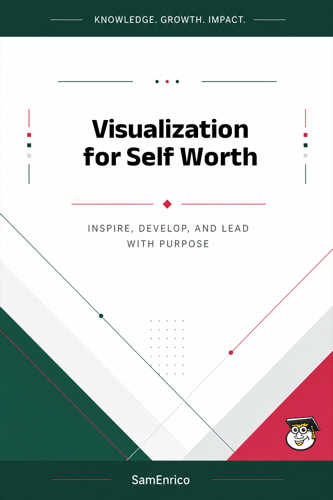
Visualization for Self Worth eBook
Employs guided imagery to reparent wounded childho
Employs guided imagery to reparent wounded childhood self and build worth.
Formats
Free sample
Chapter 1: The Ghost in the Room...--The email arrives at 2:47 PM on a Tuesday. A routine performance review from your manager, three sentences long, mostly positive, with one mild critique buried in the middle: "Could improve attention to detail on the quarterly reports." You read it once. You read it again. By the third reading, the mild critique has metastasized into a full-body condemnation. You spend the next forty-five minutes mentally replaying every mistake you have ever made, drafting a defensive response you will never send, and concluding—with absolute certainty—that you are about to be fired.You are not going to be fired.
The quarterly reports were fine. Your manager has already forgotten she wrote that sentence.An hour later, your partner walks through the door and says, absentmindedly, "You left the dishes in the sink again." The words land like a slap. Your throat tightens. Your chest hollows out. You hear: "You are lazy.
You are inconsiderate. You do not love me enough to remember a simple task." You withdraw, or you snap, or you apologize seventeen times in rapid succession. Your partner looks confused. "It's just dishes," they say. And they are right.
It is just dishes.But it was never just dishes.The Split Self Phenomenon If you have ever excelled in one domain of your life while crumbling in another—competent at work, chaotic in love; confident with strangers, terrified of family; articulate in writing, mute in conflict—you have experienced what psychologists call the split self. This is not dissociative identity disorder. It is far more common and far more subtle. It is the quiet experience of being two people in one body: the adult who knows better and the child who cannot forget.The professional who negotiates million-dollar deals but cannot ask for a raise. The parent who advocates fiercely for their children but cannot advocate for themselves.
The student who aces every exam but melts down at the slightest correction. These are not contradictions. They are evidence of an internal architecture built in childhood and never updated.The core argument of this book is simple: most of what you call your "personality flaws"—your people-pleasing, your perfectionism, your fear of abandonment, your imposter syndrome—are not flaws at all. They are survival strategies that worked for a child who had no power. They became automatic programs running in the background of your nervous system.
And they are running still, long after the danger has passed.This chapter is about identifying the ghost in your room. Not exorcising it—not yet. First, you must learn to see it. You must learn to distinguish between the adult who is actually living your life and the wounded child who is reacting to it.The Four Echoes of Low Worth Before we can heal, we must diagnose. Based on decades of clinical research and the synthesis of hundreds of case studies across the inner child literature, there are four primary ways that low self-worth manifests in adult life.
These are not personality types. They are survival adaptations. You may recognize yourself in one, two, or all of them. You may shift between them depending on the context. There is no wrong answer.Echo One: The Fear of Abandonment This is the part of you that monitors relationships for signs of departure.
You text twice when once would suffice. You reread messages for tone. You apologize for having needs. You stay in relationships long past their expiration date because leaving feels like dying. You have a finely tuned radar for the moment someone pulls away—and you interpret every neutral action as a withdrawal.The childhood origin: inconsistent caregiving.
You never knew if your parent would be warm or cold, present or gone. So you learned to hyper-vigilantly track their emotional state, believing that if you could just be good enough, small enough, helpful enough, they would stay. You are still tracking.Echo Two: The Imposter This is the part of you that believes your success is an accident. Every achievement is attributed to luck, timing, or the incompetence of others. You live in terror of being "found out." You cannot internalize praise; it slides off you like water off wax.
You work twice as hard as necessary to forestall the inevitable exposure you are certain is coming.The childhood origin: conditional praise. You were told you were "so smart" rather than "you worked hard." You were celebrated for outcomes, not effort. Or worse, you were ignored when you succeeded and punished when you failed. You learned that your worth was contingent on performance—and that performance could always be better.Echo Three: The People-Pleaser This is the part of you that says yes when every cell in your body means no. You volunteer for tasks you resent.
You attend events you dread. You laugh at jokes that aren't funny. You have lost count of the number of times you have agreed to something and then spent the following days flooded with exhaustion and secret rage—rage not at the person who asked, but at yourself for agreeing.The childhood origin: enmeshment or parentification. You were taught, explicitly or implicitly, that your job was to manage the emotions of others. If Mom was sad, you cheered her up.
If Dad was angry, you became invisible. You learned that your needs were secondary, dangerous, or nonexistent. You are still performing that role.Echo Four: The Perfectionist This is the part of you that cannot rest because rest is dangerous. You rewrite the email five times. You reorganize the closet at midnight.
You cannot submit a project because it is not quite ready. You believe, somewhere in your bones, that a single mistake will lead to total catastrophe. So you chase an impossible standard, exhausting yourself in pursuit of a finish line that keeps moving.The childhood origin: harsh or unpredictable criticism. You learned that mistakes were not learning opportunities but moral failures. You were shamed for getting a B, for forgetting a chore, for spilling a glass of milk.
You learned that love was conditional on flawlessness. You are still trying to be flawless, even though no one is watching anymore.Take a moment. Which echoes do you hear? Do not judge yourself for them. These strategies kept you safe.
They deserve gratitude, not contempt. But they also deserve retirement.The Neuroscience of the Split Why does this split persist? Why can't you simply decide to stop being a people-pleaser or a perfectionist? The answer lies in the architecture of the brain.The human brain does not finish developing until the mid-twenties. The prefrontal cortex—the seat of executive function, planning, impulse control, and the ability to understand that a single critique is not the end of the world—is the last region to come online.
Before that, the brain is run primarily by the limbic system, the emotional and survival center. The limbic system does not reason. It reacts. It learns through association and repetition, not through logic.When you experienced a wounding event in childhood—a parent's dismissal, a bully's laugh, a teacher's public shaming—your limbic system encoded that event as a survival threat. It did not…
This is the end of the free sample. Get the eBook to keep going. Buy now
About this book
Details
- Author
- Kincaid Zachery
- Publisher
- SamEnrico
- Language
- English
- Genre
- Non-Fiction, Self-Help, Guided Imagery
- Released
- 2026-06-06
- Pages (approx.)
- 152
- Available as
- eBook, Audiobook

Read better in the ZLOADR app
Your eBooks on your phone or tablet. Sign in with your SamEnrico account and start reading.
More by Kincaid Zachery
 Talent Migration Patterns in AcademiaKincaid Zachery$11.99
 Blue Zones Air QualityKincaid Zachery$11.99
 Child Suicide Loss GuideKincaid Zachery$11.99
 The Hellmann Appeal Decision AnalysisKincaid Zachery$11.99
 The Golden Lyre of Queen Hatshepsut: Egypt's Musical MonarchKincaid Zachery$11.99
 Customer Care CoordinatorKincaid Zachery$11.99
 How to Start a Chassis for Locomotive Business (Beginners Guide)Kincaid Zachery$11.99
 Real Estate Development PipelineKincaid Zachery$12.99
 Real Estate One Page Marketing ManualKincaid Zachery$12.99
 Understanding Leukocytoclastic AngiitisKincaid Zachery$17.99
You may also like
 Hong Kong Handover 1997Dunn Johnnie$11.99
 Zumba For Postnatal Recovery CourseNeal Christian$11.99
 Zumba for BeginnersLadner Nikia$11.99
 YouTube Comment Mining GuideHumes Pandora$12.99
 Worry Box MeditationCarlin Rudy$11.99
 Workplace Stress MeditationNguyen Lynn$11.99
 Workplace Stress and Sleep RepairHawley Ivory$11.99
 Workplace Perfectionism CureDelaney Jeffry$11.99
 Workplace Injustice Anger GuideWallen Isabelle$11.99
 Work Addiction and Burnout LinkGreenwood Ester$11.99
 Women in Yoga and WellnessBeattie Galina$11.99
 Women in Stand Up ComedyChun Evangeline$11.99