
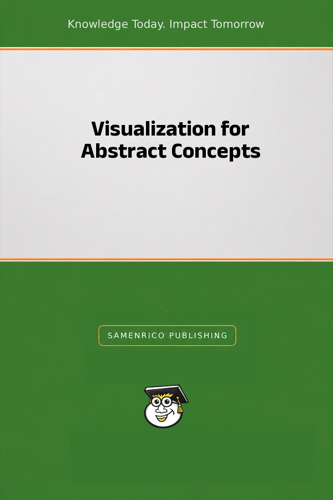
Visualization for Abstract Concepts
Teaches creating mental images for abstract ideas
Teaches creating mental images for abstract ideas like physics or philosophy.
Formats
About this book
Free sample
Chapter 1: The Apple Illusion--–- Close your eyes. Really. Do it now. I will wait.Now, picture a red apple. Not the word “apple,” not a memory of eating one, but the thing itself.
See its roundness, the curve of its cheek, the way light gathers in a glossy highlight on its skin. Notice the stem, perhaps a single green leaf still attached. Rotate it in your mind. Take a bite. Hear the crack.
Taste the tartness.You did it, didn’t you? Or something like it. Maybe the image was fuzzy, or fleeting, or only half there. But you played along because this is the standard opening move of every visualization book ever written. Picture an apple.
Picture a beach. Picture a candle flame. The message is always the same: visualization works for concrete objects, so just apply the same skill to abstract ideas.Here is the problem. That advice is a lie. Not a small lie, not a harmless simplification, but a catastrophic error that has wasted thousands of hours of frustrated effort.
You cannot visualize “consciousness” the way you visualize an apple because consciousness does not have a skin, a stem, or a glossy highlight. You cannot visualize “democracy” by rotating it in your mind because democracy has no back side. You cannot taste “entropy” or hear “justice” crackle.The apple is a trap. It seduces you into believing that abstract visualization is just concrete visualization applied to harder targets. It is not.
The two activities recruit completely different cognitive systems, operate under different rules, and produce different kinds of understanding. Trying to visualize an abstraction with the same neural machinery that handles apples is like trying to hammer a nail with a paintbrush. The tool is wrong.This chapter will dismantle the apple illusion. You will learn why your mind goes blank when faced with abstractions, why that blankness is not a personal failing, and what to do instead. By the end, you will stop searching for mental pictures and start building structural maps.
The remaining chapters will give you the vocabulary, the techniques, and the domain-specific applications. But first, we must clear the…
This is the end of the free sample. Get the eBook to keep going. Buy now
Contents
- Chapter 1
- Chapter 2
- Chapter 3
- Chapter 4
- Chapter 5
- Chapter 6
- Chapter 7
- Chapter 8
- Chapter 9
- Chapter 10
- Chapter 11
- Chapter 12
Details
- Author
- Ivory Jackelyn
- Publisher
- SamEnrico
- Language
- English
- Genre
- Non-Fiction, Self-Help, Abstract Thinking
- Released
- 2026-06-09
- Pages (approx.)
- 140
- Available as
- eBook, Audiobook

Read better in the ZLOADR app
Your eBooks on your phone or tablet. Sign in with your SamEnrico account and start reading.
More by Ivory Jackelyn
 Marilyn Sheppard Autopsy ErrorsIvory Jackelyn$11.99
 Freedom Riders StrategyIvory Jackelyn$11.99
 The History Student Memory GuideIvory Jackelyn$11.99The History Student Memory GuideIvory Jackelyn$11.99
 Pet Loss and AngerIvory Jackelyn$11.99
 Nap Clothing GuideIvory Jackelyn$11.99
 Goal Setting For SalespeopleIvory Jackelyn$11.99
 Morning Planning RoutineIvory Jackelyn$11.99
 The Silk Road Strangler: The Forgotten Highway Killer of 19th-Century ChinaIvory Jackelyn$11.99
 The Third Half: How a Rugby League Film United a Divided NationIvory Jackelyn$11.99
 Service Providers Guide to Aerobics ClassesIvory Jackelyn$11.99
 How to Produce Vaulting PolesIvory Jackelyn$11.99