
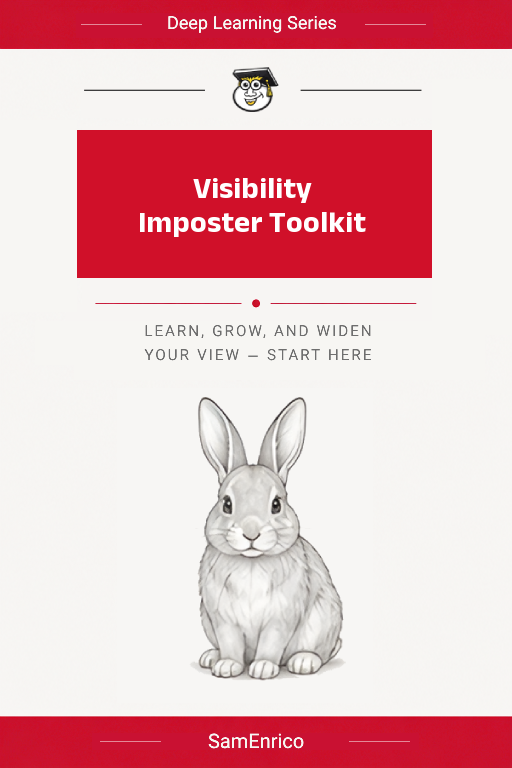
Non-FictionMental WealthPsychological ResilienceCareer Guide
Visibility Imposter Toolkit eBook
Speak up in meetings, claim credit for work, and s
by Medley Wen
Speak up in meetings, claim credit for work, and self-advocate for promotions despite feeling like a fraud. Includes email templates, meeting scripts, and annual review brag sheets.
Formats
Free sample
Chapter 1: The Silence Tax--You are standing in a conference room. Actually, you are half-standing, half-leaning against the back wall, hoping the comfortable chairs near the table will fill up before you have to commit to one. The quarterly review meeting is about to start. You have been working on this project for six months. You have the numbers in your head.
You have the solution to the problem everyone has been complaining about for weeks.You also have a voice in your head saying: Don't speak first. Wait until you are sure. What if you are wrong? What if they already thought of it? What if you sound stupid?So you wait.
Someone else speaks. They say something close to what you were thinking, but not quite right. You want to correct them. The voice says: Do not correct a senior person in front of everyone. That is career suicide.So you stay silent.
The meeting ends. The wrong solution gets tentatively approved. You walk back to your desk with the familiar cocktail of emotions: relief (you did not embarrass yourself), frustration (they got it wrong), and shame (you let it happen).Multiply that moment by a hundred meetings. By a thousand. By a decade.Then multiply it by the number of professionals who do exactly the same thing every single day.That is the Silence Tax.
And this chapter is going to show you exactly how much it is costing you—in dollars, in opportunities, and in the slow erosion of your own belief that you belong in the room at all.The Price of Holding Your Tongue Let us start with a question that most imposter syndrome books never ask: What is the actual financial cost of staying silent?Not the emotional cost. Not the psychological cost. Those matter, but they are fuzzy. They are hard to measure. They allow you to say "I will work on my confidence" and then put the book down and change nothing.The financial cost is measurable.
It is concrete. And once you see it, you cannot unsee it.Consider the following scenarios. Track your answers as you go.Scenario A: The Missed Promotion You have been in your role for three years. You are performing at the next level. Everyone knows it—except you are not entirely sure.
When your manager mentions the promotion cycle, you say "I am interested" but you do not push. You do not send the email with your brag sheet attached. You do not make the explicit ask. The promotion goes to someone else—someone who was not necessarily better than you, but who made their case more visibly.The cost: The difference between your current salary and the promoted salary, multiplied by the years until your next promotion opportunity. For a professional making 80,000,apromotionto80,000, a promotion to 80,000,apromotionto95,000 is 15,000peryear.Overfiveyears,thatis15,000 per year.
Over five years, that is 15,000peryear.Overfiveyears,thatis75,000. Over a career, that compounds into hundreds of thousands of dollars.Scenario B: The Unasked Raise You have not asked for a raise in two years. You have taken on more responsibility. You have delivered results. But asking feels awkward.
You tell yourself "the economy is uncertain" or "they will offer it when they are ready" or "I do not want to seem greedy." Meanwhile, inflation eats away at your purchasing power, and your colleagues who ask get adjustments.The cost: A typical raise upon asking is 5-10 percent. On an 80,000salary,thatis80,000 salary, that is 80,000salary,thatis4,000 to 8,000peryear.Overfiveyears,thatis8,000 per year. Over five years, that is 8,000peryear.Overfiveyears,thatis20,000 to $40,000. Over a career, with compounding, it is easily six figures.Scenario C: The Stolen Idea You have an idea in a meeting. You do not share it.
Two weeks later, a colleague presents the same idea as their own. They get the credit. They get the stretch assignment that flows from the idea. They get the visibility that leads to their promotion.The cost: Difficult to quantify precisely, but the trajectory impact is enormous. One visible idea can lead to a project lead, which leads to a management opportunity, which leads to a director role.
The compound effect of one moment of silence can be a completely different career arc.Scenario D: The Invisible Project You complete a major project. You do the work. You deliver the results. When it is time for the annual review, you write a modest, self-deprecating summary because you do not want to seem like you are bragging. Your manager, who has forty other direct reports and has forgotten 80 percent of what you did, rates you as "meets expectations." You get the standard cost-of-living increase.
The person who did half as much but wrote a confident self-assessment gets "exceeds expectations" and the accompanying bonus.The cost: The difference between a 2 percent cost-of-living increase and a 5 percent exceeds-expectations increase on an 80,000salaryis80,000 salary is 80,000salaryis2,400 per year. Over a decade, that is $24,000. Over a career, it is the difference between retiring comfortably and retiring late.Add these scenarios together. The Silent High-Performer, over a thirty-year career, loses somewhere between 500,000and500,000 and 500,000and1.5 million due to the Silence Tax.That is not a typo. Half a million to a million and a half dollars.
Gone. Because of moments of silence that felt like self-protection in the moment.The Overwork/Under-Advocacy Cycle Here is the cruel irony that makes the Silence Tax so insidious: the people who pay it the most are the people who work the hardest.Let me describe a pattern that I have seen in thousands of professionals, and see if it sounds familiar.Phase 1: The Doubt You get a new assignment, a new role, or a new responsibility. Immediately, the imposter voice activates: I am not sure I can do this. What if I fail? Everyone is going to find out I do not belong here.Phase 2: The Overwork To quiet the doubt, you work harder.
You stay late. You come in early. You triple-check your work. You add extra slides to the presentation. You do not want to leave any chance that someone could question your competence.
You tell yourself: If I just work hard enough, no one will discover the truth.Phase 3: The Attribution Error You succeed. The project goes well. The client is happy. The numbers are good. But instead of thinking I am competent, you think Anyone could have done that if they worked as hard as I did.
You attribute your success to effort rather than ability. This is a classic cognitive distortion called the "overjustification effect," and it is fuel for the imposter fire.Phase 4: The Freeze Then comes the moment of advocacy. The annual review. The promotion conversation. The opportunity to present your work to leadership.
You freeze because you do not believe the evidence of your own success. You think: I only succeeded because I worked so hard. That is not real competence. If I had to do it again, I might fail.Phase 5: The Silence You stay quiet. You do not claim the credit.
You do not make the ask. The promotion goes to someone else. The raise does not materialize. And here is the…
This is the end of the free sample. Get the eBook to keep going. Buy now
About this book
Details
- Author
- Medley Wen
- Publisher
- SamEnrico
- Language
- English
- Genre
- Non-Fiction, Mental Wealth, Psychological Resilience, Career Guide
- Released
- 2026-05-30
- Pages (approx.)
- 124
- Available as
- eBook, Audiobook

Read better in the ZLOADR app
Your eBooks on your phone or tablet. Sign in with your SamEnrico account and start reading.
More by Medley Wen
 Cat Phobia TreatmentMedley Wen$11.99
 Sleep Journal Combined PracticeMedley Wen$11.99
 Assertiveness and Self EsteemMedley Wen$11.99
 Pain Management Without Alcohol GuideMedley Wen$11.99
 Implementation Intention HandbookMedley Wen$11.99
 The Last Ride of the Flying Scotsman: A Steam Engine’s Final JourneyMedley Wen$11.99
 Understanding Inguinal HerniaMedley Wen$17.99
 Secondhand Resale Market GuideMedley Wen$12.99
 Claim ExaminerMedley Wen$11.99
 How to Become a Jewel-bearing GrinderMedley Wen$11.99
You may also like
 Hong Kong Handover 1997Dunn Johnnie$11.99
 Zumba For Postnatal Recovery CourseNeal Christian$11.99
 Zumba for BeginnersLadner Nikia$11.99
 YouTube Comment Mining GuideHumes Pandora$12.99
 Worry Box MeditationCarlin Rudy$11.99
 Workplace Stress MeditationNguyen Lynn$11.99
 Workplace Stress and Sleep RepairHawley Ivory$11.99
 Workplace Perfectionism CureDelaney Jeffry$11.99
 Workplace Injustice Anger GuideWallen Isabelle$11.99
 Work Addiction and Burnout LinkGreenwood Ester$11.99
 Women in Yoga and WellnessBeattie Galina$11.99
 Women in Stand Up ComedyChun Evangeline$11.99