
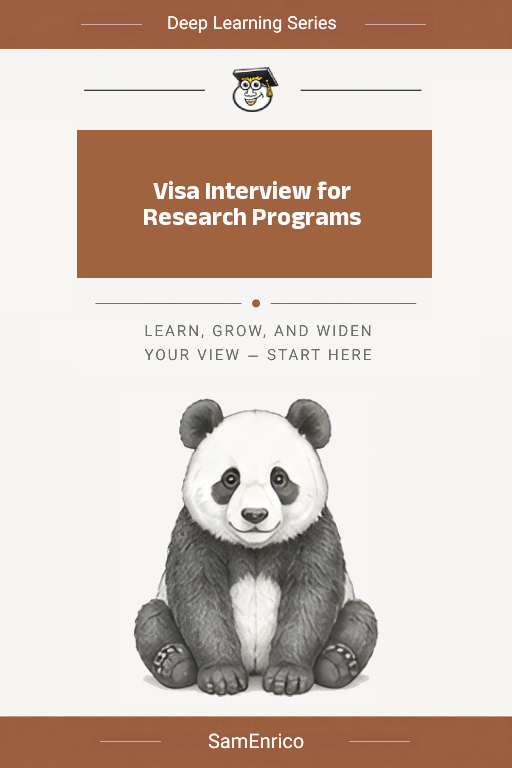
Visa Interview for Research Programs eBook
Discuss research topics, lab placements, and super
Discuss research topics, lab placements, and supervisor details for research-based degrees.
Formats
Free sample
Chapter 1: The Research Trap--Every year, thousands of brilliant researchers—people with published papers, prestigious university acceptances, and fully funded lab placements—sit down for a visa interview utterly convinced they will succeed. And every year, nearly thirty percent of them walk out with a denial stamp that has nothing to do with their qualifications and everything to do with a fundamental misunderstanding they didn't even know they had.If you are reading this book, you are likely one of those researchers. You have spent years mastering your discipline. You can explain the intricacies of CRISPR-Cas9 gene editing, the mathematical elegance of transformer architectures, or the historiographical debates surrounding postcolonial theory. You have secured a placement in a laboratory that is doing cutting-edge work.
Your supervisor is a recognized leader in the field. Your funding is secured. By every rational measure, you are exactly the kind of person a country would want to admit.And yet, you are afraid. Not because you lack confidence in your research, but because you have heard the stories. The postdoc from India with three first-author Nature papers who was denied.
The Ph D candidate from China whose entire research group was approved except for her. The visiting scholar from Brazil who was asked a single question, answered it honestly, and watched the officer shake his head. These stories are real, and they happen not because these researchers were unqualified, but because they walked into the interview room thinking like students when they should have been thinking like witnesses in their own defense.This chapter will reveal why research visa interviews are fundamentally different from any other interview you have ever experienced, why your academic achievements alone will not save you, and what you must understand before you take another step toward that consular window. By the time you finish this chapter, you will see the research visa interview for what it truly is: not a test of your knowledge, but a test of your credibility as a researcher. And you will never prepare for it the same way again.The Hidden Assumption That Destroys Most Research Visa Applications Let us begin with a confession that no visa officer will ever tell you directly.
When you walk up to that window, the officer standing on the other side starts from a position of skepticism. Not hostility, not prejudice, but institutionalized doubt. Their job is not to determine whether you are smart enough to deserve a visa. Their job is to determine whether you are telling the truth. The burden of proof is entirely on you, and the default assumption is that you are hiding something.This is not cruelty.
It is the logical consequence of a system that processes millions of applications annually, a significant percentage of which contain fraud. Officers have seen fake acceptance letters printed on stolen university letterhead. They have interviewed applicants who memorized entire scripts written by immigration consultants who had never set foot in a laboratory. They have encountered "supervisors" who turned out to be fictional, "research programs" that existed only on paper, and "funding" that evaporated under the slightest scrutiny. Every day, they catch people lying.
And so, every day, they assume you might be lying too.For a researcher, this creates a paradox. You have spent your entire academic career being rewarded for demonstrating expertise. You write long, detailed papers filled with specialized terminology. You give presentations where you dive deep into methodology. You impress your professors by showing how much you know.
But in the visa interview, expertise can be a liability. When you speak in jargon, the officer hears evasion. When you provide excessive detail, the officer hears rehearsed deflection. When you assume they understand your field, the officer hears condescension—or worse, an attempt to confuse them into approval.I once worked with a Ph D applicant in quantum computing who had prepared for his interview by memorizing every technical detail of his research. He could explain the difference between superconducting qubits and trapped ions.
He knew the decoherence times of his lab's specific hardware. He had practiced answering questions about error correction codes and gate fidelities. He walked into the interview confident that no one could question his expertise. The officer asked him one question: "What will you actually do in this program?" He launched into a thirty-second explanation of topological qubit braiding. The officer stopped him, denied his visa, and wrote a single note in the file: "Unable to articulate research in plain language."That applicant was not denied because he was unqualified.
He was denied because he failed the first and most important test of the research visa interview: the credibility test. He sounded like a student reciting a textbook, not a researcher who owned his work. And that distinction—between sounding like a student and sounding like a researcher—is the difference between approval and denial.The Three Pillars of Research Visa Success Over years of analyzing successful and unsuccessful research visa applications across dozens of countries, a clear pattern emerges. Every approval rests on three foundations. Every denial is missing at least one.
I call these the Three Pillars of Research Visa Success, and they will form the backbone of everything you learn in this book.Pillar One: A Well-Defined Research Topic. This sounds obvious, but most applicants get it wrong. A well-defined research topic is not a field of study. "I want to study cancer" is not a research topic—it is a subject area. "I want to investigate the role of the P53 protein in chemotherapy resistance in triple-negative breast cancer" is getting closer.
But even that is too broad for a visa officer. A truly well-defined research topic has three components: a specific gap in knowledge, a testable hypothesis, and a clear method. You should be able to state your topic in a single sentence that someone with a bachelor's degree in a different field can understand. If you cannot do that, you are not ready for the interview.Pillar Two: A Justified Lab Placement. Why this specific laboratory?
Why this university? Why this country? If your answer is "because it is prestigious" or "because my professor is famous," you have already lost. Prestige and fame are not justifications—they are opinions. A justified lab placement is one where you can name a specific resource that exists only in that lab and is essential to your research question.
That resource could be a piece of equipment (a cyclotron, an electron microscope, a unique animal model), a dataset (a longitudinal cohort study, a proprietary database), a collaborator (an industry partner, a government agency), or a location (a field site, a clinical population). Without a resource-specific justification, your lab placement is arbitrary.Pillar Three: A Verifiable Supervisor Relationship. The officer needs to believe that your supervisor knows who you are, wants you in their lab, and is prepared to oversee your work. This is not demonstrated by an acceptance letter alone. Acceptance letters can be forged.
What cannot be easily faked is a documented history of communication. You need to show that you have corresponded with your supervisor using institutional email addresses, that you have discussed your research plan with…
This is the end of the free sample. Get the eBook to keep going. Buy now
About this book
Details
- Author
- Mattox Danial
- Publisher
- SamEnrico
- Language
- English
- Genre
- research, Student's Shortcut, Research
- Released
- 2026-05-30
- Pages (approx.)
- 135
- Available as
- eBook, Audiobook

Read better in the ZLOADR app
Your eBooks on your phone or tablet. Sign in with your SamEnrico account and start reading.
More by Mattox Danial
 Self Esteem for Retail WorkersMattox Danial$11.99
 Business Credit for Cleaning ServicesMattox Danial$11.99
 Conversation Skills GuideMattox Danial$11.99
 Letting Go of Health ShameMattox Danial$11.99
 Demo Day Pitch PreparationMattox Danial$11.99
 Growth Mindset for EntrepreneursMattox Danial$11.99
 Emergency Road Rage KitMattox Danial$11.99
 Recruiting the Next Level BelieversMattox Danial$11.99
 The Pioneer Pens of Africa: How 19th-Century Journalists Shaped the Sports WorldMattox Danial$11.99
 The Bone Collectors of Whitechapel: Unmasking Victorian London's Body SnatchersMattox Danial$11.99
 How to Produce TrivetsMattox Danial$11.99
 How to Produce Ironing Board Hooks and RacksMattox Danial$11.99
You may also like
 Research Skills For StudentsWolf Glayds$11.99
 Rwanda Research OpportunitiesWiley Aurea$12.99
 Korean Research ScholarshipsJobe Katharine$12.99
 AI Masters Research Experience GuideHightower Kimberlee$12.99
 Japanese Research ScholarshipsWaite Mellissa$12.99
 Student Research Assistant GuideCausey Odessa$12.99