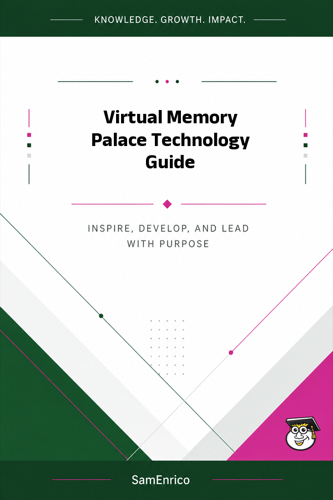
Virtual Memory Palace Technology Guide eBook
Use apps and VR to enhance method of loci with thi
by Couch Nubia
Use apps and VR to enhance method of loci with this practical digital mnemonic handbook.
Formats
Free sample
Chapter 1: The Leaky Sieve...–- Every morning, you wake up with a brain that is fundamentally broken. Not broken in the way a fractured bone is broken, or broken like a stalled engine. Your brain is broken in a far more insidious way: it was designed to forget. Before you recoil at that statement, consider the evidence. You have likely spent hundreds, perhaps thousands, of hours in classrooms, lecture halls, and training seminars.
You have crammed for exams, highlighted textbooks, and repeated phone numbers under your breath like a desperate prayer. And yet, ask yourself this simple question: what did you learn in your very first class last Tuesday? Not the professor’s name, not the room number—the content. The specific facts, the key concepts, the three bullet points that seemed so crucial at the time. Can you recall them?
If you are like ninety-five percent of the human population, those details have already begun their slow, silent drift into the fog of forgotten things.This is not a moral failing. It is not a sign of laziness, low intelligence, or a "bad memory" that you inherited from your parents. It is, quite simply, the default operating system of the biological brain. And for most of human history, this leaky, unreliable, wildly inefficient system was good enough. Our ancestors needed to remember which berries were poisonous, where the river curved during flood season, and who in the tribe could be trusted with a secret.
They did not need to memorize the periodic table, the articles of incorporation for a multinational corporation, or the 2,000 vocabulary words required to pass a Mandarin proficiency exam. The modern world has placed demands on human memory that evolution never anticipated. And every single day, you feel the weight of that mismatch.This book is not a collection of gentle suggestions or motivational platitudes about "training your brain" by doing crossword puzzles. This is a technical manual for a specific, ancient, and profoundly powerful solution—the Method of Loci, or Memory Palace—upgraded for the twenty-first century using virtual reality, augmented reality, and the apps that live in your pocket. But before we can build that solution, we must fully understand the problem.
And the problem, put simply, is that your biological memory is a leaky sieve, and everything you have been taught about how to fix it has been wrong.The Myth of the "Bad Memory"Let us dispense with the most damaging myth first. There is no such thing as a bad memory. There are only untrained memories and misdirected efforts. You do not have a memory problem; you have a retrieval problem. The information you have learned—every lecture you sat through, every textbook you read, every conversation you had—is still in there somewhere, encoded in the vast, tangled network of neurons and synapses that constitutes your brain.
The difficulty is not storage; the difficulty is access. Imagine a library containing millions of books, but with no catalog, no shelving system, and a team of librarians who randomly reshelve volumes at two in the morning. The books are present. The knowledge exists. But finding any specific book requires a miracle.
That is your brain.Consider the phenomenon of "tip-of-the-tongue" states. You know the actor’s name. You can see his face. You can even describe the movie he starred in. But the name itself hovers just beyond reach, tantalizing and inaccessible.
Ten minutes later, while you are brushing your teeth, the name pops into your head unbidden. Where was it? It was always there. Your retrieval system simply failed to locate it at the right moment. Memory champions—those astonishing individuals who memorize the order of ten shuffled decks of cards or recite pi to ten thousand digits—do not possess genetically superior brains.
Neuroimaging studies have shown that their brains are structurally unremarkable. What sets them apart is not hardware but software. They have learned systematic, reliable methods for encoding information and, more importantly, for retrieving it on demand. They have built a catalog for their mental library. And the single most powerful tool in their arsenal, used by nearly every memory champion in the world, is the Method of Loci.The Forgetting Curve and Why Cramming Fails In 1885, a German psychologist named Hermann Ebbinghaus published a groundbreaking study on the nature of human memory.
He taught himself lists of nonsense syllables—meaningless three-letter combinations like "ZOF" and "WUK"—and then tested himself at regular intervals to see how much he had retained. The result was the now-famous Forgetting Curve. Ebbinghaus discovered that within one hour of learning new information, humans forget approximately fifty percent of it. Within twenty-four hours, that number climbs to nearly seventy percent. Within a week, unless the information has been reviewed, up to ninety percent is gone.
The curve is exponential: the most rapid forgetting occurs immediately after learning, then gradually slows.This has devastating implications for how most people study. Consider the typical college student before an exam. She spends three hours cramming on Tuesday night, absorbing as much information as her working memory can hold. She takes the exam on Wednesday morning. By Thursday afternoon, she would be hard-pressed to recall even the major themes of the material.
The information never moved from short-term working memory into long-term storage because the conditions required for consolidation—repetition, sleep, and meaningful association—were absent. Cramming works for the exam and fails for everything that comes after. It is the educational equivalent of building a house on sand.The Forgetting Curve is not a law of nature that we must accept passively. It is a description of what happens in the absence of intervention. The curve can be flattened dramatically through two mechanisms: spaced repetition (reviewing information at increasing intervals) and meaningful encoding (attaching new information to existing mental structures).
The Method of Loci excels at the second mechanism, and virtual reality supercharges both. But to understand why, we must first understand the one type of memory that evolution actually optimized: spatial memory.The Evolutionary Miracle of Spatial Memory Close your eyes for a moment. Really. Do it. Picture the home you lived in when you were ten years old.
Walk through the front door. What color was the carpet? Where was the couch positioned? How many steps from the front door to the kitchen? If you are like most people, you can answer these questions with surprising accuracy, even if you have not lived in that house for decades.
You remember the creaky floorboard at the top of the stairs. You remember the smell of the basement. You remember the exact spot where you hid your diary or your favorite comic book.Now contrast that with the following: What did you eat for lunch on June 3rd, five years ago? What were the three main arguments in the op-ed you read last week? What were the names of the five new people you met at that party six months ago?
You have no idea. And that is not because your brain is lazy. It is because your brain evolved under intense selective pressure to prioritize certain types of information over others. For the entire history…
This is the end of the free sample. Get the eBook to keep going. Buy now
About this book
Details
- Author
- Couch Nubia
- Publisher
- SamEnrico
- Language
- English
- Genre
- Non-Fiction, Self-Help, Digital Memory
- Released
- 2026-06-07
- Pages (approx.)
- 130
- Available as
- eBook, Audiobook

Read better in the ZLOADR app
Your eBooks on your phone or tablet. Sign in with your SamEnrico account and start reading.
More by Couch Nubia
 Shift Work Chronotype AdaptationCouch Nubia$11.99
 Body Image for Scoliosis GuideCouch Nubia$11.99
 Housing Coop Retirement ModelCouch Nubia$11.99
 The Career Changer NetworkCouch Nubia$11.99
 Rhythm Reborn: The Untold Story of Pina Bausch’s Last MasterpieceCouch Nubia$11.99
 The Last Sprint: How the Greatest Marathoner Fell from GraceCouch Nubia$11.99
 Understanding Exomphalos-macroglossia-gigantism SyndromeCouch Nubia$17.99
 Nonprofit ManagementCouch Nubia$11.99
 Supplier Onboarding EfficiencyCouch Nubia$12.99
 Writing Executive Summaries for Technical ReportsCouch Nubia$12.99
 How to Become a Molder ApprenticeCouch Nubia$11.99