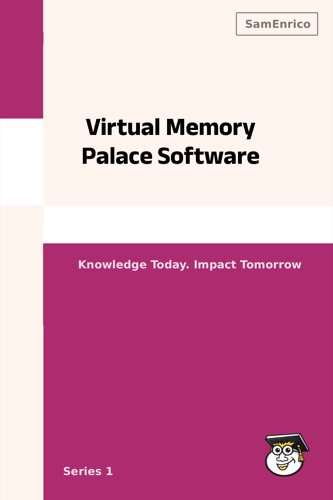
Virtual Memory Palace Software eBook
Use digital tools like Memory OS to build 3D virtu
by Fry Arnulfo
Use digital tools like Memory OS to build 3D virtual palaces.
Formats
Free sample
Chapter 1: The Broken Tapestry--–- The email arrived at 11:47 PM on a Tuesday, which was fitting because Tuesdays had become the official graveyard of Daniel’s attention span. Three hundred and forty-seven unread messages. Fourteen open browser tabs, each one a half-finished article, a comparison of project management software he would never download, a recipe for sourdough he would never bake. Two calendar notifications, already expired, reminding him of meetings he had joined late and left early. A sticky note on his monitor, smudged and curling at the edges, listing three tasks that had migrated from yesterday’s sticky note, and the day before that, and the day before that.Daniel was not unusual.
He was, in fact, terrifyingly normal. He was a senior marketing director at a mid-sized tech firm, which meant his job consisted almost entirely of remembering things: campaign metrics, client preferences, competitor positioning, quarterly projections, the names of seventeen people in the Stockholm office he met once on Zoom. He had a smartphone with 128 gigabytes of storage, a laptop with 16 gigabytes of RAM, and a biological brain that was, by every objective measure, losing the battle against both.He had tried everything. Bullet journals with their elegant dot grids—abandoned after three weeks when he forgot to buy a new pen. Digital note-taking apps with their infinite hierarchies and backlinks and bidirectional links and graph views that looked like a constellation designed by a caffeinated spider—Evernote, Notion, Obsidian, Roam, each one promising to be the last one he would ever need, each one eventually becoming a digital attic full of orphaned notes he never reopened.
He had tried voice memos, which produced hour-long recordings he would never transcribe. He had tried the Pomodoro Technique, GTD, Zettelkasten, and a dozen other systems whose names sounded like German philosophy and functioned like New Year’s resolutions.None of it worked, or rather, all of it worked a little bit, for a little while, until the friction of maintaining the system exceeded the friction of forgetting, and Daniel would find himself back at square one, staring at a blank page, trying to remember what he was supposed to be doing.The problem, he realized late that Tuesday night, was not his tools. The problem was his attention. And the problem with his attention was that it was being pulled in seventeen directions at once by a world that had been optimized, by people much smarter than him, to do exactly that. He was not failing at memory because he was lazy or stupid.
He was failing because he was human, and the modern information environment was a machine designed to exploit every weakness of the human attentional system.But somewhere in the basement of the internet, in a thread on a forum dedicated to obscure cognitive techniques, Daniel found a mention of something called the Method of Loci. The post was brief, almost dismissive: “Ancient Greek technique. Build a mental building. Put stuff in rooms. Works better than anything else.
Google it.”He did. And what he found changed the trajectory of his relationship with information forever.The Forgotten Technology of the Human Mind The story begins, as so many origin stories do, with a disaster. In the year 477 BCE, a Greek poet named Simonides of Ceos was the featured entertainer at a banquet held by a nobleman named Scopas. Simonides performed a lyric poem that, as was customary, included praise for the twin gods Castor and Pollux. Scopas, apparently feeling that the poet had spent too many verses on celestial beings and not enough on his host, informed Simonides that he would pay only half the agreed fee and that the gods could cover the rest.Simonides was not pleased, but before he could argue, a servant arrived with a message: two young men on horseback were waiting outside, asking to speak with him.
Simonides stepped out into the courtyard. No one was there. And as he stood, confused, in the open air, the banquet hall behind him collapsed. The roof caved in. Scopas and every other guest were crushed beyond recognition.
Their families, arriving at the scene, could not identify the bodies. They could not even tell which mangled remains belonged to which person.Simonides, standing in the rubble, realized something remarkable. He closed his eyes and walked backward through his memory of the banquet. He saw Scopas at the head of the table, a cup of wine in his hand. He saw the wealthy guests in order of importance, reclining on couches in the Greek style.
He saw the servants circulating with platters of figs and roasted meat. He saw, with perfect clarity, where each person had been sitting at the moment he had walked out the door.He began pointing. “This is Scopas. This is his cousin. This is the merchant from Corinth.” The families wept with gratitude.
And Simonides, who had just lost his payment and gained an insight worth more than all the silver in Greece, understood something that would shape Western memory for two thousand years.He understood that the human mind does not forget where things are.You might not remember what you ate for breakfast three days ago. You might not remember the name of the person who introduced themselves at the networking event. But if someone asked you to describe the layout of your childhood bedroom, the path from your front door to the kitchen, the location of every piece of furniture in the apartment you lived in a decade ago—you could do it. Not vaguely. Not approximately.
You could close your eyes and walk through those spaces with the fidelity of a security camera.This is not a coincidence. It is not a quirk of your personal history. It is the result of several hundred million years of evolution, during which the single most important survival task for any mobile animal was remembering where things were. Where is the water hole? Where is the predator?
Where is the path back to the nest? The brain structures that handle spatial memory—the hippocampus, the entorhinal cortex, the place cells and grid cells that won their discoverers a Nobel Prize—are among the oldest and most robust in the mammalian brain. They do not fatigue. They do not fill up. They have no known capacity limit.And for most of human history, we used them constantly.
We navigated by landmarks. We told stories anchored to places. We built knowledge in physical spaces—temples, libraries, universities—because we understood, implicitly, that location was the most powerful organizing principle available to the human mind.Then came the printing press. Then came the index. Then came the database, the spreadsheet, the search bar.
And somewhere along the way, we convinced ourselves that we no longer needed to remember. We could outsource our memory to paper, to silicon, to the cloud. We could store everything externally and retrieve it on demand.Except that is not how retrieval works. Retrieval depends on encoding. And encoding, as Daniel discovered every time he stared at a forgotten sticky note, is not something you can outsource.
You cannot Google a memory you never made.The Failed Promises of External Memory Let us be precise about what Daniel…
This is the end of the free sample. Get the eBook to keep going. Buy now
About this book
Details
- Author
- Fry Arnulfo
- Publisher
- SamEnrico
- Language
- English
- Genre
- Non-Fiction, Self-Help, Digital Memory
- Released
- 2026-06-07
- Pages (approx.)
- 130
- Available as
- eBook, Audiobook

Read better in the ZLOADR app
Your eBooks on your phone or tablet. Sign in with your SamEnrico account and start reading.
More by Fry Arnulfo
 Dividend Safety Score PrimerFry Arnulfo$11.99
 Outbreak Crisis Hotline SetupFry Arnulfo$11.99
 Foster Care Bed Wetting ShameFry Arnulfo$11.99
 Cardio Master GuideFry Arnulfo$11.99
 Goal Review SystemFry Arnulfo$11.99
 Meth Mouth Recovery GuideFry Arnulfo$11.99
 Travel Planning Weekly ReviewFry Arnulfo$11.99
 Fenrir's Unchained Fury: The Wolf Who Shattered ChainsFry Arnulfo$11.99
 The Admiral's Gambit: Yamamoto's Fate at BougainvilleFry Arnulfo$11.99
 Service Providers Guide to Workshops & SeminarsFry Arnulfo$11.99
 How to Produce Massage StonesFry Arnulfo$11.99
 OKR Communication GuideFry Arnulfo$12.99