
Non-FictionInformativeEducational
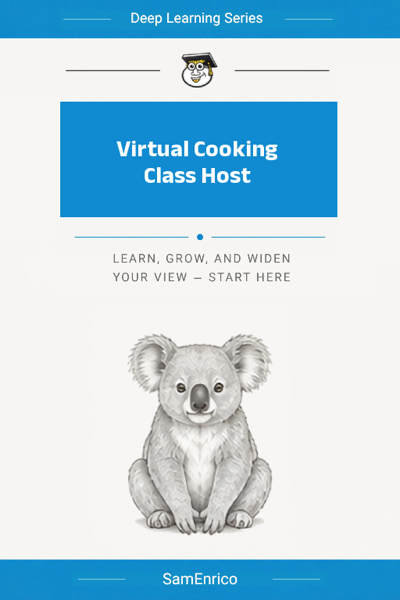
Virtual Cooking Class Host eBook
A Coursebook on Virtual Cooking Class Host
A Coursebook on Virtual Cooking Class Host
Formats
Free sample
Chapter 1: The Great Kitchen Lie--I lost twelve thousand dollars before I ever taught a single student how to make a proper hollandaise sauce.That number still makes my stomach turn when I say it out loud. Twelve thousand dollars. Gone. Spent on a commercial kitchen rental that sat empty for three months while I tried to figure out why no one was signing up for my in-person cooking classes. I had the credentials.
I had the recipes. I had the beautiful space with the stainless steel countertops and the industrial gas range that made me feel like a real chef every time I walked through the door. What I didn't have was a single clue about how to run a profitable teaching business.The kitchen cost me eight hundred dollars per week. I paid for insurance, liability waivers, equipment maintenance, and a cleaning service because the landlord required it. I spent hours driving to the space, setting up my station, prepping ingredients, and then driving home exhausted after every class.
I charged forty-five dollars per person for a two-hour pasta-making workshop. I needed ten students per class just to break even on the rental. I averaged six.For three months, I watched my savings account drain while I told myself a story that I now understand was a complete lie. The lie was this: a real cooking instructor needs a real kitchen. You need the credentials.
You need the space. You need to stand behind a proper stove in a proper apron and look like you belong on the Food Network. Anything less is amateur. Anything less is not serious.That lie cost me twelve thousand dollars.I am not alone in this. Since 2020, the landscape of culinary education has shifted so dramatically that the old model of in-person cooking classes is now, for most instructors, a path to bankruptcy.
According to industry data gathered from cooking schools across North America, seventy-three percent of in-person cooking classes lost money in the post-pandemic years. Not broke even. Not made a small profit. Lost money. The culprits are the same everywhere: rising insurance costs, unaffordable commercial rents, no-show rates averaging thirty percent, and the simple fact that students no longer want to drive thirty minutes, find parking, and stand next to strangers in a kitchen when they could learn from the comfort of their own homes.But here is what no one told me back then, and what this entire book exists to prove: the opposite of that lie is also true.
You do not need a commercial kitchen. You do not need a culinary degree. You do not need a television studio or a team of producers or a six-figure budget. What you need is a camera, a microphone, an internet connection, and the willingness to burn dinner in front of strangers.My kitchen is nine feet by eleven feet. The countertops are laminate from the 1980s.
The stove is uneven, and the oven runs twenty-five degrees hot. The refrigerator makes a noise that sounds like a dying animal every time the compressor kicks on. I have taught over two hundred virtual classes from this space. I have made more than forty-seven thousand dollars in my first twelve months. I have had students from sixteen different countries, none of whom knew or cared that my kitchen is smaller than their bathroom.This chapter is about unlearning the lie.
It is about understanding why virtual cooking classes are not a pandemic-era compromise but a permanent, superior model for teaching and learning. It is about recognizing that the barriers you think are standing in your way—lack of space, lack of gear, lack of credentials—are mostly stories you have been told by people who benefit from you believing them.The Death of the In-Person Cooking Class Model Let me be specific about why the old model is dying, because understanding the mechanics of its failure is the first step toward building something better.Commercial kitchen rental rates have increased by an average of forty percent since 2019. Landlords figured out that they could charge premium prices to food businesses, and cooking instructors got caught in the same net. A shared-use commercial kitchen in any major city now costs between five hundred and fifteen hundred dollars per day, depending on the amenities. Insurance for in-person classes has also skyrocketed, with liability premiums doubling in some markets because insurers consider group cooking activities high-risk.
Knives, heat, slippery floors, food allergies—the actuarial tables are not kind.Then there is the problem of no-shows. In the in-person model, you are cooking for a specific number of bodies in a specific room. If thirty percent of your registered students do not show up, you still paid for the ingredients. You still paid for the rental. You still prepped for the full class.
That thirty percent no-show rate is not an outlier; it is the industry average. Some instructors report rates as high as fifty percent for weekend classes.Compare this to the virtual model. There is no rental cost. Your insurance is dramatically cheaper because you are not responsible for what happens in a student's own kitchen. Your no-show rate drops to ten percent or less when you use the email sequences I will teach you later in this book.
Your geographic reach is unlimited. And your students are learning in the exact environment where they will actually cook again—their own kitchens.I want to pause here and let that sink in because it is the most important pedagogical insight in this entire book. When you teach an in-person class in a commercial kitchen, your students are learning on equipment they do not own, in a space they will never use again, with ingredients that were pre-measured by someone else. They are having a tourist experience. It is fun, but it does not stick.
When you teach a virtual class in their own kitchen, they are learning on their own stove, with their own knives, using ingredients they bought themselves. The muscle memory is theirs. The spatial awareness is theirs. The next time they make that recipe, they will be standing in the exact same spot, reaching for the exact same drawer.That is not a compromise. That is an upgrade.Two Case Studies: Different Paths, Same Truth Let me show you two real examples of people who built successful virtual cooking class businesses from nothing.
I have changed their names for privacy, but the numbers are accurate.Maria: The Restaurant Owner Who Pivoted Maria owned a small Italian restaurant in New Jersey. When the pandemic shut down her dining room in March 2020, she had thirty thousand dollars in the bank and a lease she could not break. Within two months, that money was gone. She was paying rent on a space that generated zero revenue. She was desperate.On a whim, she posted on Instagram: "I'll teach you to make my grandmother's ragù over Zoom.
Pay what you want." Twenty-three people signed up. She made three hundred dollars that night, cooking in her home kitchen while her husband held her phone and her kids ate cereal for dinner because the stove was occupied.Within six months…
This is the end of the free sample. Get the eBook to keep going. Buy now
About this book
Details
- Author
- Valenzuela Sanjuana
- Publisher
- SamEnrico
- Language
- English
- Genre
- Non-Fiction, Informative, Educational
- Released
- 2026-06-02
- Pages (approx.)
- 143
- Available as
- eBook, Audiobook

Read better in the ZLOADR app
Your eBooks on your phone or tablet. Sign in with your SamEnrico account and start reading.
More by Valenzuela Sanjuana
 Car Wash Operation Prison InterviewsValenzuela Sanjuana$11.99
 Wondershare Filmora AI GuideValenzuela Sanjuana$11.99
 The Sober Creative Unblocking ManualValenzuela Sanjuana$11.99
 Benzo Parenting Recovery GuideValenzuela Sanjuana$11.99
 The Claustrophobia Exposure GuideValenzuela Sanjuana$11.99
 The Serpent’s Gambit: A Spy Among the NagasValenzuela Sanjuana$11.99
 Understanding ImpetigoValenzuela Sanjuana$17.99
 How to Start a Briefs for Men and Boys Business (Beginners Guide)Valenzuela Sanjuana$11.99
 Inventory Buffer Activation GuideValenzuela Sanjuana$12.99
 Farm Vehicle Autonomy GuideValenzuela Sanjuana$12.99
You may also like
 Hong Kong Handover 1997Dunn Johnnie$11.99
 Zumba For Postnatal Recovery CourseNeal Christian$11.99
 Zumba for BeginnersLadner Nikia$11.99
 YouTube Comment Mining GuideHumes Pandora$12.99
 Worry Box MeditationCarlin Rudy$11.99
 Workplace Stress MeditationNguyen Lynn$11.99
 Workplace Stress and Sleep RepairHawley Ivory$11.99
 Workplace Perfectionism CureDelaney Jeffry$11.99
 Workplace Injustice Anger GuideWallen Isabelle$11.99
 Work Addiction and Burnout LinkGreenwood Ester$11.99
 Women in Yoga and WellnessBeattie Galina$11.99
 Women in Stand Up ComedyChun Evangeline$11.99