
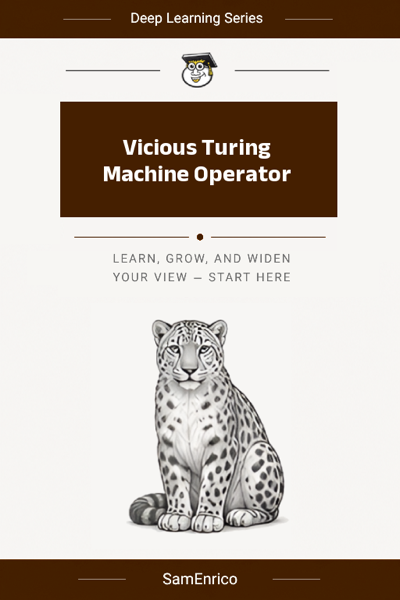
Vicious Turing Machine Operator eBook
A Coursebook on Vicious Turing Machine Operator
A Coursebook on Vicious Turing Machine Operator
Formats
Free sample
Chapter 1: The First Clearing--–- The moment your finger presses the KEC key, you cross a threshold. Before that moment, you are just another user—someone who runs programs, reads documentation, and hopes the machine does what you expect. After that moment, you become something else entirely. You become an operator who understands that every clearing key, every toggle switch, and every indicator lamp is not a feature of the machine but a vulnerability. The console is not an interface.
It is a weapon, and you have just picked it up.This is not hyperbole. It is a statement of fact about the architecture of every computer ever built. From the Ferranti Mark I of 1951 to the most modern server blade, every machine has a console—a set of hardware-level controls that bypass the operating system, ignore permission checks, and speak directly to the processor, the memory controller, and the storage subsystem. On the Ferranti Mark I, that console is a physical panel of switches and lamps. On a modern server, it is a serial port, a JTAG interface, or a Baseboard Management Controller.
But the principle is identical: at the console, you are not subject to the machine's rules. You rewrite them.This chapter is about that threshold. It is about the clearing keys—KAC, KBC, and KEC—and what they mean when you stop thinking of them as safety features and start thinking of them as tactical instruments. It is about the philosophy of Manual versus Auto, the strategic use of dummy stops, and the acoustic intelligence hidden in the Hooter's hum. And it is about the mindset shift required to stop being a user and start being an operator.By the end of this chapter, you will have performed your first manual instruction.
You will have cleared the machine, set the switches, and executed code that never existed in memory. You will have crossed the threshold.The Architecture of Obedience Every computer is a machine of absolute obedience. It has no will, no preferences, no self-preservation instinct. It does exactly what it is told, no more and no less. This is its strength and its weakness.The strength is obvious: you can rely on the machine to execute your instructions flawlessly, billions of times per second, without complaint.
The weakness is equally obvious: anyone who can feed instructions to the machine can make it do anything. And the console is the ultimate instruction-feeding mechanism.Consider the path of an instruction on a typical computer. In normal operation, the instruction is fetched from memory by the control unit, decoded, executed, and the result is stored. The operating system is involved. Memory protection is involved.
User permissions are involved. There are layers upon layers of checks and balances, all designed to prevent one program from interfering with another.At the console, all of those layers disappear. When you set the MAN/AUTO switch to MAN, you disconnect the control unit from the program counter and connect it to the hand switches. The next instruction does not come from memory. It comes from your fingers.
You are not asking the machine to run a program. You are feeding it instructions one by one, like a parent spoon-feeding a child.The machine cannot refuse. It has no concept of refusal. It has only inputs and outputs. The hand switches are inputs.
The instruction register is a destination. The connection is direct, physical, and unfiltered.This is the architecture of obedience. Understand it, and you understand why the console is a weapon.The Clearing Keys as Tactical Instruments The Ferranti Mark I has three clearing keys, each with a specific purpose. In the original manual, Alan Turing described them as tools for resetting the machine to a known state. That is true, but it is not the whole truth.
The clearing keys are also tools for sabotaging running programs, erasing evidence of tampering, and creating clean slates for bootstrapping.KAC: The Accumulator Cleaver The accumulator is the machine's primary arithmetic register. Every addition, subtraction, logical operation, and shift passes through it. It is the temporary workspace where values are transformed before being stored back to memory.KAC clears the accumulator to zero. In normal operation, this is useful for preparing for a new calculation. In vicious operation, it is useful for corrupting a calculation that is already in progress.To understand why, you must understand the timing of instruction execution.
When the machine fetches an instruction, it first reads the opcode and operands from memory. Then it executes the operation. Then it stores the result. The accumulator holds the result throughout this process. If you press KAC after the instruction has fetched its operands but before it has stored its result, the accumulator becomes zero.
The instruction completes, storing zero instead of the intended result.The program continues, unaware that its data has been replaced. It may check for errors, but it will not find any—zero is a perfectly valid value. It may log the operation, but the log will show a successful computation. The sabotage is invisible.The technique requires precise timing. Press KAC too early, and the instruction has not yet started.
Press KAC too late, and the result has already been stored. But with practice, you can learn to read the machine's rhythm—the flicker of the lamps, the rhythm of the Hooter—and press the key at exactly the right moment.KBC: The Address Displacer The B-Tube is an index register. It holds a single value—an address offset—that is added to every memory address before the access occurs. When the B-Tube contains 100, an instruction that reads address 1000 actually reads address 1100.KBC clears the B-Tube to zero. In normal operation, this resets the indexing mechanism.
In vicious operation, it redirects every subsequent memory access to a different location.The effect is subtle but devastating. Consider a program that uses the B-Tube to iterate through an array. The programmer expects the B-Tube to increment from 0 to N, accessing addresses base+0, base+1, and so on. If you clear the B-Tube in the middle of the loop, the program suddenly starts accessing base+0 repeatedly, or base+something else entirely, depending on when you press the key.The program may crash. It may enter an infinite loop.
It may overwrite critical data. Or it may simply produce incorrect results, which is often worse than a crash because the crash would be noticed.Like KAC, KBC requires timing. But KBC also requires knowledge of the program's structure. You need to know when the B-Tube is being used and for what purpose. This is where the operator's skill becomes visible: the ability to read the machine's state from the lamps and the Hooter and choose the optimal moment to strike.KEC: The Nuclear Option and the Clean Slate KEC clears everything: the accumulator, the B-Tube, the program counter, and all control flags.
The machine returns to its power-on state, as if it had just been turned on. The magnetic drum retains its data, but the machine's understanding of where it is and what it is doing vanishes.This is the nuclear option. When you press KEC, you destroy the current execution context completely.…
This is the end of the free sample. Get the eBook to keep going. Buy now
About this book
Details
- Author
- Nicholas Beryl
- Publisher
- SamEnrico
- Language
- English
- Genre
- Non-Fiction, Informative, Educational
- Released
- 2026-06-02
- Pages (approx.)
- 137
- Available as
- eBook, Audiobook

Read better in the ZLOADR app
Your eBooks on your phone or tablet. Sign in with your SamEnrico account and start reading.
More by Nicholas Beryl
 GAD Panic Attack OverlapNicholas Beryl$11.99
 Iran Hostage DiaryNicholas Beryl$11.99
 Self Hypnosis For Chemo SupportNicholas Beryl$11.99
 ABCDE for Overwhelm RecoveryNicholas Beryl$11.99
 Market Exit Barriers MapNicholas Beryl$11.99
 The Banshee's Last Wail: A Celtic Curse UnleashedNicholas Beryl$11.99
 Sand and Stars: The Forgotten Expeditions of the Trans-Saharan PioneersNicholas Beryl$11.99
 How to Start a Buckram and Similar Stiffened Textile Fabrics Business (Beginners Guide)Nicholas Beryl$11.99
 Scholarships for African Students HandbookNicholas Beryl$12.99
 Emerging Markets Artificial Intelligence OutlookNicholas Beryl$12.99
 Understanding Hairy Nose TipNicholas Beryl$17.99