
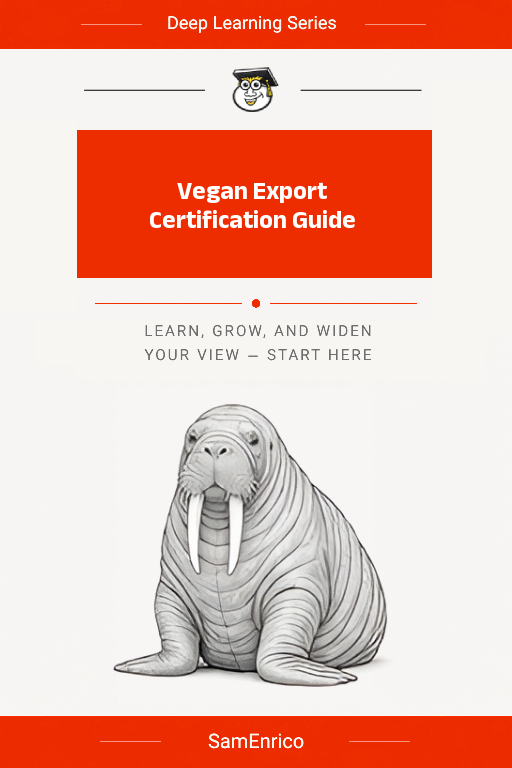
Vegan Export Certification Guide eBook
Obtain Vegan Society or Vegan Action certification
by Burger Zana
Obtain Vegan Society or Vegan Action certification for non-animal products, accessing plant-based European and US markets for cosmetics and apparel.
Formats
Free sample
Chapter 1: The $30 Billion Blindspot--–- In 2019, a small British cosmetics brand called Nourish London received a cease-and-desist letter from a German consumer protection group. The offense? On their German website, they had described three lipsticks as “vegan.” The products contained no animal ingredients. They had never been tested on animals. The formulations were 100% plant-based.
Yet a regional court in Munich fined the company €12,500. The reason was not deception—it was the absence of a particular sunflower-shaped logo.This single case encapsulates everything wrong with how most entrepreneurs approach the vegan export market. They assume that if their product is factually vegan, they can call it vegan. They assume that good intentions and clean ingredients are enough. They assume that “vegan” is a simple binary—either it is or it isn’t.
All of these assumptions are wrong, and in the European Union, they can cost you tens of thousands of euros in fines, destroyed inventory, and permanently blocked retail relationships.The global plant-based consumer goods market is currently valued at approximately $30 billion for cosmetics and apparel combined, growing at 12-15% annually. That is not a niche. That is not a trend. That is a structural shift in consumer behavior, driven by Gen Z and millennial buyers who consider animal-free certification as fundamental as a product’s safety data sheet. Yet the vast majority of brands attempting to enter this market—particularly from manufacturing hubs in Asia, Latin America, and Eastern Europe—fail within their first 18 months of export.
Not because their products are bad. Not because they lack demand. But because they do not understand that “vegan” is not a description. It is a certification. And certification is a legal process, not a marketing claim.This chapter is not an introduction.
It is a warning. Before we discuss ingredient sourcing, factory cleaning protocols, or the difference between the Vegan Society’s sunflower logo and Vegan Action’s certified checkmark, we must first understand why third-party certification has moved from optional to mandatory. We must understand the legal landscape that turned a simple word into a potential liability. And we must confront the uncomfortable truth that self-declaration—the practice of calling your product vegan without paying for an external audit—is rapidly becoming a business risk that no serious exporter can afford.The Death of Self-Declaration: How Retailers Changed the Game Fifteen years ago, the word “vegan” on a product label was largely unregulated. Brands could make the claim with little more than a cursory review of their ingredient lists.
Consumers trusted the claim because the market was small and the stakes were low. That era is over.The turning point came in 2018, when the British supermarket chain Tesco announced that all products bearing their own “Plant-Based” label would require third-party certification from The Vegan Society. At the time, industry analysts called it a minor policy change affecting a few hundred SKUs. Within 24 months, every major UK retailer—Sainsbury’s, Asda, Co-op—had followed suit. The trigger was liability.
In 2017, a UK-based yogurt company had been successfully sued by a vegan consumer who discovered that their “vegan” coconut yogurt contained trace amounts of milk protein due to shared production lines. The retailer, which had stocked the product, was named as a co-defendant. The settlement ran into six figures.Retailers learned a brutal lesson that day. When a brand self-declares “vegan,” the retailer inherits the liability if that declaration is false. If a consumer has an allergic reaction to an undeclared animal protein—say, casein in a “vegan” lipstick—the retailer’s legal exposure is identical to that of the brand.
Worse, under the EU’s General Product Safety Directive, retailers are required to conduct “reasonable due diligence” on the claims made by their suppliers. A self-declared vegan claim with no third-party audit is, in the eyes of European courts, not reasonable due diligence. It is negligence.The ripple effect crossed the Atlantic in 2020, when Whole Foods Market—now owned by Amazon—issued an internal memo to category buyers stating that all new beauty and apparel products labeled “vegan” must carry either the Vegan Action logo or the Vegan Society logo. Existing products were grandfathered for 18 months, then delisted if uncertified. By 2022, Nordstrom, Sephora USA, and Target had all adopted similar policies.
Today, the only major US retailer that still accepts self-declared vegan claims for new products is Walmart, and industry sources indicate that policy is under review following a 2024 class-action lawsuit in California alleging that twelve “vegan” private-label products contained animal-derived ingredients.The pattern is unmistakable. Self-declaration is being systematically phased out by the only entities that matter for export brands: retailers. If your product is not certified by either The Vegan Society or Vegan Action, you are not selling on the shelves of Tesco, Sephora, Nordstrom, Whole Foods, or any other major chain in the EU or US. You are limited to direct-to-consumer e-commerce, farmer’s markets, and independent boutiques that lack the volume to justify export logistics. For most brands, that is not a viable business—it is a hobby.The Greenwashing Trap: When “Vegan” Becomes a Legal Liability Beyond retail requirements, there is a more immediate threat: government enforcement of truth-in-advertising laws.
The term “greenwashing” originally referred to exaggerated environmental claims, but European regulators have broadened it to include any unsubstantiated ethical claim—including vegan status.Consider the case of Lush Cosmetics, a brand often cited as a leader in ethical beauty. In 2021, the UK Advertising Standards Authority (ASA) received a complaint about Lush’s “Vegan” lip scrub. The product was, in fact, vegan. The complaint was not about the ingredient list. It was about the absence of a certification logo on the packaging.
The complainant argued that without third-party verification, consumers had no way to distinguish between a brand’s internal ethics policy and an independently audited standard. The ASA ultimately ruled in Lush’s favor, noting their long-standing public commitment to vegan principles. But the ruling included a warning: “In the absence of a recognized certification scheme, advertisers must hold robust documentary evidence to support vegan claims.”That warning has teeth. In France, the Directorate General for Competition, Consumer Affairs, and Fraud Prevention (DGCCRF) conducted a sweep of 150 cosmetic products labeled “vegan” in 2023. They found that 22% lacked any supporting documentation for the claim.
Those products were removed from shelves, and their manufacturers were fined an average of €8,000 each. In Germany, the Wettbewerbszentrale (German Competition Authority) has filed seventy-three formal complaints against brands using unsubstantiated “vegan” claims since 2020. The fines range from €3,000 to €25,000, depending on the scale of distribution.The United States has been slower to act, but the Federal Trade Commission (FTC) is catching up. In 2022, the FTC issued updated Green Guides that explicitly address non-environmental claims for the first time, including “cruelty-free” and “vegan.” While the FTC has not yet brought a major enforcement action against an uncertified vegan brand, state attorneys general have. In 2024, the New York Attorney General’s office settled with a direct-to-consumer apparel brand that had labeled thirty products “vegan” despite using wool buttons and animal-derived glues in footwear.
The settlement required the brand to pay $250,000 in restitution and to obtain third-party certification for all future vegan claims.The legal principle…
This is the end of the free sample. Get the eBook to keep going. Buy now
About this book
Details
- Author
- Burger Zana
- Publisher
- SamEnrico
- Language
- English
- Genre
- Non-Fiction, Business Brief
- Released
- 2026-06-01
- Pages (approx.)
- 143
- Available as
- eBook, Audiobook

Read better in the ZLOADR app
Your eBooks on your phone or tablet. Sign in with your SamEnrico account and start reading.
More by Burger Zana
 Oil and Gas Precedent AnalysisBurger Zana$11.99
 Alcohol Craving ManagementBurger Zana$11.99
 Mirroring Pace and LeadBurger Zana$11.99
 Ayurvedic Head MassageBurger Zana$11.99
 Mindful Restaurant Eating for Binge EatersBurger Zana$11.99
 The Homeless Shelter TargetBurger Zana$11.99
 Memory Reconstruction After TraumaBurger Zana$11.99
 St John's Wort SADBurger Zana$11.99
 The Silk and the Scoundrel: The Untold Love Story of Lady Hester Stanhope and Her Syrian AdventureBurger Zana$11.99
 Sabor a Ti: The Salsa Revolution on TelevisionBurger Zana$11.99
 How to Produce Horse HaltersBurger Zana$11.99
 Stripe Remote Internship GuideBurger Zana$12.99
You may also like
 Hong Kong Handover 1997Dunn Johnnie$11.99
 Zumba For Postnatal Recovery CourseNeal Christian$11.99
 Zumba for BeginnersLadner Nikia$11.99
 YouTube Comment Mining GuideHumes Pandora$12.99
 Worry Box MeditationCarlin Rudy$11.99
 Workplace Stress MeditationNguyen Lynn$11.99
 Workplace Stress and Sleep RepairHawley Ivory$11.99
 Workplace Perfectionism CureDelaney Jeffry$11.99
 Workplace Injustice Anger GuideWallen Isabelle$11.99
 Work Addiction and Burnout LinkGreenwood Ester$11.99
 Women in Yoga and WellnessBeattie Galina$11.99
 Women in Stand Up ComedyChun Evangeline$11.99