
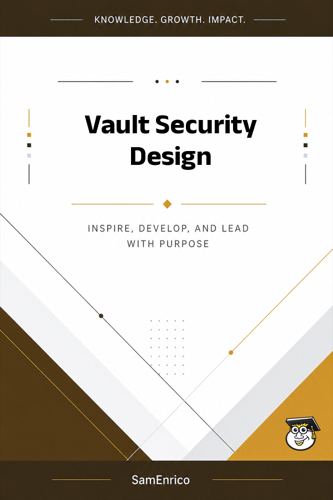
Non-FictionTrue CrimeSecurity Design
Vault Security Design eBook
How the vault was supposed to be impenetrable.
by Ahern Deeann
How the vault was supposed to be impenetrable.
Formats
Free sample
Chapter 1: The Architecture of Paranoia--–- The first time Leonard Vance tried to break into a bank, he didn't bring a torch, a drill, or even a lockpick. He brought a clipboard, a hard hat, and a three-piece suit he'd rented for seventy dollars. At 9:47 on a Tuesday morning, he walked past two security guards, three security cameras, and a motion sensor array that had cost the bank more than his entire apartment building. He smiled at the receptionist, asked for directions to the electrical room, and spent the next four hours studying every angle of the vault's surrounding walls. No one questioned him because no one could imagine a threat that didn't look like a threat.
The vault was impenetrable, they had assured him. Leonard knew better. He wasn't going to attack the vault. He was going to attack the building holding it. And the building, unlike the vault, was built by the lowest bidder.This is the central deception of vault security: architects design fortresses while criminals study the gaps between the bricks.
The architecture of paranoia is not about building higher walls; it is about understanding that every wall exists within a context, and that context is almost always weaker than the vault itself. Chapter 1 dismantles the myth that a vault can be considered in isolation. It argues that true security begins not at the vault door but at the property line—and that the most sophisticated lock in the world is useless if the building around it was designed by someone who never asked how a criminal sees space.The Myth of the Isolated Fortress For most of human history, the wealthy hid their valuables in the most obvious place: a locked chest in a locked room in a locked house. The assumption was that layers of locks created layers of security. But this assumption contained a fatal flaw: it treated each layer as independent, when in reality, the entire structure shared common weaknesses.
A chest could be carried away. A room could be entered through the wall. A house could be burned down. The fortress mentality—the belief that a sufficiently hardened core could survive any attack—ignored the fact that fortresses are only as strong as their least defended approach.The modern vault industry inherited this flawed logic. When a security consultant evaluates a vault installation, the standard practice is to assess the vault itself: the door's UL rating, the wall's concrete thickness, the lock's manipulation resistance.
What receives far less attention is the building that contains the vault. Is the floor beneath the vault made of reinforced concrete or cheap plywood? Is the wall adjacent to the vault shared with a janitorial closet or an unmonitored stairwell? Is the ceiling above the vault accessible from a drop ceiling in the hallway? These questions are not hypothetical.
They are the questions that criminals ask first.The term "architecture of paranoia" was coined by security theorists in the late 1970s to describe a design philosophy that assumes malice rather than convenience. A paranoid architect does not ask, "What is the most efficient way to move people through this space?" but rather, "How would I break into this space if I had three weeks and no budget?" This shift in perspective is uncomfortable because it requires admitting that most buildings are designed by people who have never considered how a criminal thinks. A criminal does not see a wall as a boundary; they see it as a surface to be penetrated. They do not see a locked door as an obstacle; they see it as a challenge to be bypassed. And they do not see a security camera as a deterrent; they see it as a puzzle to be solved.Crime Prevention Through Environmental Design (CPTED)The most influential framework for understanding the architecture of paranoia is Crime Prevention Through Environmental Design (CPTED), developed by criminologist C.
Ray Jeffery in the 1970s and expanded by architect Oscar Newman in his seminal work Defensible Space. CPTED is built on a simple premise: the physical environment can be designed to influence human behavior, and that influence can either encourage or discourage criminal activity. The framework rests on four core principles, each of which has direct application to vault security.1. Natural Surveillance Natural surveillance is the ability of legitimate users of a space to observe what is happening in that space. A bank lobby with large windows, clear sightlines, and well-placed teller stations naturally discourages criminal activity because anyone attempting to case the vault would be visible to multiple people.
Conversely, a building with long hallways, blind corners, and recessed doorways creates hiding spots where criminals can work undetected.For vault security, natural surveillance extends beyond the bank lobby to the entire building. The hallway leading to the vault should be straight, well-lit, and visible from a guard station. The vault door should be positioned so that anyone approaching it can be seen from multiple angles. Windows should be positioned to allow passersby to see into the building, not just out of it. These design choices cost little but have a massive impact on the psychology of a potential attacker.
A criminal who knows they are being watched will almost always choose a different target.2. Territorial Reinforcement Territorial reinforcement is the use of physical features to communicate ownership and boundaries. A well-defined property line, a clearly marked entrance, and a visible security presence all signal that a space is cared for and monitored. Criminals are less likely to attack spaces that feel owned because the risk of being noticed is higher.In vault design, territorial reinforcement means eliminating ambiguity. The vault should not be hidden or disguised; it should be announced.
The path to the vault should pass through progressively more secure zones, each marked with signs, access controls, and visible cameras. This creates a psychological barrier: by the time a criminal reaches the vault, they have crossed multiple boundaries, each of which increased their anxiety and their risk of detection.3. Access Control Access control is the most obvious CPTED principle: limiting who can enter a space and under what conditions. For a vault, access control begins far from the vault door. The building itself should have a single, monitored entrance.
Elevators should require keycards to reach secure floors. Stairwells should be locked from the inside to prevent re-entry after hours. Every door between the street and the vault should be a checkpoint.The key insight of CPTED is that access control is most effective when it is layered. A single locked door can be bypassed. A series of locked doors, each requiring different credentials and each monitored by a different system, creates a gauntlet that exhausts both time and patience.
The vault itself should be the final layer, not the only layer.4. Maintenance and Image The fourth principle is often overlooked but critically important: a space that looks neglected signals that no one cares, which signals that no one is watching. Graffiti, broken windows, burned-out lights, and overgrown landscaping all communicate that security is lax. Criminals are drawn to decay because decay implies absence.For a vault, this means that every element of the surrounding environment must be maintained…
This is the end of the free sample. Get the eBook to keep going. Buy now
About this book
Details
- Author
- Ahern Deeann
- Publisher
- SamEnrico
- Language
- English
- Genre
- Non-Fiction, True Crime, Security Design
- Released
- 2026-06-07
- Pages (approx.)
- 136
- Available as
- eBook, Audiobook

Read better in the ZLOADR app
Your eBooks on your phone or tablet. Sign in with your SamEnrico account and start reading.
More by Ahern Deeann
 Craigslist Obsessive CheckingAhern Deeann$11.99
 Challenging Angry ThoughtsAhern Deeann$11.99
 Body Scan Mindfulness WorkbookAhern Deeann$11.99
 Unidentified Remains Clothing AnalysisAhern Deeann$11.99
 Homicide Cold Case SquadAhern Deeann$11.99
 Atomic Habits For AutomationAhern Deeann$11.99
 Cronometer GuideAhern Deeann$11.99
 Wild Thing: The Untold Story of New Zealand's Rock 'n' Roll RevolutionAhern Deeann$11.99
 Whispers of the First Oracle: The Riddle That Shaped CivilizationAhern Deeann$11.99
 How to Produce Natural CraftsAhern Deeann$11.99
 Growing CallianthemumAhern Deeann$11.99
 A Collector's Handbook to the Simca 1501Ahern Deeann$11.99
You may also like
 Hong Kong Handover 1997Dunn Johnnie$11.99
 Zumba For Postnatal Recovery CourseNeal Christian$11.99
 Zumba for BeginnersLadner Nikia$11.99
 YouTube Comment Mining GuideHumes Pandora$12.99
 Worry Box MeditationCarlin Rudy$11.99
 Workplace Stress MeditationNguyen Lynn$11.99
 Workplace Stress and Sleep RepairHawley Ivory$11.99
 Workplace Perfectionism CureDelaney Jeffry$11.99
 Workplace Injustice Anger GuideWallen Isabelle$11.99
 Work Addiction and Burnout LinkGreenwood Ester$11.99
 Women in Yoga and WellnessBeattie Galina$11.99
 Women in Stand Up ComedyChun Evangeline$11.99